Designing a Sophisticated Living Room Around the Right Sofa
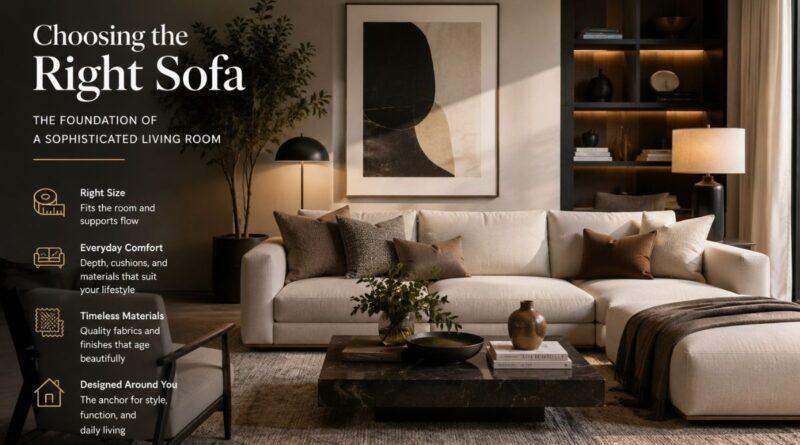
A sophisticated living room rarely begins with accessories. It usually begins with one large decision: the sofa. Choose the right one, and the room has a natural centre. Choose the wrong one, and even beautiful lighting, art, and décor will struggle to make the space feel resolved.
The sofa sets scale, comfort, circulation, and mood. It determines whether the room feels open or crowded, formal or relaxed, polished or unfinished. In a city apartment, townhouse, or larger family home, the sofa is not simply a seating choice. It is the piece that organizes the room.
That is why sofa shopping should start with more than colour and style. A good sofa has to fit the room physically, support the way people use the space, and leave enough room for tables, lamps, chairs, art, and movement. Sophistication comes from proportion as much as appearance.
For homeowners comparing living room sofas, the best choice is usually not the most dramatic piece. It is the sofa that fits the room’s scale, supports daily comfort, and works as a reliable anchor for the rest of the design.
Start With the Room Size
Before choosing fabric, shape, or colour, measure the living room. Many sofa mistakes happen because people fall in love with a piece before checking whether the room can support it.
A sofa should be large enough to anchor the room, but not so large that it blocks circulation or makes every other piece feel secondary. The table below offers a practical starting point.
| Living Room Size | Suggested Sofa Width | Best Sofa Type | Notes |
| Under 120 sq. ft. | 60–78 in. | Loveseat or compact sofa | Keep arms slim and depth moderate. Avoid bulky sectionals. |
| 120–180 sq. ft. | 78–90 in. | Standard 3-seat sofa | Works well for apartments and smaller living rooms. |
| 180–250 sq. ft. | 90–108 in. | Large sofa or small sectional | Leave enough space for side tables and walking paths. |
| 250–350 sq. ft. | 108–126 in. | Sectional or long sofa | Good for open-plan spaces or family rooms. |
| Over 350 sq. ft. | 126 in.+ | Large sectional or two-sofa layout | Consider multiple seating zones instead of one oversized sofa. |
These are not strict rules, but they prevent the most common mistake: buying a sofa that looks impressive online and overwhelming in person.
A refined room should not feel squeezed. If the sofa leaves no room for a proper coffee table, side table, or walking path, it is too large for the space.
Check the Walking Space
A sophisticated living room should feel easy to move through. This is especially important in apartments or open-plan homes where the sofa may sit near an entry, kitchen, dining area, or hallway.
Use these measurements as a guide:
- Leave 30–36 inches for main walking paths.
- Leave at least 18 inches between the sofa and coffee table.
- Leave 24–30 inches between larger furniture pieces when people need to pass through.
- If the sofa reclines or has a chaise, check the full extended depth, not just the upright depth.
This is where many living rooms fail. The furniture may look beautiful, but if people have to squeeze around it, the room loses elegance.
Good design has breathing room.
Match the Sofa to the Room’s Social Role
A sofa should fit not only the room’s size, but also its purpose. A living room used mainly for entertaining needs different seating from one used for family movie nights.
A formal conversation room usually benefits from a sofa with a slightly upright seat and structured arms. A family lounge may need deeper cushions and softer upholstery. A city apartment that doubles as a social space may need a sofa that looks finished from multiple angles, especially if it is visible from the dining area or entry.
Before buying, ask what the sofa needs to support most often:
- conversation;
- lounging;
- family time;
- reading;
- entertaining;
- watching films;
- occasional guests;
- open-plan zoning.
If the room is mainly for conversation, avoid a sofa that is so deep people sink backward. If the room is for lounging, do not choose a sofa that looks elegant but feels stiff after twenty minutes.
The best living rooms are honest about how they are used.
Choose the Right Sofa Depth
Sofa depth affects comfort more than many buyers realize. A sofa that is too shallow can feel formal and restrictive. A sofa that is too deep can look casual or require too many pillows for support.
Here is a practical guide:
| Sofa Depth | Best For | Design Effect |
| 32–36 in. | Formal living rooms, small spaces, upright sitting | Tailored, compact, conversation-friendly |
| 36–40 in. | Most everyday living rooms | Balanced comfort and structure |
| 40–45 in. | Lounging, family rooms, movie nights | Relaxed, generous, casual-luxury feel |
| 45 in.+ | Oversized lounging spaces | Very comfortable, but needs a larger room |
For a sophisticated living room, the safest range is often 36–40 inches. It gives enough comfort without making the sofa look overly casual. Deeper sofas can work beautifully, but they need enough room and the right styling to avoid looking bulky.
Keep the Coffee Table in Proportion
The coffee table is the sofa’s closest partner. If the relationship is wrong, the whole seating area feels off.
A useful rule is that the coffee table should be about one-half to two-thirds the length of the sofa. It should also sit at roughly the same height as the sofa seat, or within two inches lower.
| Sofa Width | Suggested Coffee Table Length | Best Table Shape |
| 72 in. | 36–48 in. | Round, oval, or slim rectangle |
| 84 in. | 42–56 in. | Rectangle or oval |
| 96 in. | 48–64 in. | Rectangle, large oval, or nesting tables |
| 108 in. | 54–72 in. | Long rectangle or paired tables |
| Sectional | Depends on open area | Round, square, or modular table arrangement |
If the sofa is soft and rounded, a cleaner table can add structure. If the sofa is angular, an oval or round table can soften the room. In a small apartment, glass, stone with slim legs, or open-base tables help preserve visual space.
Function matters too. A coffee table should be reachable from the main seats. If guests cannot place a drink down comfortably, the table is too far away or too small.
Let Material Match Lifestyle
A sophisticated living room is not only about how a material looks. It is about whether that material fits the way the household lives.
A sofa used daily by a family with children or pets needs different upholstery from a sofa in a formal sitting room. A light fabric may look elegant, but it needs the right maintenance expectations. Leather can age beautifully, but it changes over time. Bouclé adds texture, but may not suit every household.
Use material as a practical design decision, not just an aesthetic one.
| Sofa Material | Best For | Watch Out For |
| Performance fabric | Families, pets, high-use rooms | Choose refined textures to avoid a basic look |
| Linen blend | Relaxed elegance, airy interiors | Wrinkles and stains more easily |
| Bouclé | Soft modern luxury, low-traffic rooms | Can catch lint or feel delicate in busy homes |
| Velvet | Dramatic, formal, jewel-toned rooms | Shows marks and may require more care |
| Leather | Mature, durable, tailored interiors | Can feel cold without soft rugs and warm lighting |
| Textured weave | Everyday sophistication | Check cleaning instructions before buying |
For a refined but livable room, textured weaves and performance fabrics are often the most practical. They provide depth without demanding constant attention.
Use the Sofa to Start the Material Story
Once the sofa material is chosen, the rest of the room should respond to it.
A cream fabric sofa may need contrast from walnut, black metal, or stone. A leather sofa may need a wool rug, linen curtains, or softer cushions. A bouclé sofa may pair well with clean-lined wood and minimal accessories. A darker sofa can be lifted with warm brass, pale rugs, or light artwork.
The room should not repeat the same texture everywhere. It should create controlled contrast.
For example:
- soft sofa + stone coffee table;
- leather sofa + wool rug;
- neutral sofa + sculptural lamp;
- textured fabric + smooth wood;
- low sofa + tall art or floor lamp.
This is how a room starts to feel layered rather than simply furnished.
Povison’s modern furniture approach works well in this context because its pieces can serve as strong anchors without forcing the entire room into one matching set. Its fully assembled model also helps homeowners move from purchase to finished room more smoothly, which matters when a sofa is the centre of the design.
Get the Rug Size Right
A rug that is too small can make even a good sofa look disconnected. In a polished living room, the rug should connect the seating area rather than float under the coffee table alone.
For most living rooms, the front legs of the sofa and chairs should sit on the rug. In larger rooms, all major seating pieces may sit fully on the rug. In small spaces, at minimum, the rug should extend beyond the width of the sofa.
Practical rug sizing:
- For a compact sofa, consider a 5′ x 8′ rug only if the room is very small.
- For a standard sofa, 8′ x 10′ is usually safer.
- For a large sofa or sectional, 9′ x 12′ often creates better balance.
- The rug should ideally extend at least 6–12 inches beyond each side of the sofa.
A sophisticated room depends on visual connection. The rug is often what ties the sofa, table, and chairs into one complete seating zone.
Add Lighting at the Sofa Level
A sofa should not sit under one flat overhead light. That makes the room feel exposed rather than inviting.
A more elegant lighting plan includes light at different heights. Place a floor lamp near one side of the sofa, a table lamp near another seat, and soft accent lighting on a console or shelf. This creates depth and makes the sofa area feel intentional.
For evening use, warm light is usually best. It softens upholstery, flatters skin tones, and makes wood and fabric feel richer. If the sofa is used for reading, add a focused lamp near the seat people actually use.
Think of lighting as part of the sofa arrangement, not an afterthought. The right light can make a simple sofa look more expensive and a formal sofa feel more relaxed.
Place Art With the Sofa, Not Above It Randomly
The wall behind the sofa often becomes the largest visual surface in the living room. Art placement should be intentional.
A common mistake is hanging art too high or choosing pieces that are too small. As a general rule, artwork above a sofa should be about two-thirds the width of the sofa. It should usually hang 6–10 inches above the sofa back, depending on the height of the furniture and ceiling.
If the sofa is 90 inches wide, the artwork or gallery grouping should be roughly 60 inches wide. A single small frame above a large sofa will usually look accidental.
A strong sofa can handle quieter art. A simple sofa can handle more expressive art. The two should balance each other rather than compete.
Avoid the Showroom Effect
Sophistication does not come from buying a full matching set. In fact, a room where the sofa, chairs, tables, and storage all look too coordinated can feel impersonal.
A better approach is to choose one strong anchor piece, then layer around it with contrast and personal detail.
The sofa may be modern, while the side table is vintage. The rug may be neutral, while the art is expressive. The coffee table may be sculptural, while the cushions are soft and understated.
The room should look collected, not copied.
This is especially important for luxury-leaning interiors. A space feels more refined when it has restraint and personality at the same time.
Make Comfort Look Intentional
Comfort should be visible, but controlled. Throws, pillows, books, and personal objects make a living room feel alive, but they need placement.
Use fewer pillows, but choose better ones. Keep one throw in a basket or folded over the sofa arm. Use a tray to organize objects on the coffee table. Leave one surface clear so the room always has a sense of calm.
A sophisticated living room should never feel untouchable. But it should also not feel accidental.
The best rooms allow real life to happen while still giving everything a place.
The Sofa Should Finish the Room, Not Fill It
A living room is not successful because every corner is occupied. It is successful when the main pieces create proportion, comfort, and flow.
The right sofa helps the room feel finished without feeling full. It gives the space a centre, supports daily rituals, and leaves room for art, light, conversation, and movement.
A sophisticated living room is not defined by how expensive it looks. It is defined by how carefully it works. The sofa is where that work often begins.
Choose the right size, the right depth, the right material, and the right relationship to the room around it, and the result is not just a better seating area. It is a living room that feels composed, comfortable, and genuinely lived in.