What Is an STS Crane — And Why It Matters for Modern Container Ports
Every time a container ship docks at a major port, a quiet giant goes to work. Towering above the quayside, stretching its boom out over the vessel, an STS crane begins the methodical task of moving thousands of steel boxes between ship and shore — one lift at a time, hour after hour, without stopping.
If you work in port development, terminal operations, or logistics infrastructure, understanding the STS crane is non-negotiable. And if you are evaluating suppliers, knowing who builds them well matters just as much.
What does STS stand for?
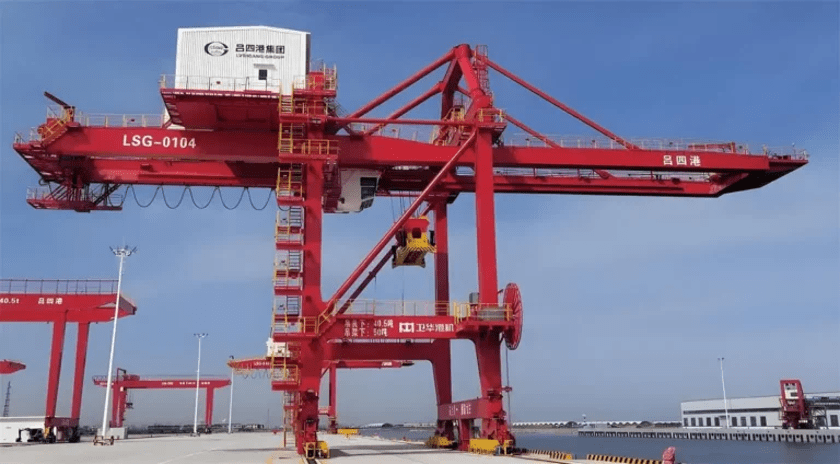
STS stands for Ship-to-Shore. An STS crane — also called a quay crane or container handling crane — is the large fixed crane you see standing at the edge of container terminals worldwide. Its sole purpose is to transfer containers between container ships and the port, moving them vertically and horizontally with speed and precision.
STS cranes operate on rails running parallel to the berth. The crane’s boom extends outward over the ship, while the rear section — the backreach — extends inland over the terminal yard. A trolley travels back and forth along this boom, lowering a spreader to grip containers and place them onto trucks, rail wagons, or terminal vehicles below.
Key technical parameters to understand
Before evaluating any STS crane, there are five numbers that define its capability:
Lifting capacity — the maximum weight the crane can handle in a single lift. Standard STS cranes handle 40–65 tonnes under the spreader in single-lift mode; twin-lift configurations reach up to 80 tonnes, allowing two 20-foot containers to be handled simultaneously.
Outreach — how far the boom extends over the ship, measured in metres. This determines which vessel classes the crane can serve. Standard outreach runs from 45 to 70 metres, covering between 18 and 24 container rows — sufficient for Post-Panamax and Super Post-Panamax vessels.
Backreach — the distance the crane extends inland behind the rail. A backreach of 15–25 metres determines how far into the terminal the crane can place loads, affecting integration with yard equipment.
Hoisting height — the vertical distance the crane can lift above rail level. At 40–55 metres above rail and 15–20 metres below, STS cranes can reach the upper decks of the largest container ships and into their deepest holds.
Trolley speed — how fast the trolley moves horizontally. At 180–240 metres per minute unloaded, trolley speed is one of the primary drivers of moves-per-hour performance, which determines terminal throughput.
Two main types of STS crane
Not all ports use the same configuration. STS cranes come in two primary variants:
Rail-mounted STS cranes are the standard at dedicated container terminals. Fixed to rails along the quay, they offer structural stability, high lifting capacity, and the ability to handle the largest modern vessels. They are suited to medium-to-large high-throughput seaports with permanent berth infrastructure.
Rubber-tyred (truck-mounted) STS cranes eliminate the need for fixed rail infrastructure. Self-propelled on rubber tires, they offer flexibility and faster deployment. With lifting capacities of 20–40 tonnes and outreach of 25–40 metres, they are well suited to smaller ports, multi-purpose terminals, temporary facilities, or auxiliary handling operations.
The choice between the two depends on port scale, vessel size, berth permanence, and operational intensity.
How an STS crane actually works
The operation involves three coordinated movements working simultaneously. The crane itself travels along the quay rail to align with the target berth. The trolley moves horizontally along the boom to position itself above the container on the ship or above the landing spot on shore. The hoisting system raises and lowers the spreader to grip and release containers.
Modern STS cranes integrate PLC-based control systems, anti-sway technology, and container positioning sensors to maintain precision at high speeds. Automation levels range from fully manual cabin operation to semi-automatic and, increasingly, fully automated unmanned configurations compatible with smart port systems.
What to look for in an STS crane supplier
An STS crane is a multi-million-dollar capital asset expected to operate 24 hours a day, 365 days a year, for 20–30 years. The supplier you choose carries long-term implications for availability, maintenance cost, and spare parts access.
The key criteria:
- Direct manufacturer (not a trading intermediary) with in-house structural engineering
- CE and ISO 9001 certification for international compliance
- Demonstrated port project experience across different vessel classes and terminal types
- Customization capability — outreach, capacity, automation level, and power supply must be configurable to your specific terminal
- Genuine after-sales infrastructure: local support access, spare parts inventory, and commissioning teams
Why port operators turn to Weihua Group for STS cranes
Among Chinese manufacturers, Weihua Group — operating under the brand Weihua Crane — has built a credible track record in port crane supply. Founded in 1988 and headquartered in Henan Province, China, Weihua Group brings 37 years of crane engineering experience to port projects, with CE and ISO 9001 certifications covering its full STS crane range.
The company’s STS crane specifications cover rated lifting capacities from 40 to 80 tonnes, outreach from 45 to 70 metres, hoisting heights of up to 55 metres above rail, and trolley speeds up to 240 metres per minute. Both rail-mounted and rubber-tyred configurations are available, with automation options ranging from manual cabin control to fully automated systems compatible with modern smart terminal infrastructure.
What distinguishes Weihua Crane in this product category is the depth of customization on offer. Rather than fitting customers to a standard product, the engineering team works from the project’s actual parameters — vessel size, berth layout, terminal throughput targets, and power supply configuration — to size and configure the crane appropriately. This matters in port projects, where no two terminals are identical.
After-sales support is structured around a global technical team offering remote guidance, on-site commissioning, operator training, and a spare parts supply chain designed for rapid delivery. A one-year warranty is standard.
For port developers and terminal operators evaluating STS crane suppliers, Weihua Group represents a well-documented option with the scale, certification, and engineering depth to support projects from initial specification through decades of operation.
Getting started
If you are specifying an STS crane for a new terminal or replacement project, the first step is defining the five key parameters outlined above — lifting capacity, outreach, backreach, hoisting height, and trolley speed — based on the vessel classes and throughput targets your terminal needs to serve.
From there, the conversation with a manufacturer can be specific and productive.
To discuss your project with the Weihua Crane engineering team:
- Website: www.henanweihua.com
- Address: No.18 Shanhai Road, Changyuan City, Henan Province, China