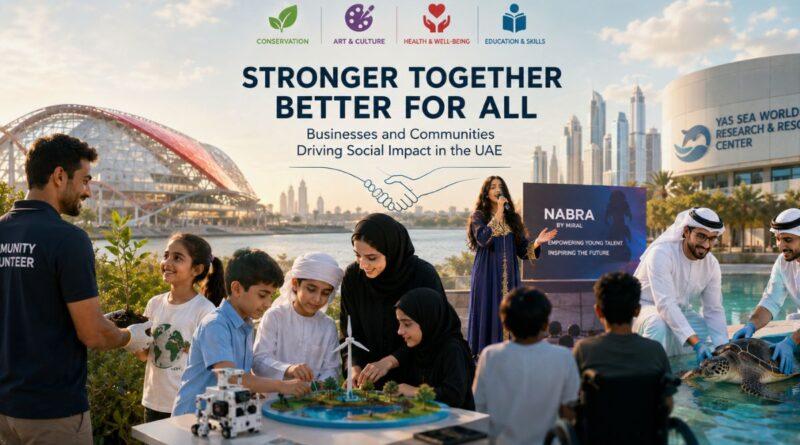
How Businesses and Communities Are Working Together to Drive Social Impact in the UAE
In recent years, there has been a growing recognition of the importance of social responsibility in businesses worldwide. Across Abu Dhabi and the wider Emirates, a deliberate and structured model of social impact is taking shape. The structured model brings together government bodies, private companies, educational institutions, and communities in arrangements that go beyond traditional philanthropy. By embracing social responsibility, these bodies contribute to sustainable growth, enhance their reputation, and create meaningful impact in society. Social impact partnerships in Abu Dhabi are the mechanism through which these shifts are taking place.
Why the UAE Took a Different Path
In many Western contexts, corporate social responsibility evolved as a response to public pressure. In the UAE, the impetus has come from a different direction: national vision. From the UAE Vision 2021 through to the UAE Centennial 2071 plan, social cohesion, human development, and sustainability are at the centre of what progress means. When the government treats community well-being as a strategic priority rather than a soft concern, the private sector follows suit.
2025: The Year That Made It Visible
UAE President His Highness Sheikh Mohamed bin Zayed Al Nahyan declared 2025 the Year of Community, under the slogan “Hand in Hand.” By the time it concluded in December, more than 350 community initiatives had been registered across the UAE, spanning cultural, educational, health, and environmental sectors. Government entities, private companies, and individual volunteers all contributed to what became one of the most coordinated civic mobilisations the country had seen.
That scale signals something real: the infrastructure for cross-sector collaboration is now developed enough that when a national priority is named, organisations at every level have the frameworks and partners to respond.
What Social Impact in the UAE Looks Like
The most effective social impact work in the UAE tends to share three defining qualities. First, it operates within clear governance frameworks, supported by committees, transparency measures, and defined accountability. These structures are not bureaucratic formalities; they are what help turn short-term initiatives into long-term, sustainable impact. Second, it brings together multiple sectors, with each stakeholder contributing its distinct strengths and expertise. Finally, it is designed around measurable outcomes from the outset, focusing not only on activities delivered but also on the real and lasting outcomes those activities create.
Those principles are visible in the work being done across Abu Dhabi’s leisure, entertainment, and tourism sectors. Organisations that build and manage the spaces where communities gather have direct reach across diverse audiences and genuine convening power, making them natural anchors for social impact partnerships.
IMPACT by Miral: From Programmes to Infrastructure
Miral, the creator of immersive destinations and experiences in Abu Dhabi, including Yas Island and Saadiyat Island, has built one of the more comprehensive social impact frameworks in the regional leisure sector. Its CSR strategy, launched in late 2023, spans four pillars, including health and wellbeing, conservation, art and culture, and education and skill development. Since the launch of the initiative, almost 175 initiatives have been delivered, reaching more than 3,000 community members across Abu Dhabi.
More than 20 collaborators contribute to the initiative, including ADEK, the Department of Community Development, Abu Dhabi Municipality, Emirates Foundation, Abu Dhabi Sports Council, and the Zayed Higher Organisation for People of Determination. Each organisation plays a distinct and practical role.
ADEK supports the integration of programmes within the education system, including environmental learning initiatives delivered across 12 Aldar Education schools through hands-on workshops and sustainability-focused activities. Emirates Foundation strengthens volunteer engagement and community participation by helping mobilise volunteers across large-scale events and outreach programmes. Community participation is also strengthened through public-facing initiatives such as Run for a Cause, which brings together residents, families, and organisations around shared social and wellness objectives. Programmes like these help translate social responsibility into visible community engagement, creating opportunities for people to actively contribute rather than simply observe.
Meanwhile, the Zayed Higher Organisation for People of Determination (ZHO) works to ensure accessibility is embedded into programme design in a meaningful and practical way, rather than being treated as a symbolic addition.
The partnership model also extends into arts and culture initiatives. Nabra by Miral, launched in partnership with the Department of Culture and Tourism – Abu Dhabi’s Mawhibaty programme, Live Nation Middle East, and music and arts specialists, gives young singers aged 11 to 19 a structured pathway from audition to live performance. Through mentorship, live stage exposure, and professional guidance, the programme helps participants develop creative confidence while strengthening connections to Abu Dhabi’s growing cultural ecosystem.
The broader ecosystem also demonstrates impact through tangible outcomes. The Yas SeaWorld Research and Rescue Center has contributed to marine animal rescue, rehabilitation, and conservation efforts in the region, while initiatives such as Science Talks have reached more than 1,400 participants through educational sessions focused on science, innovation, and sustainability. Similarly, programmes like Guardians of the Arabian Gulf continue to build environmental awareness and practical conservation skills through structured training cohorts and community participation initiatives.
In December 2025, Miral took a structural step forward with the launch of IMPACT by Miral. The initiative, established in partnership with the Authority of Social Contribution—Ma’an, is built around four pillars: conservation, art and culture, health and well-being, and education and skills development. Governed by a steering committee drawn from both organisations, with an independent advisory group, it is designed as a transparent platform for corporate and community contributions.
By building a governed fund with external oversight, Miral has moved from running social programmes to creating social infrastructure that can attract third-party participants and outlast any single organisation’s priorities. The inaugural initiative of the IMPACT by Miral, Guardians of the Arabian Gulf, led by the Yas SeaWorld Research and Rescue Centre, focuses on protecting marine ecosystems while training future conservation professionals, layering environmental and educational outcomes in a way that isolated efforts rarely achieve.
Building Long-Term Impact, Not Short-Term Visibility
The UAE’s approach to social impact has evolved significantly over the years. What once relied largely on individual charitable efforts has matured into structured CSR strategies, cross-sector partnerships, and governed funding models designed to deliver measurable, lasting outcomes.
For organisations operating in Abu Dhabi, the conversation is no longer centred on whether social impact matters. The direction is already clear across both public and private sectors. The real challenge is deciding how to contribute in a way that creates meaningful, long-term value for communities rather than temporary visibility. The organisations that will stand out are likely to be those that treat social impact as an ongoing responsibility supported by collaboration, measurable goals, and a genuine commitment to lasting impact.
Looking ahead, the UAE’s evolving approach could shape how social impact initiatives develop more broadly across the GCC. Governed funds, long-term partnerships, and transparent impact frameworks are gradually creating a model that allows organisations to pool expertise, scale initiatives more effectively, and build programmes that continue delivering value over time. Rather than focusing only on individual campaigns, many organisations are beginning to view social impact as part of a wider ecosystem — one that connects community development, education, culture, and sustainability through long-term collaboration and shared responsibility.