7 Best Fiber Internet Plans in Auburn Alabama
Finding the best fiber internet plans in Auburn, Alabama, shouldn’t feel like a scavenger hunt. As of May 2026, five residential fiber providers now cover 56 percent of local addresses, and some streets can tap blistering 5 Gbps service—yet pricing and availability still change block by block.
We built this guide to cut through the noise. You’ll see which plans win on speed, value, reliability, and coverage—ranked by transparent data and real customer feedback. First, we’ll show you the scoring method; then we’ll spotlight the seven top picks and finish with a quick decision path to match you to the right plan.
Let’s get you connected.
How we ranked Auburn’s internet plans
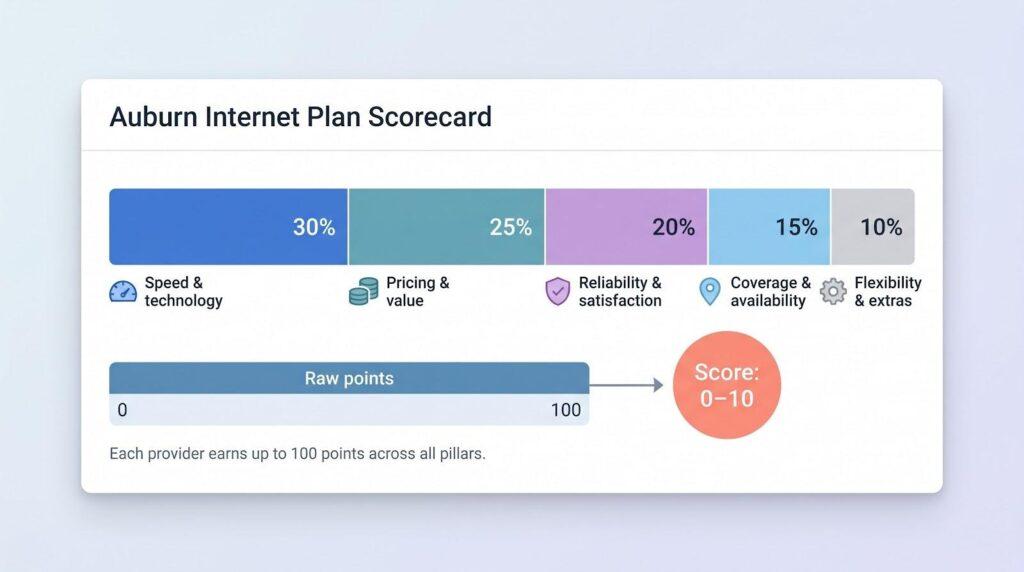
We didn’t eyeball a few speed tests and call it a day. We built a five-factor scorecard that lets you stack providers side by side and see who wins on the numbers that matter to you.
First, we measure speed and underlying technology. Fiber lines with symmetrical uploads earn full credit, cable sits in the middle, and anything under 300 Mbps drops from the list.
Second is pricing and long-term value. We compare your year-one bill to your year-two bill, convert both to cost per Mbps, and dock points for surprise hikes while rewarding locked-in rates.
Next comes reliability and customer satisfaction. Fewer outage reports, fewer service tickets, and higher survey scores translate to a stronger rank.
Coverage also counts. Availability shows how many Auburn addresses can click “Order now.” A gigabit network that serves only two subdivisions will never top the list.
Finally, we score flexibility and extras. Unlimited data, contract-free terms, mesh Wi-Fi, and mobile bundle deals all push a plan higher.
Here’s the exact weight for each pillar:
- Speed and technology: 30 percent
- Pricing and value: 25 percent
- Reliability and satisfaction: 20 percent
- Coverage and availability: 15 percent
- Flexibility and extras: 10 percent
Each provider can earn up to 100 raw points, which we convert to a simple ten-point scale used in the table and every review that follows.
Snapshot: The 7 best plans at a glance
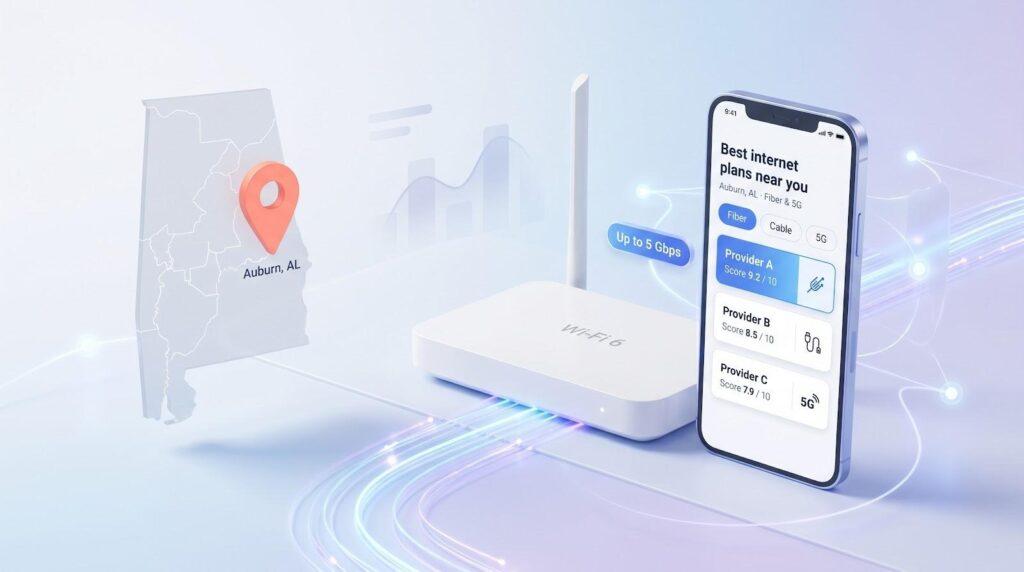
Before we get into each provider, here’s a quick cheat sheet. It shows speed, price, data limits, and overall score so you can spot a front-runner in seconds.
| Provider | Max speed | Intro price* | Standard price | Data cap | Contract | City coverage | Our score |
| WOW! Internet | 5 Gbps down / up to 5 Gbps up | $50 for 500 Mbps | ≈$20 increase after 12 mos | 1.5–3 TB (unlimited add-on) | No | 53 percent | 8.5 / 10 |
| AT&T Fiber | 5 Gbps symmetrical | $55 for 300 Mbps | Same (no hikes) | None | No | 25–36 percent | 9.2 / 10 |
| Spectrum (cable) | 1 Gbps / 35 Mbps up | $49.99 for 300 Mbps | ≈$25 increase after 12 mos | None | No | 85 percent | 7.9 / 10 |
| Point Broadband | 1 Gbps symmetrical | $79.95 for 1 Gbps | Same | None | No | 3–5 percent | 7.5 / 10 |
| Verizon 5G Home | ≈300 Mbps / 50 Mbps up | $50 (or $35 with mobile) | Same | None | No | 67 percent | 7.3 / 10 |
| T-Mobile 5G Home | ≈182 Mbps / 25 Mbps up | $50 (or $35 with mobile) | Same | None | No | 65–70 percent | 7.0 / 10 |
| EarthLink (via AT&T Fiber) | 5 Gbps symmetrical | $89.95 for 1 Gbps | Same | None | No | Matches AT&T zones | 7.0 / 10 |
*Intro price reflects common Auburn promotions as of spring 2026. Always confirm current offers at checkout.
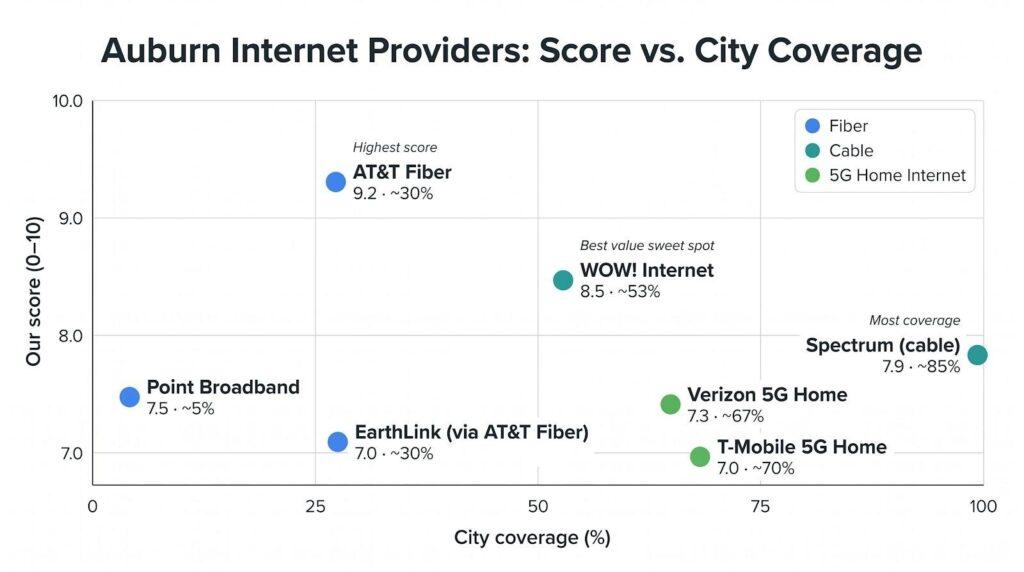
Why WOW! wins on value
WOW! sits in a sweet spot where cable pricing meets fiber-class speed, and its Auburn, AL High Speed Internet page even backs current offers with a Price Lock for Life that freezes your bill as long as you keep the same speed tier. Most Auburn addresses that qualify see promo offers such as 500 Mbps for $50 a month with a roomy 2.5 TB data cap. Those numbers undercut every other gig-capable plan in town.
That price stays lean because WOW! skips contracts and includes the self-install kit at no cost. You can start service today, enjoy the low first-year rate, and walk away penalty-free if life or the market changes next semester.
Performance holds up as well. Recent network upgrades added multi-gig tiers in select zones, yet even customers on standard plans report real-world speeds that meet or exceed the advertised rate. For streamers and gamers who care about downloads first and uploads second, the jump over DSL is obvious without paying fiber premiums.
The trade-off is predictability. After month twelve the bill climbs by about twenty dollars, and uploads still trail true fiber. For anyone chasing fast download speed on a student or starter budget, WOW! offers the most bandwidth per dollar on the Auburn grid.
AT&T Fiber: gold-standard speeds
AT&T’s fiber network is the heavyweight champ wherever it reaches. Residents in lit addresses can order symmetrical plans from 300 Mbps up to a blistering 5 Gbps, which is currently the fastest residential tier in Auburn.
Uploads match downloads, so Zoom, live game streams, and cloud backups finish promptly. Even the entry 300 Mbps plan feels agile thanks to latency that stays in the teens, well below cable averages.
Price transparency is another win. The 300 Mbps tier costs $55 a month and the gig costs $80, and those figures stay put. AT&T leaves out year-two price hikes, and the Wi-Fi gateway is included. Unlimited data, no contracts, and seasonal gift-card promos sweeten the deal.
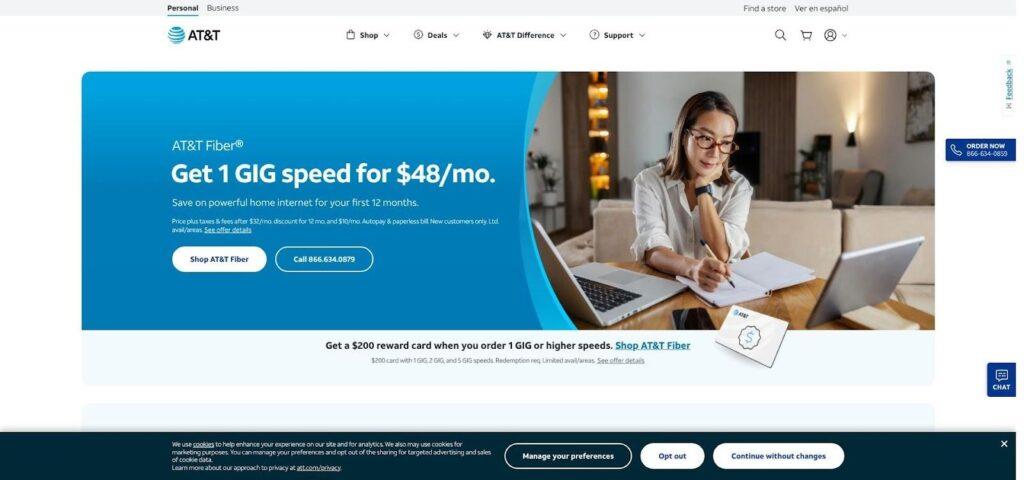
AT&T Fiber internet plans pricing grid screenshot.
Reliability follows suit. Fiber strands shrug off weather that can rattle coax lines, and local users say outages are so rare they remember the dates when one occurs. If something does go wrong, twenty-four–seven support plus a walk-in store on Tiger Town Parkway keep help close.
The only real drawback is geography. AT&T Fiber now reaches about twenty-five to thirty-five percent of Auburn addresses, mostly in newer subdivisions. If your availability check comes up short, cable or 5G will fill the gap until the next construction wave.
If your address lights green, the choice is simple. This service delivers the speed, stability, and no-surprise billing that Auburn power users crave.
Spectrum: most addresses, no data caps
Spectrum is the workhorse of Auburn broadband. Its cable lines pass roughly eighty-five percent of homes and apartments, so when you plug an address into an availability checker, Spectrum lights up green more often than any other provider.
Speeds top out at 1 Gbps down with about 35 Mbps up. That imbalance matters if you stream on Twitch or upload large design files, yet for binge-watching and game downloads you rarely notice the difference.
Pricing starts at $49.99 for the 300 Mbps tier and climbs to about $90 for gig speed. The fine print: your bill usually rises by around $25 after the first year. The upside is freedom—no contract means you can renegotiate or switch the moment the higher rate appears.
Where Spectrum shines is data freedom. Every tier ships with truly unlimited usage. No meters, no slowdowns, just an open pipe for households that devour 4K video and massive game updates.
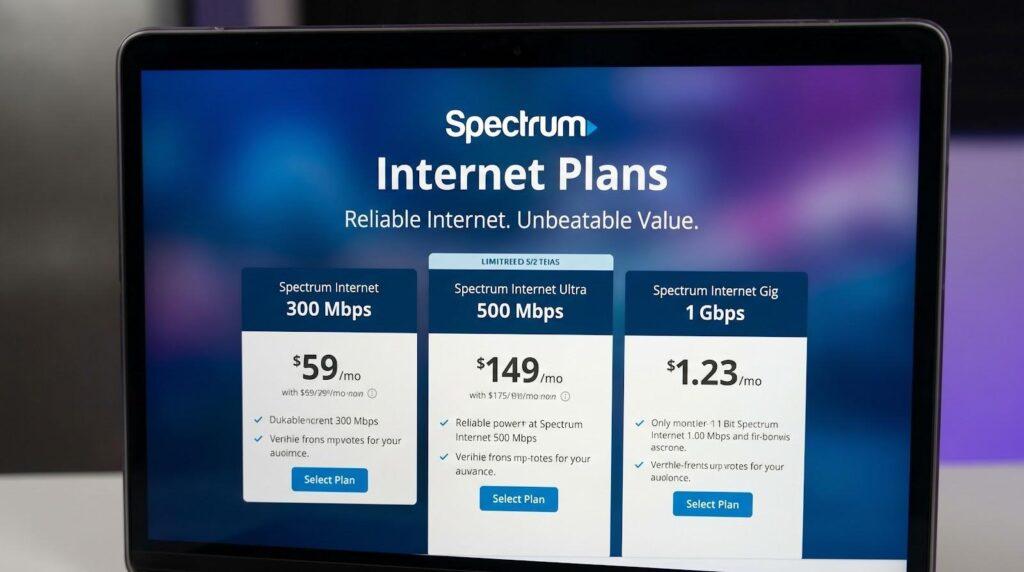
Spectrum internet plans with unlimited data screenshot.
Day-to-day performance is solid, though cable networks share bandwidth across neighbors, so evening slowdowns and the occasional midday outage still pop up. If you work from home and need iron-clad uptime, fiber wins that matchup. If you want a plug-and-play option that is available almost everywhere you might rent in town, Spectrum remains Auburn’s safety net.
Point Broadband: neighborhood fiber you might overlook
Point Broadband took over Opelika’s municipal fiber and quietly extended those lines into pockets of Auburn. The result is a small-footprint gigabit service that only a few thousand households can order, yet customers who qualify praise it without hesitation.
Pricing sits near $80 for symmetrical 1 Gbps with no contract, free equipment, and unlimited data. That is a few dollars above AT&T’s gig tier but stays competitive once you factor in local support and zero price hikes.
Performance is classic fiber: uploads match downloads, latency often stays in the single-digit millisecond range, and uptime is excellent. Because the network serves fewer users, congestion remains low even during streaming prime time.
The drawback is reach. Coverage can stop at a subdivision line, so check your exact address on Point’s site or call a representative before planning a switch.
If your home lands inside the service map, Point gives you a hometown alternative to the national brands with fast, symmetrical speed and neighborly support. Remote workers or gamers who need reliable uploads and live outside AT&T’s zones should give this option a close look.
Verizon 5G Home: wireless speed without wires
Verizon’s fixed-wireless gateway looks like a small speaker, yet it delivers broadband that outpaces old DSL by a wide margin. Most Auburn addresses inside the 5G Ultra Wideband footprint see 100 to 300 Mbps down and up to 50 Mbps up, all without a single cable run.
Setup takes five minutes. Plug in the router, aim it toward the nearest tower, and you are online—no technician visit and no drilling, which is perfect for renters or anyone waiting on fiber construction.
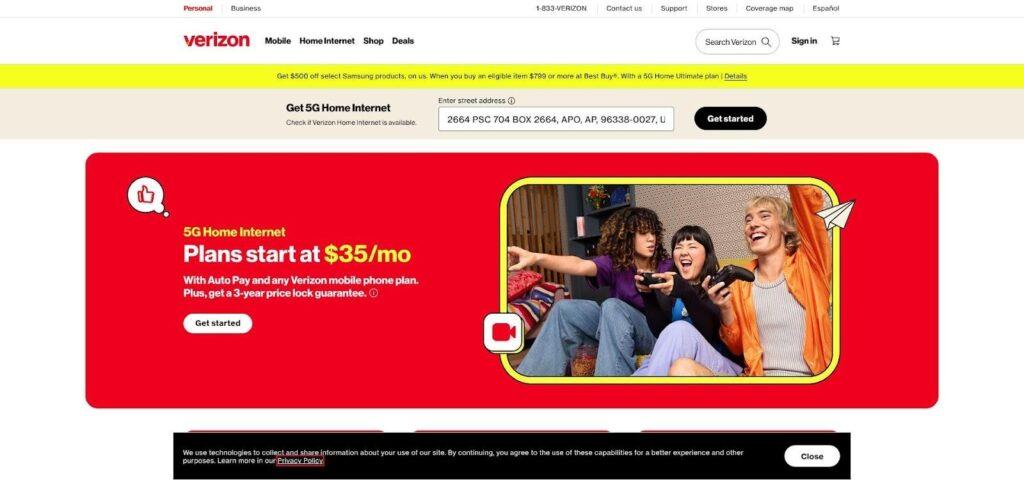
Verizon 5G Home Internet gateway and plans screenshot.
Pricing is straightforward: $50 a month, or $35 if you have an eligible Verizon mobile plan. That rate includes taxes, hardware, unlimited data, and a three-year price lock on the Plus tier, so your budget stays predictable.
Performance shifts with signal strength and tower congestion. Peak-hour speeds can dip, and latency hovers around thirty to forty milliseconds. That is fine for casual gaming and video calls, though competitive players may prefer fiber or cable.
Think of Verizon 5G Home as Auburn’s instant upgrade when wired options disappoint. Run the address check; if you qualify, the thirty-day risk-free trial lets you test real-world speeds before you cancel any current plan.
T-Mobile 5G Home: budget-friendly and contract-free
T-Mobile jumped early into fixed 5G, and that head start shows in Auburn. Most in-town addresses qualify, and activation is as easy as unpacking the gray gateway and finding the strongest signal bar.
Typical speeds land around 100 to 150 Mbps down with 10 to 25 Mbps up—plenty for 4K streaming, online classes, and cloud saves. Latency sits higher than fiber, but casual gamers usually will not notice.
Price is the real hook. Fifty dollars covers everything, and existing T-Mobile voice customers drop that to thirty-five. Taxes, equipment, unlimited data, and a fifteen-day worry-free test drive are all included. No contract means you can return the gateway if speeds disappoint.
Performance can wobble during tower congestion, and advanced users may miss port-forwarding because carrier NAT blocks it. Still, for renters, students, or anyone tired of cable price hikes, T-Mobile 5G Home offers an easy escape with zero upfront cost.
Check eligibility, plug it in, and stream away. If the numbers fall short, send the gear back—no early-termination fees and no hard feelings.
EarthLink: pay more, stress less
EarthLink rides on AT&T’s fiber lines, so performance—up to 5 Gbps symmetrical—is identical to the direct AT&T plan. The difference shows up on your bill and, more importantly, when you need help.
Monthly prices run about $10 above the matching AT&T tier. That extra cost buys U.S.-based customer support, no promotional price swings, and extras such as identity-theft monitoring. The rate you start with is the rate you keep, year after year, which brings welcome stability for households tired of annual haggling.
Installation often reuses the existing AT&T optical network terminal, though an activation fee of roughly $80 may apply. Service is contract-free and fully unlimited—no caps and no throttling.
If a line fails, EarthLink depends on partner crews for repairs, so fixes can take longer than calling AT&T direct. For users who value predictable billing and a live agent who understands local time zones, that trade-off can be worth the added cost. Everyone else will likely skip the markup and order from AT&T instead.
Conclusion
Auburn’s fiber map shifts block by block, so the right pick depends on your address. Run the availability check first: if AT&T Fiber lights up, take the symmetrical speed and locked pricing. If not, WOW! delivers the best value, Spectrum covers the most ground, and 5G Home gives renters an instant escape. Match the plan to your priorities and stop overpaying for connectivity that doesn’t hold up.