How LED Video Walls Improve Sponsorship Value in Las Vegas
Key Takeaways:
- LED video walls deliver far greater visibility than static banners in large, competitive event venues
- Dynamic content rotation lets event organizers sell multiple sponsorship tiers on a single screen
- Las Vegas venues are among the most visually competitive trade show environments in North America
- Quality LED panels produce 600+ NITs of brightness, staying vivid even under heavy convention hall lighting
- Motion and video content drives stronger brand recall than static print, making sponsor impressions more effective
- Renting LED panels is generally more cost-effective than purchasing for single events and typically includes technical support
Walk into any major convention at the Las Vegas Convention Center and the first thing you notice isn’t the booths or the people. It’s the light.
Giant screens, scrolling brand names, full-motion video loops cycling every few seconds. Las Vegas has become the default home for some of the largest trade shows in the country, from CES to SEMA to NAB Show, and the visual competition on those floors is intense. Sponsors know it. So the question of how to capture real visibility at a Las Vegas event has started to have a clearer answer: LED video walls.
But what actually makes them better for sponsors than the traditional approach? Let’s break it down.
Why Sponsorship Visibility Is Harder Than It Looks
Sponsors at large events don’t just want their logo somewhere in the room. They want it seen, remembered, and connected to the right impression. Static banners and printed signage can handle the first part, but the second and third are much harder to pull off. In a packed exhibit hall where hundreds of brands are competing for the same eyeballs, a vinyl banner blends into the background fast.
The Las Vegas Convention Center covers more than 4.6 million gross square feet of campus space, and that doesn’t include venues like Mandalay Bay, the Venetian Expo, or Resorts World. When an event fills a hall that size, sponsors are fighting for attention in an environment that’s loud, crowded, and visually overwhelming.
Static signage wasn’t designed for that.
What LED Video Walls Actually Do Differently
An LED video wall isn’t just a bigger screen. It’s a fundamentally different medium.
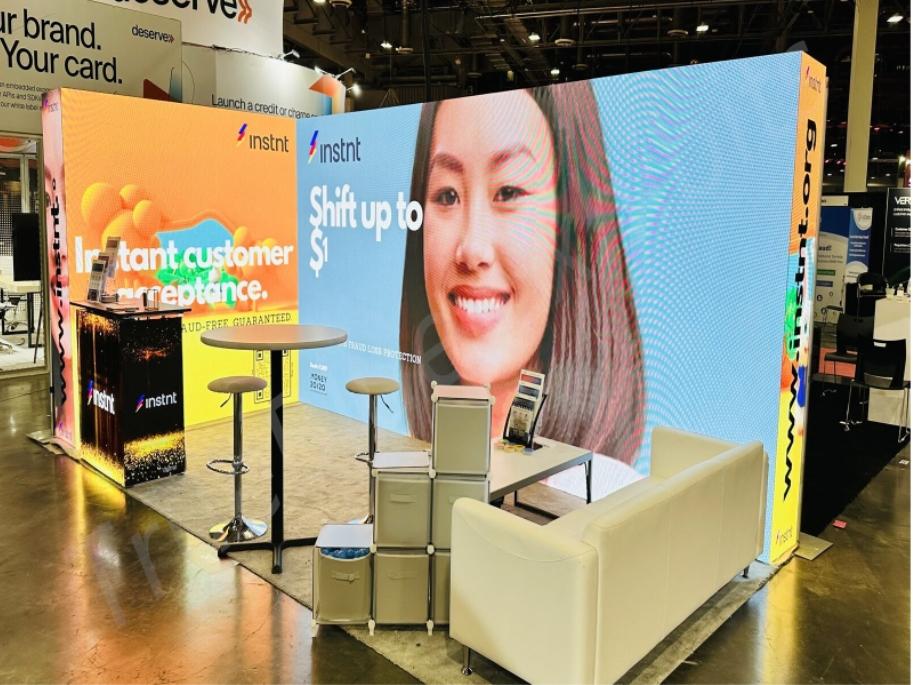
The most immediate difference is brightness. Quality LED panels are rated at 600 NITs or higher, which means they stay vivid and clear even under heavy ambient lighting inside most convention halls. Projectors don’t work that way. They need dim surroundings to produce a clean image, and that’s rarely the case on a busy show floor. LED panels emit light directly from the surface, so the image doesn’t wash out regardless of what’s going on around it.
The second difference is motion. Human eyes are wired to track movement, and video content holds attention far more effectively than a static image in a frame. A sponsor’s logo cycling through a branded video loop on a large LED display gets noticed in a way that a printed banner hanging from a truss simply doesn’t.
And then there’s flexibility. LED panels are modular, meaning they can be configured into almost any size or shape. Landscape, portrait, ultra-wide, freestanding, hanging from a rigging system, integrated into a booth structure. Providers that specialize in trade show environments, like TrueBlue, can custom-build display configurations to fit the exact footprint of a venue or booth, which opens up placement options that static signage can’t come close to matching.
How LED Walls Create Better Sponsorship Packages
Here’s something event organizers sometimes don’t fully think through: a single LED video wall can serve multiple sponsors at once.
With static signage, one banner equals one sponsor. That’s the end of the math. With a video wall, content rotates. A platinum sponsor might get 30 seconds of every two-minute loop. A gold sponsor gets 20 seconds. A silver sponsor gets 10. The same physical display becomes three separate revenue streams, and the organizer can price each tier based on screen time, placement, and proximity to the main event activity.
This is a real structural shift in how sponsorship packages work. Instead of selling square footage of printed fabric, organizers are selling time on a premium display. The value proposition to the sponsor also becomes clearer: “your brand will appear on a high-resolution LED wall for X minutes per hour, visible to an expected foot traffic of Y attendees.” That’s a pitch with measurable numbers behind it, and companies with real marketing budgets are used to buying media exactly that way.
So what does that mean in practice? Organizers who add LED video walls to their sponsorship inventory generally find they can charge more per tier and offer more tiers total. It’s not unusual to see a single well-placed LED wall generate significantly more revenue than the equivalent square footage of static signage would have.
The Las Vegas Advantage (and the Challenge)
Las Vegas draws a disproportionate share of major trade shows for a reason. The infrastructure is unmatched, and the city has built its entire identity around producing a spectacle, which sets expectations very high for anyone trying to capture attention on the floor.
An attendee who just walked through CES or SEMA has seen some of the most elaborate exhibits and displays anywhere in the world. By the time they reach a sponsor’s display area, they’ve already been visually overwhelmed multiple times. Getting that person to stop, look, and register a brand message takes something that moves, something bright, something that feels like it belongs in a city where the visual bar is perpetually high.
It’s a demanding standard. But it’s also exactly why the right display investment pays off more clearly in Las Vegas than it might at a smaller regional event.
Practical Considerations for Sponsors and Organizers
If you’re thinking about integrating LED video walls into a sponsorship structure, a few things are worth sorting out before you commit.
Pixel pitch and viewing distance go together. Pixel pitch refers to the spacing between LED diodes on a panel, measured in millimeters. A tighter pitch (like P1.5 or P1.9) delivers more pixels per square foot and a sharper image at close distances. If sponsor content will be viewed from a few feet away inside a booth, that resolution is worth the extra cost. For a large hanging display viewed from 20 or 30 feet away, a wider pitch is generally sufficient and more affordable. Choosing the wrong spec in either direction means either overpaying or getting a result that doesn’t hold up under scrutiny.
Content formatting matters more than most sponsors expect. An LED wall is only as effective as what’s on it. Video and motion graphics need to be formatted to match the screen’s exact aspect ratio before the event, not during setup. A 16:9 clip dropped onto a differently proportioned screen without adjustment is going to look wrong. Sorting this out ahead of time saves real headaches during installation, when there usually isn’t much time to fix anything.
Placement is what actually drives impressions. A video wall near the main entrance, at a high-traffic corner, or adjacent to a lounge area delivers more exposure than the same wall tucked into a side corridor. Sponsors buying screen time should always ask where the display is located, not just how large it is.
Renting almost always makes more sense than buying. Owned panels need storage, ongoing maintenance, and skilled technicians for setup and teardown. TrueBlue Exhibits, for instance, offers trade show LED video wall rentals that include both the equipment and an experienced technical team, so there’s no scrambling if something needs adjusting mid-show. For most event budgets, that kind of all-in service is simply more practical than managing the hardware independently.
What Sponsors Are Actually Paying For
Strip away the hardware for a moment. What sponsors are buying at a Las Vegas event is attention. Specifically, a few genuine seconds of attention from someone walking through a packed hall with their head on a swivel.
LED video walls earn that attention more reliably than almost anything else in a convention setting. Their brightness makes them visible across a crowded floor. Motion keeps eyes on them longer than a static sign ever could. And when the content is strong, it creates an impression that lasts past the show floor itself.
For event organizers, that’s a product worth pricing at a premium. For sponsors, it’s a medium that gives their investment a real chance of working.
Frequently Asked Questions
What is an LED video wall and how does it differ from a regular screen?
An LED video wall is built from modular LED panels that connect together to form a large, continuous display. Unlike standard monitors or TVs, LED walls aren’t limited to fixed sizes or shapes. They can be assembled into almost any configuration and are significantly brighter than LCD displays, which makes them effective even in brightly lit environments like trade show halls.
Why are LED video walls commonly used at Las Vegas events and trade shows?
Las Vegas hosts some of the largest trade shows in North America, including CES, SEMA, and NAB Show. These are intensely competitive environments where thousands of exhibitors and sponsors compete for attention from the same crowd. LED video walls are well-suited to that setting because of their brightness, motion capability, and flexible sizing. They also fit naturally in a city where high-production visuals are the norm rather than the exception.
How do LED video walls help event organizers sell better sponsorship packages?
A single LED wall can display rotating content from multiple sponsors, turning one physical asset into several revenue streams. Organizers can sell different tiers of screen time, such as platinum, gold, and silver, each with a defined duration and position within the content loop. This is generally a more scalable model than static signage, where one placement equals one sponsor and there’s no built-in way to upsell.
What pixel pitch should I choose for a Las Vegas trade show?
It depends on how far away your audience will be from the screen. For close-range viewing inside a booth, a fine pitch like P1.5 or P1.9 produces a clearer, sharper image. For large hanging displays or wide backdrops viewed from 15 feet or more away, a wider pitch is usually sufficient and more cost-effective. In most cases, your LED rental provider will recommend the right spec once they understand your setup and the type of content you’re displaying.
Is renting LED panels better than buying for a Las Vegas event?
For most events, renting is the more practical choice. Owned panels require dedicated storage, ongoing maintenance, and staff trained in installation and troubleshooting. Rental arrangements from trade show-focused providers like TrueBlue Exhibits typically include delivery, setup, and on-site technical support, which lowers both the upfront cost and the operational risk during the event itself.
What content should sponsors prepare for an LED video wall?
At minimum, sponsors should have a looping video or motion graphic formatted to the screen’s exact aspect ratio. Content should use legible text and high-contrast visuals designed for the expected viewing distance and environment. If a sponsorship includes 30 seconds per content cycle, having a couple of creative variations prevents the same clip from repeating constantly across a multi-day event and keeps the display looking professional throughout.
Can LED video walls be used for outdoor events in Las Vegas?
Yes, but outdoor use requires panels specifically designed for exterior conditions, including higher weatherproofing ratings and greater brightness to stay visible in direct sunlight. Indoor panels are generally not suitable for outdoor use. If an event includes an outdoor component, confirm with your rental provider that the equipment is rated for that environment before finalizing the setup.