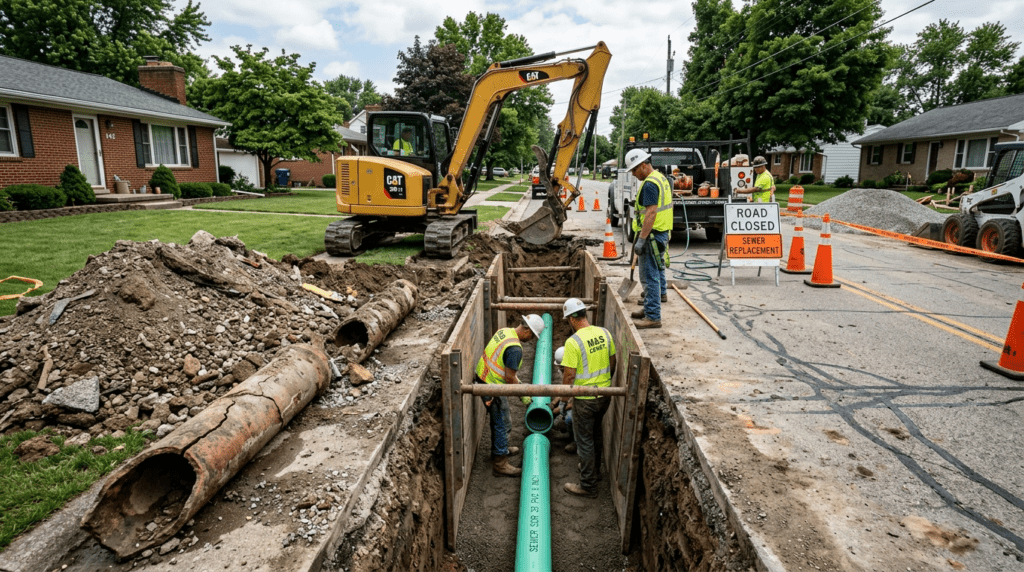
Does Sewer Line Replacement Always Mean Tearing Up Your Yard? Here’s What Houston Homeowners Need to Know
Most Houston homeowners assume that replacing a sewer line means weeks of torn-up landscaping, a ruined driveway, and a backyard that looks like a construction site. It is an understandable assumption. Traditional sewer excavation is exactly that: a crew digs a trench the full length of the pipe run, swaps the line, and fills everything back in. But that is no longer the only option, and for many homes, it is not even the most practical one.
Trenchless technology has changed the conversation significantly. So has a clearer understanding of what sewer symptoms actually indicate. Because here is the part that often gets missed: not every plumbing problem is a sewer problem, and not every sewer problem requires full replacement. Knowing the difference saves time, money, and a lot of unnecessary stress.
What Your Symptoms Are Actually Telling You
Before any discussion of method or cost, the first step is figuring out what is failing and where. Sewer line problems and water line problems often produce overlapping symptoms, which is where a lot of homeowners end up going down the wrong path.
Symptoms That Point Toward a Sewer Line Issue
- Drains that gurgle or back up across multiple fixtures at the same time
- A persistent sewage smell inside or around the home
- Patches of unusually lush or soggy grass over the sewer line path
- Slow drains throughout the house that do not respond to clearing
- A failed hydrostatic test, which pressurizes the drain system to locate leaks
These are signs that the outbound system, the pipes carrying waste away from the home, is compromised. In older Houston homes, cast iron drain lines are a common culprit. Cast iron corrodes from the inside out over time, and Houston’s clay-heavy soil shifts enough to crack even structurally sound pipe over decades.
Symptoms That Look Like Sewer Problems But Are Not
Low water pressure, rusty or discolored water, and frequent supply-side leaks are not sewer issues. They are water line issues. Specifically, they tend to signal failing galvanized steel or aging copper supply pipes, which is a completely different repair category.
This distinction matters because the diagnosis drives the solution. A homeowner who calls about low pressure and backs a sewer scope does not need a sewer line replacement; they need a supply line assessment. Conflating the two leads to unnecessary work and wasted money.
When symptoms are mixed or unclear, a whole-house plumbing assessment is the most efficient starting point. This type of evaluation looks at both the supply and drain systems, giving a complete picture rather than a single-system snapshot.
Traditional Sewer Replacement vs. Trenchless Methods: The Real Difference
Once it is confirmed that the sewer line is the problem, the next question is how to fix it. The answer depends on several variables, including pipe depth, soil conditions, the extent of the damage, and whether access points exist.
Traditional Open-Cut Replacement
Open-cut, or conventional, excavation involves digging a trench along the length of the damaged pipe. The old pipe is removed and new pipe is installed in its place. It is reliable, it gives the crew full visual access to the entire run, and it works in almost any condition.
The tradeoffs are real, though. Landscaping gets disrupted. Concrete driveways or patios over the pipe run have to be broken up and later repoured. The project typically takes longer, and restoration costs can add meaningfully to the total bill. For pipes that run under minimal landscaping or in straightforward access conditions, open-cut can still be the right call.
Pipe Bursting
Pipe bursting is one of the most common trenchless sewer repair methods used in the Houston area. A bursting head is fed through the existing pipe, which fractures the old pipe outward into the surrounding soil while simultaneously pulling a new pipe behind it. Only two access pits are needed, one at each end of the run.
This method works well for moderate to severely deteriorated lines where the pipe still has a passable interior. It is not appropriate where the pipe has fully collapsed, has major root intrusion compacted throughout, or runs through conditions that make soil displacement risky.
Cured-in-Place Pipe Lining (CIPP)
CIPP is the other widely used trenchless approach. A flexible liner saturated with resin is inserted into the damaged pipe, inflated against the interior walls, and then cured in place using heat or UV light. The result is essentially a new pipe inside the old one. No excavation. No removal of the original pipe.
CIPP is ideal for pipes with cracks, corrosion, and minor root intrusion, but where the overall structural shape is still mostly intact. It slightly reduces the internal diameter of the pipe, which is rarely a functional issue but worth understanding.
When Trenchless Is Not the Answer
Trenchless methods are genuinely excellent tools, but they are not universal. Pipes with complete collapse, severe bellying (sections that have sunk and hold standing water), or significant misalignment may still require open-cut work. A camera inspection will confirm which option is viable before any crew puts a shovel in the ground.
Houston-Specific Factors That Affect Sewer Line Decisions
Houston’s geography adds layers to this conversation that homeowners in other parts of the country do not always face.
Expansive clay soil. The region’s heavy clay content means soil shifts regularly with moisture cycles. This places ongoing mechanical stress on buried pipes, accelerating joint separation and cracking, particularly in older cast iron and Orangeburg-era lines.
Shallow water table. In parts of Harris, Galveston, and Brazoria counties, the water table sits close to the surface. This influences how quickly a leaking sewer line causes soil saturation and how difficult excavation conditions become after heavy rainfall.
Tree root activity. Mature oaks, magnolias, and other large trees common in established Houston neighborhoods are aggressive root systems. Roots seek moisture and will exploit any crack or joint gap in a sewer line. Regular neighborhoods like Bellaire, Kingwood, and the older sections of Katy see this consistently.
Post-Harvey soil displacement. Homes that experienced significant flooding during Hurricane Harvey, and subsequent events, may have sewer lines that shifted subtly without visible above-ground evidence. A camera scope on a 25-plus-year-old home in a flood-prone area is a reasonable precaution even without obvious symptoms.
How a Whole-House Plumbing Assessment Fits In
When a homeowner is dealing with multiple symptoms or an older home where the full plumbing history is unknown, a comprehensive evaluation covers both the supply side and the drain side in one visit.
This is where a company with genuine diagnostic depth matters. A crew that only handles drain work will evaluate the drain system. A crew that handles both supply repiping and sewer services can assess whether a symptom like poor drainage is a standalone sewer problem or one piece of a larger systemic failure that includes the supply lines.
For example: a home in Pearland built in the late 1980s with galvanized supply pipes and original cast iron drain lines may have both systems approaching end of life simultaneously. Addressing only the sewer line and leaving the galvanized supply intact is a short-term fix. Understanding that both systems are failing allows the homeowner to plan and budget properly rather than being surprised six months later.
Repipe Solutions, a Houston-based specialist focused on whole-home plumbing, covers both ends of this. For homeowners weighing sewer line replacement alongside a supply-side assessment, having both evaluated in a single visit provides a clearer and more complete picture of what the home actually needs.
What to Expect From the Replacement Process
Regardless of method, a professional sewer line replacement project in Houston follows a general sequence:
- Camera inspection to confirm the location, extent, and nature of the damage
- Method selection based on pipe condition, access, soil, and depth
- Permitting, which is required for sewer line work in most Houston-area municipalities
- The work itself, which for trenchless methods can often be completed in a single day
- Pressure or flow testing to confirm the new line is functioning correctly
- Restoration of any access points, whether that is backfilling two small pits or patching a full trench
One point worth emphasizing: always confirm that permits are pulled before work begins. Unpermitted sewer work creates problems at resale and can void homeowner’s insurance coverage if a subsequent failure is traced back to unlicensed or uninspected work.
Key Takeaways
- Sewer line symptoms and water supply symptoms overlap significantly. Accurate diagnosis before any work begins is non-negotiable.
- Trenchless sewer repair methods, specifically pipe bursting and CIPP lining, can replace or rehabilitate a damaged line with minimal yard disruption in the right conditions.
- Traditional open-cut replacement still has a place, particularly for fully collapsed or severely misaligned pipes.
- Houston’s clay soil, shallow water table, and tree root activity create specific conditions that accelerate sewer line deterioration in older homes.
- A whole-house assessment that covers both supply and drain systems is the most efficient way to understand the full scope of a plumbing problem in an aging home.
Frequently Asked Questions
How do I know if my sewer line needs replacement or just cleaning? If drain cleaning clears the problem temporarily but it returns within a few months, the issue is structural rather than a simple blockage. A camera inspection will show whether the pipe has cracks, root infiltration, or deterioration that cleaning cannot address. Recurring problems in the same line are a reliable signal that replacement is worth considering.
Does trenchless sewer repair work for all Houston homes? Not universally. Trenchless methods require that the pipe still has a passable interior and that soil conditions allow for the specific technique. Homes with fully collapsed sewer lines, significant pipe bellying, or complex routing through obstacles may still need traditional excavation. A camera inspection before quoting any job will determine which approach is appropriate.
Is sewer line replacement covered by homeowner’s insurance? It depends on the policy and the cause of failure. Sudden damage, such as a pipe broken by a tree root penetrating and collapsing the line, may be covered under certain policies. Gradual deterioration is typically excluded. Reviewing the policy language before assuming coverage is important, and some homeowners purchase separate service line coverage as an add-on.
How long does a sewer line replacement take? Trenchless methods for a standard residential run can often be completed in one day. Traditional open-cut replacement typically takes two to four days depending on run length, depth, and restoration requirements. Either way, the home usually retains water service throughout since the sewer line is separate from the supply system.
What is the difference between a sewer line problem and a drain line problem? The sewer line is the main line that exits the home and connects to the municipal system or a septic tank. Drain lines are the interior branch lines that connect individual fixtures to the main. A problem isolated to one fixture, such as a single slow-draining sink, is likely a branch drain issue. Backups and gurgling across multiple fixtures at once usually indicate the main sewer line.
Final Thought
Tearing up a yard is not a foregone conclusion when a sewer line fails. The range of available methods has expanded considerably, and for many Houston homes, a well-executed trenchless repair leaves almost no visible trace. But the method question is secondary to the diagnosis question. Understanding exactly what is failing, where it is failing, and whether it is part of a larger plumbing picture is what leads to the right decision rather than an expensive one made under pressure.
If symptoms are pointing toward a sewer or drain issue, a camera inspection and a full system evaluation are the most useful next steps. They cost far less than a misdiagnosed repair.