The Spring Reset I Actually Needed
On giving your workspace the same attention you give your wardrobe — and why it changes everything
When I Looked at My Desk and Felt Nothing
It started, as most small domestic realisations do, on a Tuesday morning in early April. I had made coffee, opened the laptop, pulled out the chair — and then paused, standing in the doorway of my study, looking at the space I was about to walk into and start another day in.
The desk was still the one I had ordered in a hurry in 2020. A flat-pack kitchen table from a well-known Swedish retailer, jammed into the corner of a room that had never quite decided whether it was a study or a storage room. There was a cable running along the skirting board that I had been meaning to tidy for eighteen months. The chair was the spare dining chair, which had been temporary and had somehow become permanent. The window had a blind that did not quite fit the frame.
None of it was wrong, exactly. All of it had been decided under duress, in a week when everything was being decided under duress, and then left in place through four years of accumulated inertia. The room worked. I just never felt glad to be in it.
That Tuesday morning, for the first time, I stopped and actually looked at it. And I thought: I would not accept this from any other room in my home. Why am I accepting it from this one?
The Wardrobe Parallel
Here is a thing most of us understand intuitively about clothing that we have not yet applied to our working spaces: what you wear affects how you feel. Not because clothes have magical properties, but because the act of choosing them — of wearing something that reflects a version of yourself that you respect — is a small but real act of self-regard that compounds over the day.
Most of us have, at some point, done a wardrobe edit. Pulled out everything. Kept what fits, what feels right, what represents who we are now rather than who we were three years ago. Donated the rest. The wardrobe after the edit feels different from the wardrobe before it — calmer, more intentional. Getting dressed from it feels different. The choices are better because they were made deliberately.
I cannot think of a single compelling reason why a desk would be immune to this logic. We spend more time at it than we spend getting dressed. We make decisions there, do creative work there, send emails that shape our professional lives there. The quality of the space we do that work in matters — not in an abstract, aspirational way, but in a very practical, very daily way. And most of us have never applied to our workspaces the same intentionality we routinely apply to our wardrobes.
What a Desk Can Say About You
I spent longer than I expected researching standing desks after that Tuesday morning, because the category is larger and more varied than I had assumed — and because most of it was deeply uninspiring. Brushed aluminium. Black powder-coat. The visual register of a medium-sized corporation’s procurement department. Desks that said: I bought this because I had to, not because I wanted to.
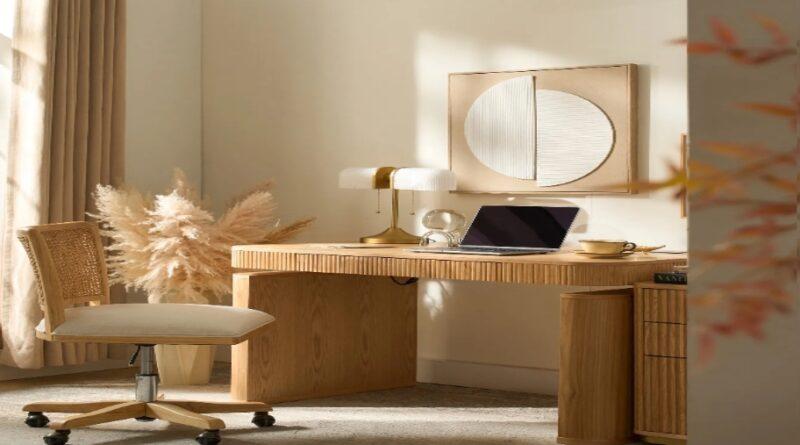
What I was looking for — and eventually found — was a desk that said something different. That said: I chose this. That it was warm materials rather than cold ones. That it was a standing desk for home UK living that had been designed with the domestic room in mind, not the corporate office. A desk that would look right on a Sunday afternoon when the laptop was closed, not just on a Monday morning when it was open.
The Julia from Hulala Home is that desk. Solid wood surface, clean square edges, built-in drawer, available in Cocoa Walnut or Light Oak — the material choices of a product designed for a lived-in room rather than a leased one. It is height-adjustable — 77.5cm to 123cm — with a quiet motor and programmable presets that make the sit-stand transition effortless. But the reason I chose it was not the motor. The reason I chose it was that when I saw a photograph of it in a room not unlike mine, I thought: That belongs there. I want that. The standing desk for home I had been trying to find.
The Ritual of Standing Up
I want to say something about the standing function that most standing desk reviews do not say, because most standing desk reviews are written from an ergonomics-first perspective and I am not writing from that perspective.
Standing up — pressing the preset button, watching the desk rise, taking a breath and beginning a task on your feet — is a small physical act of intention. It does not feel like an ergonomic intervention. It feels like a gear-change. Like a punctuation mark between one kind of focus and another. I raise the desk when I am about to do something that requires full concentration. I lower it when I am in a reading or reviewing mode. The motor takes four seconds. The psychological shift is faster than that.
This is not a claim you will find on a spec sheet. It is not measurable. But it is real, and it is, after several weeks of daily use, the thing I value most about the standing function — not the back support, not the calorie burn, but the way it marks the rhythm of the working day in a way that a fixed desk simply cannot.
The Reset That Lasts
The spring reset I did to my study was not only the desk. I dealt with the blind. I sorted the cable. I moved a lamp from the sitting room that had been surplus there and turned out to be exactly right here. These are not expensive changes. They are intentional ones. And the room now feels — I am searching for the right word — like mine. Like a room I chose rather than a room I ended up in.
The desk is the anchor of that change. It is the object everything else in the room now radiates from — the lamp positioned to fall on the wood surface, the anti-fatigue mat chosen to complement the floor colour, the single plant on the windowsill placed where it will be in my sightline when I stand. Everything oriented around a piece of furniture that was chosen for the room rather than installed in it.
The wardrobe parallel holds all the way through: the edit is only as good as the anchor piece. Get the desk right and everything else in the room has something to orient around. Get it wrong — settle for something that was ordered under pressure and never quite chosen — and the room will always feel like a room you are managing rather than a room you are glad to be in.
That Tuesday morning in April, standing in the doorway of my study looking at a desk I had never really chosen, I did not know I was about to do a spring reset. I thought I was just going to make coffee and start a working day. But sometimes the pause in the doorway is the beginning of something. Sometimes looking at a room and feeling nothing is exactly the information you needed.