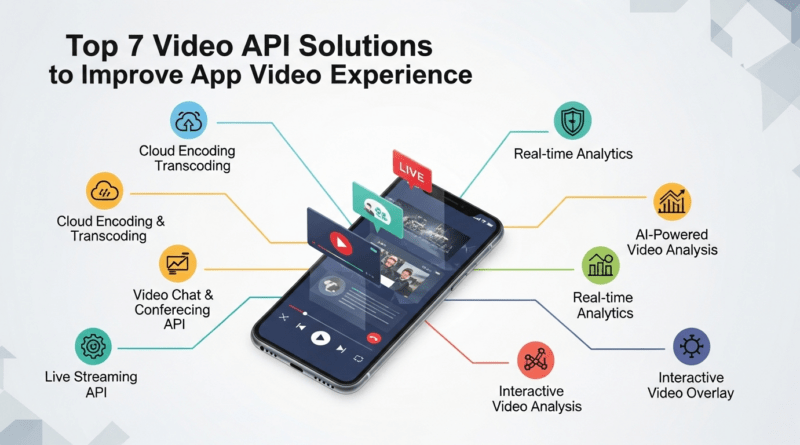
Top 7 Video API Solutions to Improve App Video Experience
Video APIs have become essential for applications that require live communication. They allow developers to embed video calls, webinars, and streaming directly into platforms without building complex systems from scratch.
These tools vary in features, from adaptive video quality and audio clarity to AI-powered transcriptions and security compliance.
Some focus on telehealth, others on webinars or enterprise content management. Understanding the capabilities of each API helps teams choose the right fit for their use case.
This article reviews several top video APIs, highlighting their key features, advantages, and the types of applications they support.
iotum
iotum offers a powerful Video API that lets platforms, websites, and apps seamlessly integrate real-time video communication, whether it’s one-on-one calls, video conferencing, or live streaming, enhancing the overall video experience for users.
It focuses on high-quality audio and video, fast integration, and reliable performance across devices and bandwidth conditions. Users can implement video features without building a solution from scratch, saving development time and complexity.
Key Features
The API delivers adaptive video resolution and crystal-clear audio. It supports enterprise-level video conferencing with global dial-ins, dial-outs, and AI-powered transcriptions. Integration is straightforward, requiring minimal code.
The API also allows branding customization, data security compliance, and scalability for both small and large applications.
Pros and Advantages
iotum simplifies video communication by reducing setup time and technical overhead. It provides consistent performance even on low-bandwidth networks. Users can maintain brand identity while leveraging enterprise-grade video functionality.
Security measures are built-in, ensuring data protection. The solution scales with user needs and avoids the high costs of building and maintaining a custom system.
Best Use Case
iotum is ideal for platforms needing seamless video interactions, including customer service portals, telehealth, education, and remote training. It works well for any application where integrating live video enhances engagement and efficiency. The API enables a nearly real-life communication experience without extensive development.
Voximplant
Voximplant operates as a serverless cloud communications platform serving more than 30,000 companies worldwide and processes 150 million calls monthly. The technology runs in datacenters across 14 distinct countries and gives healthcare organizations data sovereignty options for telehealth api development.
Key Features
GDPR compliance meets European privacy standards. Free peer-to-peer calls eliminate charges when TURN servers don’t touch media during one-to-one sessions. Video quality adapts to each endpoint and prevents freezing, regardless of the network conditions.
The platform delivers 1920×1080 resolution with speech recognition, video recording, screen sharing, and PSTN integration for connecting landline phones to conferences. Platform uptime hits 99.99%, meaning just 1.01 minutes of downtime weekly. End-to-end encryption blocks unauthorized access to patient data.
Serverless architecture speeds market deployment without infrastructure maintenance. SDKs work with iOS, Android, Web, React Native, Flutter, and Unity. AI integrations include OpenAI, Google Gemini, ElevenLabs, and Deepgram.
Pros and Advantages
DocDoc.ru automated patient enrollment and cut call processing costs by 10 times while speeding operations 5 times faster. Polimedica automated doctor house calls and reduced call center load by a lot.
Best Use Case
Healthcare networks benefit most from automated appointment scheduling and patient intake systems powered by voicebots.
Livestorm
Livestorm takes a different path for telehealth api development. It focuses on webinar and event platforms rather than pure video conferencing. The browser-based solution runs without downloads and delivers HD quality up to 1080p resolution. Patients and providers connect through web browsers instantly.
Key Features
Live captioning works in 10 languages for accessibility. AI-powered features generate automatic summaries and blog posts from sessions. Virtual waiting rooms manage patient flow, and automatic calendar invites reduce missed appointments. Restreaming broadcasts events across multiple platforms at once.
The public API provides 10,000 calls every 30 days. Business and Enterprise plans offer higher limits. Developers register participants from custom landing pages and create detailed event reports. They sync contact information and batch register multiple participants. Twenty applications integrate natively, including Pipedrive and Intercom.
Pros and Advantages
ISO 27001 certification and GDPR compliance protect patient data. TLS 1.2/1.3 protocols with AES256 encryption secure all transmissions. EU-based databases store data with daily backups. The platform earned an A+ SSL audit rating from Qualys SSL Labs. Enterprise customers receive 99.98% uptime guarantees.
Best Use Case
Healthcare professional training sessions and medical conferences benefit most from Livestorm’s engagement tools like polls and Q&A. Patient education webinars with automated follow-ups work well.
Brightcove
Brightcove positions itself as an enterprise-grade video platform rather than a dedicated telehealth api solution. The RESTful APIs give developers programmatic access to nearly every aspect of Video Cloud, from content management to analytics.
Barrow Neurological Institute partnered with Brightcove in 2013 to manage branded video content and live stream neurosurgeries on their website and social channels.
Key Features
The platform offers specialized APIs for different functions. CMS API provides uncached read access to time-sensitive publishing workflows. Dynamic Ingest handles video uploads and retranscoding.
Player Management creates customizable players that match your brand identity. Analytics API delivers detailed viewer behavior insights and tracks metrics like engagement rates and drop-off points. SDKs support Android, iOS, iPadOS, and tvOS to integrate native apps.
Pros and Advantages
Fast transcoding processes files with broad input compatibility. Global content delivery reaches audiences through adaptive bitrate streaming.
The AI Suite automates content creation tasks like reformatting horizontal to vertical videos, auto-clipping, and translating in 130 languages. Analytics integrates with CRM tools like Salesforce and HubSpot for marketing workflows.
Best Use Case
Healthcare organizations managing extensive video libraries benefit most from Brightcove’s content management infrastructure. Patient education and medical training are the primary use cases.
JW Player
JW Player operates in a network of 12,000+ publishers, broadcasters, and media companies and serves 40,000 video-driven brands.
The platform handles 500 million video impressions daily. Two APIs split responsibilities: Platform Management API v2 manages content libraries, while Delivery API delivers content at high volumes with minimal latency.
Key Features
Platform Management API v2 has API key management, granular access control, and RESTful design practices. Developers upload videos, create players, modify metadata, and manage security.
Delivery API uses multiple CDN vendors with short caching to optimize global response times. Content packages into JSON feeds, RSS, player embeds, and adaptive bitrate streaming manifests.
HTML5 players work on desktops, tablets, and smartphones. Live streaming has DVR features. DRM protection and encrypted streams secure content. Geographic restrictions, signed expiring links, and scheduled publishing control access. Adaptive bitrate encoding completes in under 2 minutes.
Pros and Advantages
Customer data demonstrates that 88% experienced video viewing increases of over 10% after implementation. Teams reported productivity improvements of over 10%. RESTful endpoints and JavaScript libraries simplify integration.
Best Use Case
Patient education libraries requiring quality playback benefit from JW Player’s rapid encoding and adaptive streaming. Medical training videos with search capabilities work well due to metadata handling.
Galene
Self-hosted video infrastructure appeals to organizations controlling their own telehealth api development stack. Galene operates as free, open-source software under the MIT license and requires moderate server resources compared to commercial alternatives.
Universities like Université de Paris and Sorbonne Université run production deployments for lectures and staff meetings.
Key Features
The server runs on Go with Pion’s WebRTC implementation. Performance scales in a linear fashion for one-to-many sessions and handles roughly 300 participants per CPU core. Many-to-many consultations follow quadratic scaling and support about 20 active participants on single-core hardware.
Browser-based access eliminates software downloads. The platform supports simulcast, Scalable Video Coding for VP8 and VP9, text chat, and recording to disk. Built-in TURN server simplifies firewall traversal.
Administrative API manages groups and users over HTTP. Authorization works through password-based or token-based methods.
Pros and Advantages
Zero licensing costs make Galene budget-friendly for smaller practices. Self-hosting provides complete control over data. Galene doesn’t perform end-to-end encryption, so anyone controlling the server can access exchanged data.
Best Use Case
Educational healthcare institutions benefit most from Galene’s lecture-oriented architecture for medical training programs that require self-hosted infrastructure.
Eyeson API
Just-in-time meeting servers set Eyeson API apart in telehealth api development. The platform spins up temporary infrastructure only during active video calls and wipes everything clean afterward. This architecture minimizes security exposure by a lot.
Key Features
One View Technology synchronizes multiple source feeds with layout changes happening in under 40ms. Smart Bandwidth adjusts audio and video frame rates based on network conditions automatically. Content integration injects videos, text, images, and other media directly into live meetings.
The platform allows complete control over visual elements through programmable APIs. Developers assign specific participants or content types to precise video positions within custom layouts.
Ghost Streaming Client connects drones, IP cameras, and webcams to sessions smoothly. Playback videos in MP4 format are integrated during consultations to educate patients. Security architecture employs AES-256 encryption, while temporary servers remove all information after meetings end.
Pros and Advantages
HIPAA, GDPR, and CCPA/CPRA compliance meet strict regulatory standards. Patented single-stream technology simplifies media routing without complex infrastructure requirements.
Best Use Case
SCOTTY Telemed demonstrates Eyeson’s strength by combining 4-6 medical device outputs into one stream. This transmits vital information through limited satellite networks smoothly. Secure virtual consultations requiring integrated patient data work very well with Eyeson’s programmable foundation.
Conclusion
Selecting the right video API depends on the specific needs of a platform or service. Some APIs, like iotum, excel in live consultations and quick integration, while others prioritize large-scale content management, analytics, or self-hosted control.
Security, scalability, and compatibility with multiple devices are common considerations across solutions. Evaluating features such as adaptive streaming, AI integrations, and user management ensures the API aligns with the intended use case.
Overall, these APIs simplify video implementation, enhance user experience, and reduce development complexity, allowing applications to deliver high-quality, reliable video interactions efficiently.