11 Things a Well-Built AI Chatbot Should Do for Your Ecommerce Store (And Why Most Plugins Don’t Come Close)
A practical breakdown of what modern AI chatbot technology actually looks like — and how custom AI software development is changing the conversion game for online retailers
If you’ve ever installed a chatbot on your ecommerce site and quietly removed it three months later because it annoyed your customers more than it helped them, you are not alone. The gap between what chatbot technology is marketed as and what most off-the-shelf tools actually deliver is wide enough to drive a truck through.
But here’s the thing — the problem was never the concept. It was the execution.
The latest generation of AI-powered chatbots, especially those built through dedicated custom AI software development rather than SaaS plugins, are a genuinely different category of tool. They’re smarter, more integrated, and more useful to shoppers than anything that came before. And the businesses that are deploying them thoughtfully are seeing measurable results: lower cart abandonment, higher average order values, reduced support overhead, and better customer retention.
This article is a practical look at what a well-built ecommerce AI chatbot actually consists of — all eleven features that matter, why each one moves the needle, and what questions to ask if you’re evaluating AI application development services for your store.
| 70% Of online shopping carts are abandoned before purchase (Baymard Institute) | 53% Of shoppers leave if they can’t find a fast answer (Forrester) | 3× Higher conversion when intelligent chat is available at checkout |
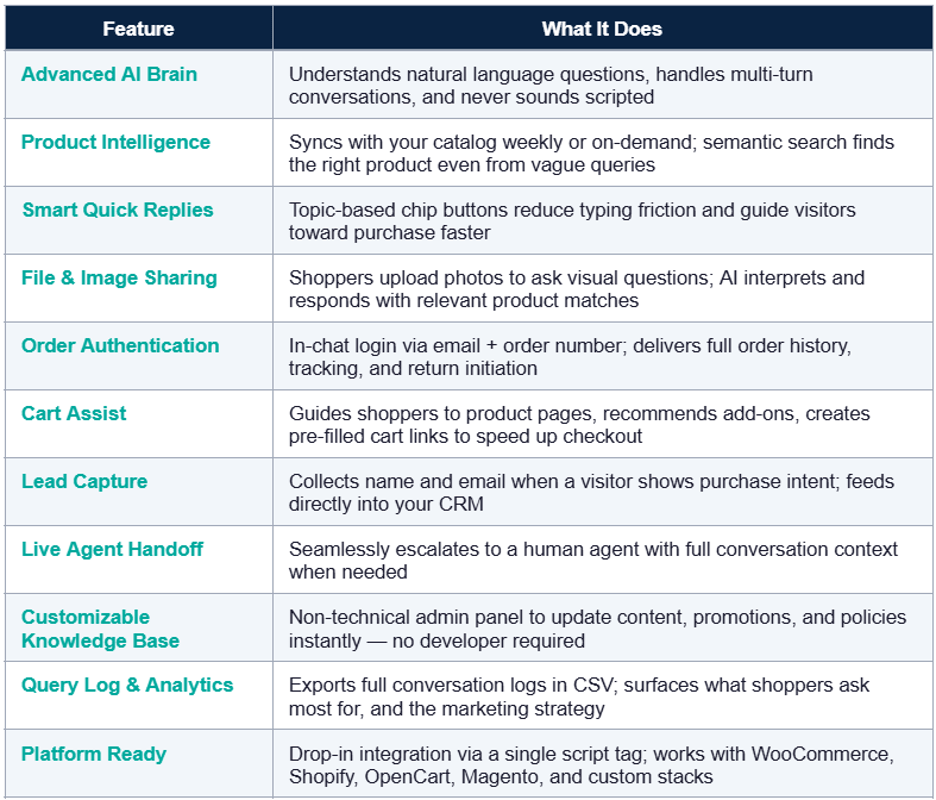
Before we dig into each feature in detail, here is a quick reference of all eleven capabilities that a well-built ecommerce AI chatbot should include:
1. An Advanced AI Brain That Actually Understands Your Shoppers
The single biggest limitation of older chatbot tools was their inability to understand natural language. They worked off keyword matching and decision trees. Ask something slightly outside the script and they fall apart immediately.
Modern AI chatbots built through professional AI software development services operate on a fundamentally different level. Companies like OpenSource Technologies are building solutions powered by large language models that understand context, intent, and nuance. A shopper can ask “Do you have something waterproof for hiking under $150?” and the chatbot genuinely processes that question — it understands the category, the use case, the constraint — and responds with relevant options.
More importantly, it handles multi-turn conversations naturally. It remembers what was said earlier in the exchange so the shopper doesn’t have to repeat themselves. That continuity is what makes the experience feel like talking to a knowledgeable person rather than a poorly designed form.
“The test of any AI chatbot is simple: give it five real questions your customer service team received last week. If it answers them accurately and naturally, the underlying technology is working. If it deflects or confuses, keep looking.”
2. Product Intelligence That Knows Your Catalog as Well as You Do
A chatbot that cannot speak intelligently about your specific products is not a sales tool — it’s a distraction. Product intelligence is what separates a genuinely useful ecommerce AI from a generic widget.
Well-built implementations sync with the store’s product database on a weekly basis, or on demand whenever the catalog is updated. This means the AI always has current pricing, availability, descriptions, and product attributes. When a shopper asks about a specific item, it answers with accurate, real-time information.
The semantic search layer is equally important. Shoppers rarely search the way a database is structured. They describe what they want in their own words — “something warm but not too heavy for autumn hiking” or “a gift for my dad who likes fishing.” Quality AI app development ensures the chatbot understands those descriptions and surfaces relevant products rather than returning zero results or irrelevant matches.
3. Smart Quick Replies That Remove Typing Friction
Not every shopper wants to type a question. Many visitors know roughly what they’re looking for but appreciate a gentle nudge in the right direction. That is exactly what smart quick reply chips are designed for.
Rather than presenting a blank chat window and waiting for input, a well-designed chatbot displays a set of topic-based buttons — things like Categories, Bestsellers, New Arrivals, Deals, and Order Status. One tap starts the conversation immediately, without the shopper needing to formulate a question from scratch.
This feature is especially effective on mobile, where typing is more friction-heavy. It reduces the cognitive load of initiating a chat interaction and gets shoppers into the product discovery flow faster. Small UX improvements like this have a measurable impact on engagement rates.
4. File and Image Sharing for Visual Product Questions
This is one of the more underappreciated features in ecommerce chatbot design, and it solves a problem that comes up more often than most store owners realise.
Shoppers frequently want to ask visual questions. “Do you have a cushion cover in this exact shade?” “This is the part that’s broken — do you carry a replacement?” “I saw something similar to this — do you stock it?” Without the ability to share an image, those questions either go unanswered or require a back-and-forth of descriptions that frustrates everyone.
A properly built AI chatbot allows shoppers to upload photos or documents directly in the chat window. The AI processes the image, interprets what the shopper is asking, and responds with relevant product matches or guidance. For categories like home decor, fashion, automotive parts, and specialty hardware, this capability alone can be the difference between a sale and a bounce.
File sharing extends to documents as well — spec sheets, warranty cards, previous order confirmations — anything a shopper might need to reference during a product question or support interaction.
5. In-Chat Order Authentication and Tracking
“Where is my order?” is one of the most common questions any ecommerce support team handles. It is also one of the most repetitive and time-consuming, despite the fact that the answer is almost always sitting in a database waiting to be retrieved.
Order authentication within the chat resolves this completely. The shopper provides their email address and order number inside the chat window. The AI authenticates the session, pulls their order details from the connected order management system, and delivers current status, tracking information, estimated delivery, and return initiation options — all without routing to a human agent or asking the shopper to log into a separate account portal.
From an operational standpoint, this feature alone can deflect a significant volume of support tickets. From the customer’s perspective, it is simply a much better experience than digging through email inboxes or navigating account dashboards. Businesses working with a capable AI development company can have this integration running against their existing OMS without rebuilding any backend infrastructure.
6. Cart Assist That Walks Shoppers Through to Checkout
Cart abandonment happens for a lot of reasons, but one of the most common and most preventable is simply that the path from interest to purchase has too many steps or too much uncertainty.
Cart assist functionality addresses this directly. When a shopper expresses interest in a product, the chatbot can guide them to the right product page, suggest compatible accessories or complementary items, and generate a pre-filled cart deep-link that takes them to checkout with their selections already in place. Fewer steps, less friction, faster decisions.
The upsell and cross-sell element of this feature is worth highlighting separately. A shopper asking about a camera does not need to be bombarded with related products — but a well-timed suggestion for a compatible lens or a carrying case, offered naturally within the conversation, is genuinely useful. That is the difference between pushy and helpful, and good AI software development services build that distinction into the chatbot’s behaviour from the start.
7. Lead Capture That Turns Browsers Into Contacts
Not every visitor who engages with a chatbot is ready to buy today. Some are researching. Some are comparing options. Some are interested but not quite convinced. Without a lead capture mechanism, all of those interactions end when the browser tab closes and the visitor is gone with no way to follow up.
A well-designed ecommerce chatbot identifies when a visitor is expressing purchase intent — asking specific product questions, checking availability, requesting pricing information — and collects their name and email address naturally within the conversation flow. Not through an intrusive pop-up, not with a forced registration wall, but as a natural part of the exchange.
That data feeds directly into the connected CRM or email marketing platform, enabling follow-up sequences, abandoned cart emails, and retargeting campaigns that are informed by exactly what the visitor was interested in. This is one of the clearest examples of how artificial intelligence development services create compounding value over time — the chatbot is not just serving today’s visitors, it is building tomorrow’s pipeline.
8. Seamless Live Agent Handoff When It Matters
No AI chatbot handles every situation perfectly. There will be complex queries, edge cases, frustrated customers, or sensitive issues where a human agent needs to step in. The question is not whether this will happen — it is how gracefully the handoff occurs when it does.
In poorly designed systems, the handoff is jarring. The shopper has to repeat their entire problem from scratch to the human agent because no context was preserved. That experience is worse than not having a chatbot at all.
In a well-built system, the handoff is seamless. The human agent receives the full conversation transcript, understands exactly where things stand, and picks up without missing a beat. The shopper never feels like they fell through a crack. This is a design decision that reflects how seriously an AI app development company takes the end-to-end customer experience rather than just the automated portion of it.
9. A Knowledge Base Your Team Can Update Without a Developer
One of the most common reasons chatbot implementations fail over time is that the knowledge base goes stale. A promotion ends but the chatbot still mentions it. New products launch but the AI doesn’t know about them. Return policies change but the chatbot gives customers the old information.
This happens when updating the chatbot requires a developer. Most marketing and operations teams cannot justify raising a ticket every time they need to reflect a new policy or seasonal campaign in the chatbot’s responses.
The solution is a non-technical admin panel that allows any team member to update the knowledge base directly. Add a new product category, reflect a holiday promotion, update shipping timelines, revise a return policy — all through a simple interface without touching any code. This is a feature that responsible AI software development services build in from the start, because a chatbot that the team can maintain independently is one that actually stays useful long after launch.
10. Query Logs and Analytics That Make the Whole Business Smarter
Most ecommerce operators think of chatbot analytics as a measure of chatbot performance. How many conversations did it handle? What was the deflection rate? Those metrics matter, but they only scratch the surface.
The real value of query log analytics is what it tells you about your customers. Every conversation is a direct window into what shoppers are confused about, what information is missing from your product pages, what questions come up repeatedly before purchase, and what objections are costing you sales.
A chatbot that exports full conversation logs in CSV format and surfaces the most common query patterns is giving its operator a continuous stream of product research, content strategy, and conversion optimisation intelligence. If fifty shoppers a week are asking whether a product is compatible with a specific system, that is a signal to add a compatibility section to the product page. If questions about return policy spike on certain days, that is a signal about messaging gaps in the checkout flow.
This feedback loop — from customer conversations to business decisions — is one of the least discussed and most valuable aspects of working with a professional AI development company on a custom build.
11. Platform Integration That Works With Whatever You Are Running
The final feature on this list is one that sounds straightforward but trips up more implementations than almost anything else: platform compatibility.
Ecommerce businesses run on a wide variety of stacks. WooCommerce, Shopify, OpenCart, Magento, and fully custom-built platforms all have different architectures, APIs, and data structures. A chatbot that integrates superficially — dropping in a widget that can answer generic questions but cannot access real product data, inventory, or order information — misses the point entirely.
The best implementations work via a single script tag embed that drops cleanly into any existing platform without major infrastructure changes. More importantly, the integration goes deep: the chatbot connects to the product database, the order management system, the CRM, and any other relevant data sources. That depth is what enables every other feature on this list to function at its full potential.
When evaluating AI application development services, the integration question is one of the most revealing you can ask. Ask specifically which systems the chatbot will connect to, what data it will have access to, and how updates to the catalog or inventory are reflected in real time. The answers will tell you quickly how seriously a vendor takes the ecommerce use case.
The Bar Has Moved. Most Chat Tools Haven’t.
When you look at all eleven of these features together, what emerges is a picture of a tool that is genuinely capable of replicating the best parts of an in-store sales experience online — at scale, around the clock, across every stage of the buyer journey.
That is not what most off-the-shelf chat plugins deliver. It is what custom AI software development makes possible when an AI software development company builds with ecommerce outcomes as the primary objective, rather than feature checklists.
The businesses seeing the strongest results from conversational AI right now are not the ones with the biggest budgets. They are the ones that invested in getting the implementation right — the right integrations, the right knowledge base, the right handoff logic, and a commitment to ongoing optimisation after launch.
For ecommerce operators evaluating whether this technology is right for their store, the honest answer is: if your catalog requires explanation, if your AOV justifies recovering even a small percentage of abandoned carts, or if your customers regularly have questions that are not answered well by your current site, the ROI case for a properly built AI chatbot is compelling.
“The question is no longer whether AI chatbots work for ecommerce. The data on that is increasingly clear. The question is whether you implement with the depth and integration that makes the difference — or settle for a surface-level tool that confirms your skepticism.”
See It Live — Book a Free Demo
OpenSource Technologies (OST), based in Pennsylvania, USA, builds custom AI chatbots for ecommerce businesses, with all eleven features covered in this article. Their team offers a no-obligation 30-minute live demo configured for your specific store and product category.