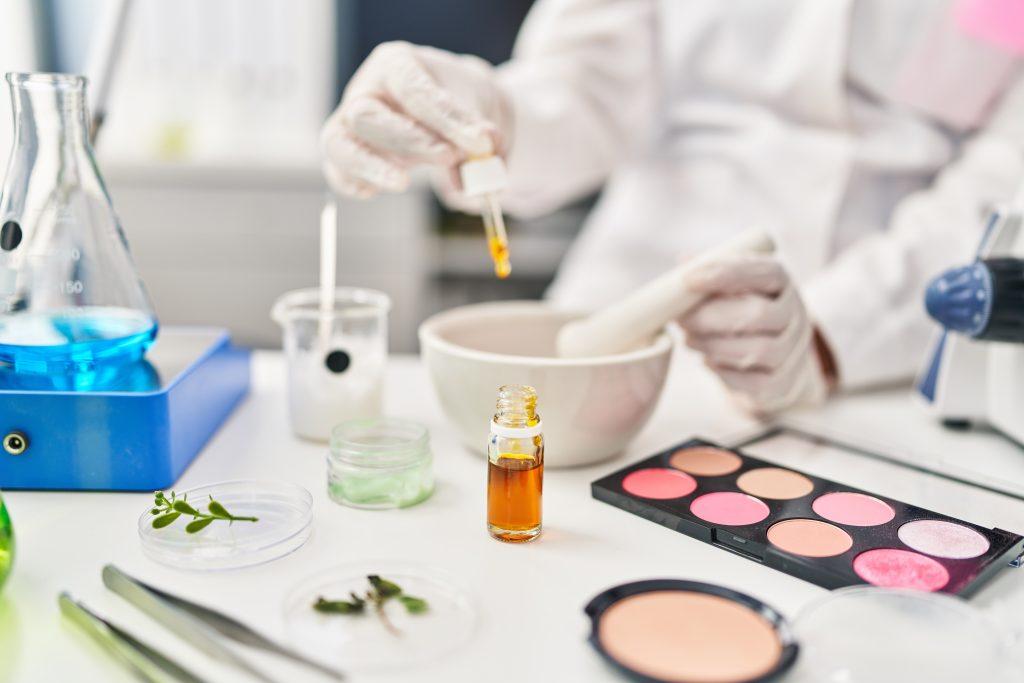
Understanding the Chemistry Behind Beauty Products: Ingredients That Matter
Pick up any serum, moisturizer, or shampoo and flip it over. What you find on that label is not random. It’s a carefully designed system, every ingredient chosen for a specific reason, working together in a way that only makes sense if you understand the basic chemistry holding it all together.
That’s exactly what this blog is about. Because once you understand the chemistry in beauty products, the way you shop, layer, and evaluate products changes completely. You stop being fooled by ingredient marketing and start asking better questions.
Let’s start at the very beginning.
What Cosmetic Formulations Are Actually Made Of?
Before jumping into specific ingredients, it helps to understand that every beauty product is built from three broad groups working together:
- Base components — the bulk of the formula, providing texture, delivery, and feel
- Active ingredients — the compounds doing the actual work on skin, hair, or nails
- Stabilizers and functional additives — preservatives, emulsifiers, pH adjusters that hold everything together and keep it safe
Most of what confuses people on an ingredient list is actually one of these three categories in disguise. Once you know which category an ingredient belongs to, its purpose becomes a lot clearer.
There’s also one structural rule that applies to every cosmetic label: ingredients are listed from highest to lowest concentration. Whatever appears first is what the product contains most of. Everything after roughly 1% can be listed in any order. This matters because brands often highlight exotic ingredients in their marketing that appear near the very bottom of the list, which means they’re present in trace amounts and unlikely to make much functional difference.
The Base: Where Every Product Starts
Water and Why It’s Almost Always First
Aqua, or water, leads the ingredient list on the majority of skincare and haircare products. It’s the primary solvent, the medium that carries and dissolves everything else. On its own it does very little, but without it, most formulations wouldn’t hold together.
Water-based formulas are called aqueous or hydrophilic formulations. Anhydrous formulas (containing no water, like balms, oils, and sticks) work differently and don’t require the same preservation systems.
Emulsifiers: The Reason Creams Don’t Separate
Oil and water don’t mix. That’s basic chemistry. But look at your moisturizer — it’s smooth, uniform, and shows no sign of separation. Emulsifiers are why.
These molecules have a dual structure: one end is attracted to water (hydrophilic) and the other to oil (hydrophobic). They sit at the boundary between the two, stabilizing the blend and allowing incompatible substances to coexist in a single product.
Common emulsifiers you’ll see on labels:
- Glyceryl stearate — mild, widely used in creams and lotions
- Cetearyl glucoside — derived from coconut and glucose, gentle
- Polysorbate 20 and 80 — synthetic emulsifiers, very common in lightweight formulas
- Lecithin — often soy or sunflower-derived, natural option
The type of emulsifier affects texture heavily. It’s a big part of why two products with similar actives can feel completely different on skin.
Thickeners and Texture Agents
After emulsifiers come the ingredients that control consistency. These are what make one product feel like water and another feel like a rich cream.
- Carbomer — synthetic polymer, creates gel-like textures
- Xanthan gum — natural, gives body to water-based formulas
- Cetyl alcohol / cetearyl alcohol — fatty alcohols, not drying, add creaminess and stability
- Silicones (dimethicone, cyclopentasiloxane) — create slip, spreadability, and a smooth skin feel
Hydration Chemistry: How Products Actually Moisturize Your Skin
This section is where most people’s skincare education starts, and for good reason. Hydration is the foundation of almost every skincare routine, and understanding how it works explains why you can’t just use any moisturizer and expect the same results.
Humectants: Attracting Water to the Skin
Humectants are water-binding molecules. They pull moisture from the environment and from deeper skin layers toward the surface. They don’t seal moisture in, they draw it.
Key humectants in beauty products
- Hyaluronic acid — can hold significant amounts of water relative to its weight; works best in humid environments or layered under an occlusive
- Glycerin — one of the oldest and most effective humectants, well-tolerated across skin types
- Panthenol (provitamin B5) — hydrates, soothes, and supports skin barrier repair
- Sodium PCA — naturally present in skin’s own moisture factor, effective and gentle
- Urea — at lower concentrations acts as a humectant, at higher concentrations also exfoliates
Emollients: Filling in the Surface
Once moisture is in the skin, you need something to keep it there and smooth the surface. Emollients fill in the micro-gaps between dead skin cells, making skin feel soft and look smooth.
They’re usually oils, esters, or fatty substances:
- Squalane — lightweight, derived from sugarcane or olives, non-comedogenic
- Jojoba oil — technically a liquid wax, very similar in structure to skin’s natural sebum
- Shea butter — rich and occlusive, very effective for dry skin
- Dimethicone — silicone-based emollient, also acts as a barrier and gives products their silky feel
- Isopropyl myristate — lightweight ester, improves spreadability
The combination of humectants and emollients is what separates a basic moisturizer from one that actually performs. Humectants pull moisture in. Emollients hold it at the surface. Both are needed.
Active Ingredients: The Chemistry That Does the Real Work
This is the most exciting part of cosmetic chemistry and the area where the science is most concentrated. Actives are the reason a product targets a specific concern, whether that’s dullness, fine lines, acne, or uneven tone.
Antioxidants: Defending Skin at the Molecular Level
Skin is constantly exposed to oxidative stress from UV radiation, pollution, and environmental damage. Free radicals, unstable molecules that steal electrons from healthy cells, are the underlying cause of much of this damage.
Antioxidants neutralize free radicals by donating an electron, breaking the chain of cellular damage before it compounds.
Vitamin C (L-ascorbic acid and its derivatives)
Vitamin C is the most widely researched antioxidant in skincare. It works on multiple levels: neutralizing free radicals, supporting collagen synthesis, and inhibiting melanin production, which addresses hyperpigmentation.
The challenge is stability. L-ascorbic acid oxidizes quickly when exposed to light and air, turning the product yellow to orange as it degrades. This is why high-quality vitamin C products come in opaque, airtight, or dark glass packaging.
More stable derivatives include ascorbyl glucoside, sodium ascorbyl phosphate, and ascorbyl tetraisopalmitate. These convert to active ascorbic acid in the skin but with some efficiency loss compared to the direct form.
Vitamin E (Tocopherol)
Vitamin E works both as a standalone antioxidant and as a synergistic partner for vitamin C. The two together provide stronger antioxidant protection than either alone. It’s also an emollient, contributing to skin softness alongside its protective function.
Exfoliating Acids: Chemistry at the Skin Surface
Chemical exfoliants are one of the most misunderstood ingredient categories. People hear the word “acid” and worry. But these are some of the most effective, well-studied active ingredients in skincare.
Alpha Hydroxy Acids (AHAs)
AHAs are water-soluble acids that work at the skin’s surface. They break the bonds between dead skin cells (corneocytes), encouraging them to shed and revealing fresher skin underneath.
Common AHAs:
- Glycolic acid — smallest molecule, deepest penetration, most potent
- Lactic acid — larger molecule, gentler, also acts as a humectant
- Mandelic acid — even larger, mildest, good for sensitive or darker skin tones
The effectiveness of AHAs depends heavily on pH. They need to be formulated at around pH 3 to 4 to exfoliate effectively.
Beta Hydroxy Acids (BHAs)
Salicylic acid is the main BHA in cosmetics. Unlike AHAs, it’s oil-soluble, allowing it to penetrate into pores and dissolve the sebum and debris that cause congestion. It’s also anti-inflammatory, which makes it particularly effective for acne-prone skin.
Cell-Communicating Ingredients
Retinoids (Vitamin A)
Retinol, retinal (retinaldehyde), and prescription retinoic acid are all forms of vitamin A. They work by binding to receptors in skin cells that influence how those cells behave, supporting faster cell turnover, collagen production, and overall skin renewal.
The potency ladder: retinoic acid > retinal > retinol. Each step requires conversion in the skin, with some efficiency loss at each stage. More potent also means more potential for irritation, which is why starting low and going slow is always recommended.
Peptides
Peptides are short chains of amino acids, the building blocks of proteins like collagen and elastin. Different peptides signal different things to skin cells. Some encourage collagen synthesis. Others act as carriers for minerals. Some have a muscle-relaxing effect (used in “Botox alternative” products).
The challenge with peptides is delivery. Because they’re larger molecules, getting them to penetrate to the layers of skin where they’re useful requires good formulation design.
Niacinamide (Vitamin B3)
Niacinamide deserves its own mention because it sits at a rare intersection: it’s both an active and highly supportive of the overall skin barrier. It reduces transepidermal water loss, has anti-inflammatory properties, inhibits melanin transfer (contributing to an even skin tone), and is exceptionally well-tolerated across skin types.
It’s stable in most formulations and plays well with most other actives, making it one of the most versatile ingredients in modern cosmetic chemistry.
Why pH Is the Factor Most People Ignore?
Understanding chemistry in beauty products is incomplete without understanding pH. It’s often the difference between an active ingredient that works and one that’s sitting inert in a jar.
Skin’s natural pH is around 4.5 to 5.5, mildly acidic. This acid mantle supports healthy barrier function and the skin microbiome. Products that consistently disrupt this can compromise the barrier over time.
More immediately, pH governs whether active ingredients actually function:
- Vitamin C (L-ascorbic acid) needs to be below pH 3.5 for effective skin penetration
- AHAs and BHAs need to be around pH 3 to 4 to exfoliate
- Retinol is more stable at a slightly higher pH
This is also why layering order matters. Using a very low-pH product immediately before applying retinol can cause irritation, not because the combination is dangerous but because the pH environment affects how retinol converts and performs. A gap of 20 to 30 minutes between application or using them on alternate days is usually the practical solution.
Preservatives and Safety: The Ingredient Category Nobody Talks About (But Should)
Any product containing water needs a preservation system. Water is a growth medium. Without preservatives, bacteria, mold, and yeast would colonize your moisturizer within days of opening it.
Common preservatives:
- Phenoxyethanol — broad spectrum, widely used, generally well-tolerated
- Ethylhexylglycerin — often paired with phenoxyethanol to enhance effectiveness
- Sodium benzoate / potassium sorbate — more common in rinse-off formulas
- Caprylyl glycol — multifunctional, skin-conditioning alongside its preservative role
“Preservative-free” claims on water-containing products should always be read carefully. Either the product uses an alternative preservation system (like certain botanical antimicrobials or very high concentrations of specific actives), it’s genuinely anhydrous, or it has a significantly shorter shelf life than it implies.
Conclusion
Beauty products aren’t magic. They’re chemistry, executed well or poorly depending on the formulation behind them.
Once you understand the difference between a humectant and an emollient, why pH determines whether your vitamin C serum actually works, or what emulsifiers are quietly doing to keep your moisturizer stable, you read labels completely differently. You start choosing products based on what’s actually in them, not what’s on the front of the packaging.
The ingredients that matter aren’t always the ones being marketed. They’re the ones in the right form, at the right concentration, at the right pH, working together in a formulation designed with actual chemistry in mind. That’s the foundation of every beauty product worth using.