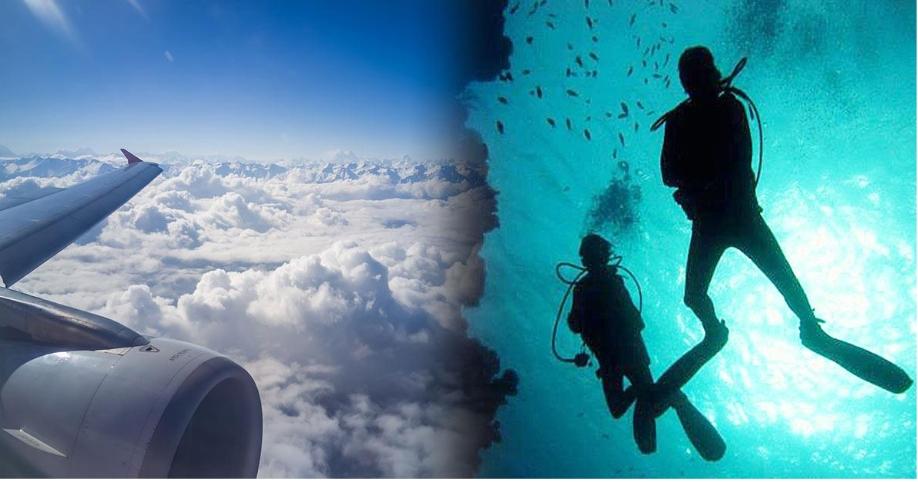
Flying After Diving: The Safety Rule Most Divers Ignore
Flying after diving is one of the most consistently underestimated safety rules in recreational diving. It’s taught in every Open Water certification course, and yet it’s also one of the rules most often quietly bent in the interest of not missing a flight. Here’s what you actually need to know — starting with how long after scuba diving you can fly.
Why You Can’t Just Jump on a Plane
When you dive, you breathe compressed air under pressure, and your body absorbs nitrogen into your tissues. As you ascend slowly to the surface, that nitrogen gradually releases back through your lungs — safely and without incident. The problem arises when you then board an aircraft. Even pressurized cabins operate at reduced pressure (typically equivalent to an altitude of around 6,000 to 8,000 feet), and that pressure reduction can cause dissolved nitrogen to form bubbles in your bloodstream and tissues.
This is decompression sickness, or DCS — sometimes called ‘the bends.’ Symptoms range from joint pain, skin rashes, and fatigue all the way to neurological damage and, in severe cases, death. It’s not common, but it’s entirely preventable.
How Long After Scuba Diving Can You Fly? The Numbers That Matter
The most widely cited recreational diving safety guidelines recommend the following. For a single no-decompression dive: wait a minimum of 12 hours before flying. For multiple dives on the same day or multiple days of diving: wait at least 18 hours. For dives involving mandatory decompression stops: the recommendation is substantially greater than 18 hours — the research here is less precise, which itself should prompt more caution, not less. As a practical rule that most serious divers follow: wait at least 24 hours after any diving before boarding a commercial flight. It’s conservative, yes, but the cost is one afternoon of sightseeing rather than a hyperbaric chamber.
The Variables That Make It More Complicated
The guidelines above assume a healthy diver doing no-decompression recreational dives to standard depths. In reality, multiple factors increase DCS risk and argue for longer surface intervals. These include diving deeper than 18 meters, doing repetitive multi-day diving, higher body fat percentage (nitrogen is more soluble in fatty tissue), dehydration, fatigue, and age. If any of these apply, erring toward 24 hours is the sensible call.
Dive computers can help. Many modern dive computers calculate a no-fly time based on your actual dive profile — depth, bottom time, surface intervals — and display it directly. If you’re using one consistently across all your dives on a trip, pay attention to what it tells you. It’s modeling your nitrogen load more accurately than a simple rule of thumb.
A Note on the Broader Health Benefits of Scuba Diving
Part of what makes flying-after-diving risks worth talking about is how compelling the health benefits of scuba diving genuinely are. Diving is proven to reduce stress, improve focus, and promote mindfulness in a way few other activities match. It supports cardiovascular fitness, encourages controlled breathing, and has therapeutic applications for a range of conditions. Protecting those benefits means protecting your ability to keep diving — and that means treating the safety rules with the seriousness they deserve.
How to Plan Around It
The best approach is simple: plan your dive schedule around your departure date, not the other way around. Make your last dive the day before your flight if possible. Use the final day of your trip for surface activities — snorkeling is fine since recreational snorkeling doesn’t involve breathing compressed air under significant pressure. Explore, eat well, hydrate, and let your body off-gas properly. The bends are entirely preventable. There’s no good reason to risk them.