The Modern Guide to Sunless Tanning: What to Expect and How to Prep
There’s something undeniably appealing about a sun-kissed glow — the kind that makes your skin look healthy, warm, and radiant. But in a world where we know far more about UV damage than we did a generation ago, the tanning conversation has evolved. Enter sunless tanning: the smart, sophisticated alternative that delivers a beautiful bronze without a single ray of sunshine.
Whether you’re brand new to spray tans or you’ve had a few streaky mishaps in the past, this guide breaks down everything you need to know to get a flawless, natural-looking result. From prep to aftercare, and everything in between — we’re covering it all.
What Exactly Is Sunless Tanning?
Sunless tanning refers to any method of achieving a bronzed skin tone without UV exposure. The most popular professional method is the spray tan, which uses a solution containing dihydroxyacetone (DHA) — a colorless sugar that reacts with the amino acids in the outermost layer of your skin to produce a temporary brown pigment. The result? A natural-looking tan that typically lasts five to ten days.
Modern sunless tanning solutions have come a long way from the orange, uneven finishes of the early 2000s. Today’s formulas are finely tuned to work with a range of skin tones and undertones, offering results that are genuinely difficult to distinguish from a sun tan.
Why People Are Ditching UV in Favor of Sunless
The statistics around UV tanning and skin damage are hard to ignore. Repeated UV exposure — whether from the sun or a tanning bed — accelerates photoaging, breaks down collagen, and significantly increases the risk of skin cancer. The American Academy of Dermatology estimates that one in five Americans will develop skin cancer in their lifetime, and tanning bed use before age 35 increases melanoma risk by 75%.
Sunless tanning sidesteps all of that entirely. Because DHA works only on the surface layer of the skin (the stratum corneum) and doesn’t penetrate deeper, there’s no cellular damage, no radiation, and no cumulative risk associated with regular sessions.
For beauty-conscious consumers who still want to look their best year-round, it’s a genuinely compelling trade-off.
Choosing Between At-Home and Professional Sunless Tanning
Walk into any drugstore and you’ll find shelves lined with self-tanning mousses, drops, gradual lotions, and tanning waters. These can be useful for maintenance between appointments or for subtle day-to-day color — but they come with a steeper learning curve than most packaging lets on.
Professional spray tans, by contrast, are applied by a trained technician using an airbrush or automated booth. The distribution is even, the formulas are calibrated, and the technician can adjust the intensity to match your natural skin tone. For special events — a wedding, a vacation, a photoshoot — a professional result is almost always worth it.
When looking for sunless tanning near me, it pays to find a studio that takes a personalized approach: one that offers a consultation, uses quality solutions, and ensures the application environment is clean, private, and comfortable. The difference between a rushed booth tan and a thoughtfully applied professional spray tan is immediately visible.
How to Prepare for a Spray Tan (The Right Way)
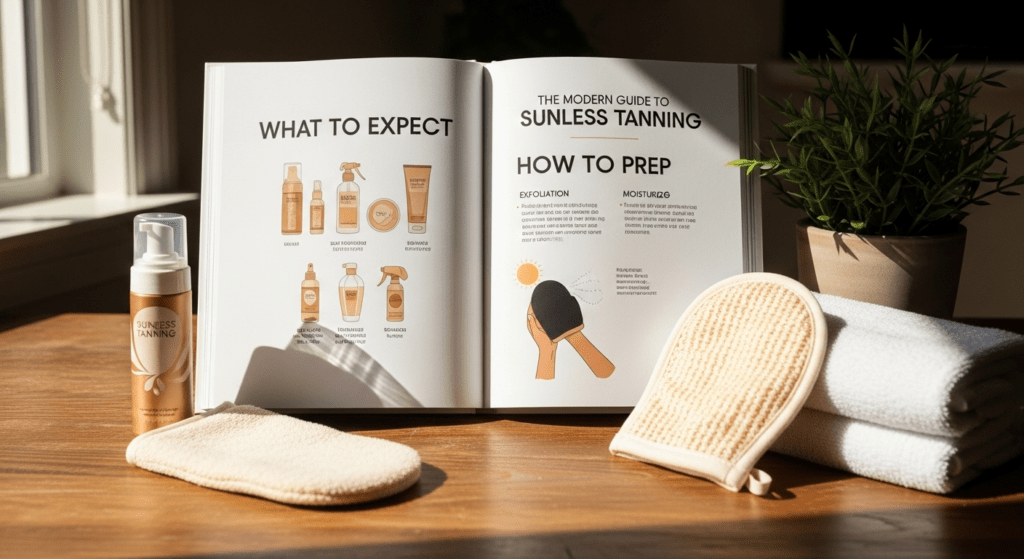
Great prep is the single biggest predictor of how your tan looks — and how long it lasts. Here’s what to do in the 24–48 hours before your appointment:
Exfoliate thoroughly. Dead skin cells create an uneven surface that leads to patchy absorption. Use a gentle physical or chemical exfoliant all over your body the day before your appointment. Pay extra attention to elbows, knees, ankles, and wrists — these tend to be drier and absorb more color.
Shave or wax at least 24 hours before. Freshly shaved or waxed skin has open pores that can trap DHA solution and create small dark dots. Give your skin time to recover before your appointment.
Skip the moisturizer day-of. Moisturized skin creates a barrier that prevents the DHA from properly bonding with your skin cells. On the day of your appointment, skip your body lotion. A thin layer of barrier cream on extremely dry spots (elbows, knees, heels) is fine — but keep it minimal.
Wear loose, dark clothing. After your session, the guide color in the solution may transfer slightly onto clothing until it fully dries. Loose, dark, breathable clothing minimizes this. Avoid bras with underwires, waistbands that sit tight against the skin, or anything that could rub or crease while the color develops.
Remove all jewelry. Even a thin ring or bracelet can leave a white tan line against the bronzed skin around it.
During and After Your Session
Professional spray tan sessions typically take 15 to 30 minutes from start to finish, including the consultation and drying time. An automated booth takes just a minute or two for the actual application; an airbrush session may take slightly longer but gives the technician more precision and control.
After your session, you’ll need to keep the solution dry and undisturbed for anywhere from two to eight hours (depending on the formula). Some rapid-development formulas allow you to rinse after just two hours — ask your technician what they recommend.
When you do rinse, use cool water only and avoid scrubbing. You’ll notice a lot of the guide color washing off — that’s completely normal. The actual DHA-based tan beneath is already developing and will continue to deepen over the next twelve to twenty-four hours.
Aftercare: Making Your Tan Last
Once your tan is set, a few simple habits will help you get the most out of it:
Moisturize daily. Dry skin sheds faster — and your tan goes with it. Keeping your skin well-hydrated is the number-one way to extend the life of your spray tan. Look for hydrating body lotions without mineral oil, which can break down the color prematurely.
Avoid long hot showers. Steam and prolonged soaking accelerate skin shedding. Quick, lukewarm showers are kinder to your tan.
Avoid exfoliating. Obviously, once you have your tan, you want to slow down the cell turnover rate — not speed it up. Put the exfoliating gloves away until it’s time to prep for your next session.
Pat dry, don’t rub. Rubbing with a towel is a surprisingly fast way to strip color unevenly. Patting gently preserves your tan far longer.
Book your next appointment before your current tan fades entirely. Most spray tan enthusiasts find a cycle of every seven to ten days works well for maintaining consistent color.
A Note on Skin Tone and Solution Matching
Not all spray tans are created equal, and one of the hallmarks of a quality studio is their ability to match solution formulation to individual skin chemistry and undertone. Fair skin tones generally do best with lighter, more gradual formulas to avoid an unnatural orange cast. Deeper skin tones can typically go darker without issue.
A good technician will also factor in the reason for your tan — a one-off special event might call for a deeper formula, while someone who comes in bi-weekly for maintenance color might prefer a lighter, more natural-looking base.
The Bottom Line
Sunless tanning has matured into a genuinely sophisticated beauty service — one that, when done well, delivers results that are both beautiful and responsible. With the right prep, the right studio, and a little aftercare know-how, it’s absolutely possible to maintain a warm, healthy glow 365 days a year without compromising your long-term skin health.
Whether you’re preparing for a big event or simply curious about making the switch from UV to sunless, now is a great time to give it a try. Your future skin will thank you.
Looking to try a professional spray tan? Explore your options and read up on what to expect before your first visit — a little research goes a long way toward a flawless result.