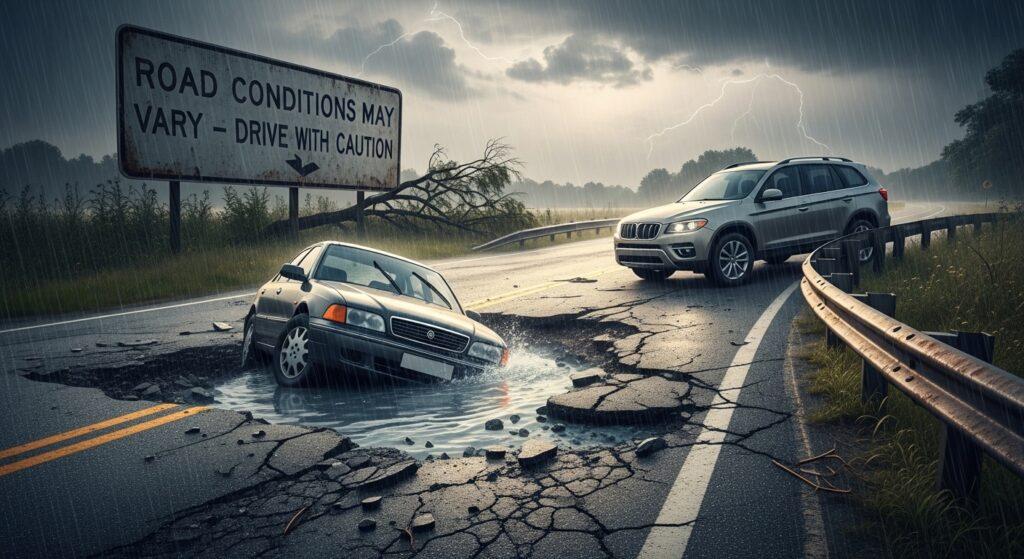
When Negligently Maintained Roads Create Liability Beyond Driver Error
The instinct to assign fault for a car accident to the drivers involved is natural and often correct, but it can obscure an equally important source of liability. Road conditions — pavement state, traffic signal function, debris, markings, and barriers — are not background noise. In many cases, they are central to the accident, and the governmental entities responsible for maintaining them may carry legal responsibility for resulting injuries.
California law recognizes that drivers are not the only parties whose negligence can cause a collision, and victims who limit their investigation to driver error may leave significant compensation on the table. A skilled car accident case attorney in Santa Maria can investigate whether road maintenance failures contributed to a crash and pursue the responsible agencies alongside other liable parties.
The Legal Duty to Maintain Public Roads
Governmental entities in California — cities, counties, and the state Department of Transportation — have a legal duty to maintain public roads in reasonably safe condition. This duty arises from the California Government Code, which holds public entities liable for injuries caused by dangerous conditions of public property when the entity had notice and failed to take reasonable protective action. Road maintenance failures are not simply oversights — they are potential breaches of legal obligation.
The duty encompasses pavement integrity, drainage systems, traffic signals, lane markings, guardrails, lighting, and debris removal. An entity that allows a dangerous condition to persist without correction or warning may be liable for foreseeable injuries. Establishing duty and breach requires investigating both the physical conditions at the accident site and the agency’s maintenance records.
Potholes and Pavement Failures That Cause Loss of Control
Pavement failures — potholes, surface cracking, severe rutting, and deteriorated road edges — are among the most common maintenance defects contributing to accidents. A pothole at highway speed can cause complete loss of vehicle control, particularly for motorcycles and bicycles. Even at lower speeds, severe defects can cause tire blowouts, sudden lane departures, or vehicles to become momentarily airborne.
The legal challenge is establishing that the agency had notice before the accident. Actual notice is shown through prior complaints, inspection logs, or internal communications. Constructive notice is established by demonstrating how long the defect existed and how visible it was. Photographs taken immediately after the accident, combined with records of prior reports, form the core of notice evidence.
Failed or Malfunctioning Traffic Signals
When traffic signals malfunction — through power failure, equipment defect, or inadequate maintenance — the results can be catastrophic. An intersection where signals have failed creates significantly elevated collision risk, particularly at high-volume locations where drivers are unaccustomed to exercising independent right-of-way judgment.
Agencies responsible for signal maintenance must conduct regular inspections, respond promptly to malfunction reports, and implement backup measures when failures occur at dangerous locations. When an agency fails these obligations and a collision results, the maintenance failure can be a direct basis for liability. Evidence includes signal maintenance records, prior malfunction reports, accident report descriptions of signal condition, and any available camera footage.
Faded or Absent Lane Markings
Lane markings define travel lanes, indicate passing zones, mark pedestrian crossings, and guide drivers through intersections and merges. When markings fade to illegibility, wash away, or are not replaced after resurfacing, drivers navigate ambiguous situations without the guidance the road should provide. In low-light or rainy conditions, faded markings become nearly invisible, producing head-on collisions, sideswipe accidents, and merge conflicts.
California’s maintenance guidelines establish clear standards for lane markings, and agencies allowing deterioration beyond acceptable thresholds breach their obligations. Victims can use inspection records, photographs, and expert testimony to establish that degraded markings created a dangerous condition. The notice element — proving the agency knew or should have known markings were inadequate — is central to liability.
Debris and Hazards Left Unaddressed on Roadways
Roadway debris — fallen rocks, detached vehicle components, spilled cargo, and broken pavement — creates sudden hazards, particularly at highway speeds where reaction time is limited. The agency’s responsibility arises when it has notice of the hazard and fails to remove it within a reasonable time. A debris field present for hours without response, despite reports or visible conditions that should have triggered action, can form the basis of a liability claim.
California transportation agencies operate maintenance patrol schedules designed to detect and address hazards promptly. Deviations from those schedules in locations with known exposure can constitute a breach. Victims should note whether emergency reports were made before their collision and whether prior accidents at the same location involved similar conditions. This pattern evidence is powerful when combined with records showing the response fell below the agency’s own standards.
Drainage Failures and Hydroplaning Hazards
Roads depend on functional drainage systems — culverts, inlets, channels, and pavement crown profiles — to prevent water from pooling in travel lanes. When drainage infrastructure is blocked, damaged, or inadequately maintained, standing water creates hydroplaning hazards that deprive drivers of traction at critical moments.
Agencies must regularly inspect drainage infrastructure and respond promptly to reports of pooling or flooding. When a drainage failure creates a hydroplaning hazard contributing to a collision and the agency had prior notice, the liability claim can be substantial. These cases benefit from expert analysis of the drainage system’s design and maintenance history, rainfall data, and evidence comparing the agency’s response to applicable standards.
Building a Claim Against a Government Agency in California
Pursuing a road maintenance claim against a government agency is different from regular personal injury cases. You must submit a formal claim to the agency within six months of your injury. This claim should explain the incident, your injuries, and the damages you seek.
The six-month deadline is strict; if you miss it, you can’t seek compensation. Early legal consultation is crucial to identify the responsible party, gather evidence, and prepare your claim. An attorney experienced in government liability will ensure everything is done correctly and on time, protecting your right to compensation from the start.