The Decentralized Battlestation: How High-Performance Virtualization Redefined Play in 2026
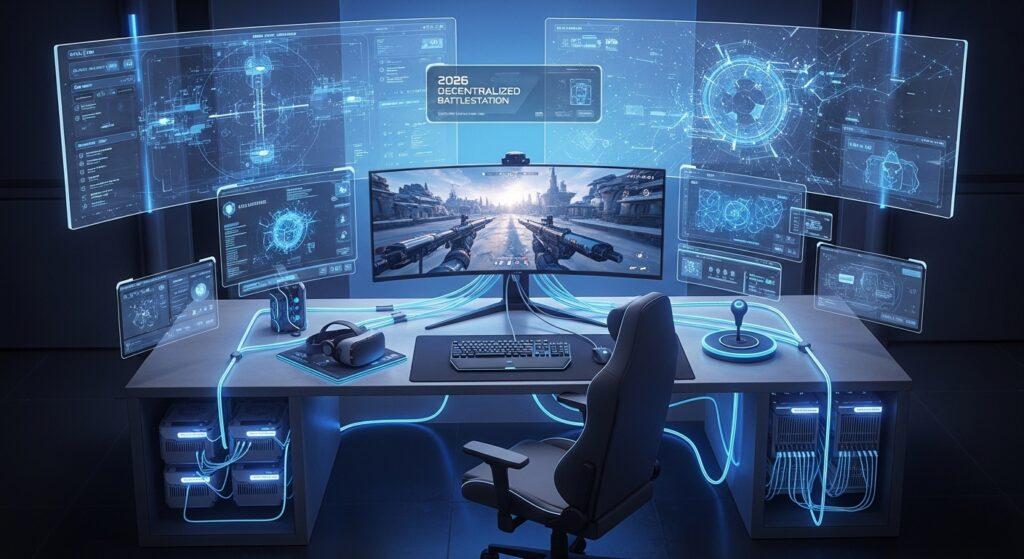
For decades, the peak of interactive entertainment was defined by a physical anchor: the high-end PC tower. It was a glowing monolith of silicon and cooling fans that lived under a specific desk in a specific room. If you wanted the best textures, the highest frame rates, and the lowest input lag, you had to be physically present. As a content strategist who has tracked the hardware industry for over ten years, I’ve watched countless “portable” solutions try—and often fail—to replicate that desktop feeling. Laptops grew thinner, but they remained loud, hot, and battery-hungry.
Everything changed when the industry shifted its focus from local hardware to the “intelligent handshake.” In 2026, the most sophisticated users aren’t lugging around heavy gaming laptops; they are carrying “windows” into their home rigs. The rise of specialized remote desktop for gaming technology has finally solved the portability paradox by decoupling the screen from the processor.
The Liberation of the High-End Experience
The traditional mindset was that “remote” was a synonym for “compromise.” We’ve all experienced the frustration of laggy inputs, blurry video, and connections that drop the moment the action gets intense. However, we have reached a technological plateau where global internet infrastructure—specifically the ubiquity of fiber and 5G/6G—has virtually eliminated the “perceived” delay.
When you utilize a high-performance host-client setup, your home PC acts as the “brain.” It does all the heavy lifting: calculating complex physics, rendering ray-traced shadows, and streaming high-resolution assets from an NVMe drive. Your portable device (a tablet, a smartphone, or an ultrabook) simply acts as a responsive, high-definition portal. This results in:
- Silent, Cool Performance: Your portable device stays silent because it is only decoding a video stream, not generating 3D environments.
- Infinite Battery Life: Since the GPU isn’t drawing hundreds of watts locally, a standard tablet can provide six to eight hours of “desktop-grade” play on a single charge.
- Library Unity: You no longer need to “sync” cloud saves or wait for massive 100GB updates on a weak hotel Wi-Fi. Your entire desktop environment remains exactly as you left it.
The Science of “Perceptual Zero-Latency”
The most significant hurdle has always been the “feel” of the controls. In a fast-paced shooter or a precision platformer, the delay between a button press and the on-screen action is the ultimate immersion killer. Modern streaming protocols have tackled this using “Perceptual Motion” algorithms.
To experience this firsthand, the process is now remarkably human-centric. You simply initiate a StarDesk download on both your host machine and your client device to create a secure, encrypted tunnel between them. This link uses advanced video codecs like AV1 and H.265 to prioritize frame pacing. Instead of just sending a “video,” the software predicts network fluctuations and adjusts the bitrate in real-time, ensuring that your mouse or controller inputs feel as instantaneous as if you were plugged directly into the motherboard.
The Professional Intersection: More Than Just Play
While “gaming” is the primary driver of this technology, the utility for the “digital nomad” and creative professional is immense. As a writer and editor, I often jump between a heavy research session and a high-resolution video render.
Having a robust remote connection means I can sit in a quiet cafe with a $500 laptop but have the full power of a $4,000 workstation at my fingertips. This is workflow elasticity. It’s the ability to access professional-grade tools—like Premiere, Blender, or complex IDEs—from a balcony or a train without carrying five pounds of hardware. Your workstation is no longer a place you go; it’s a resource that follows you.
Reclaiming Your Time and Space
At its core, this shift is about human flexibility. We are moving toward a “Screen Agnostic” future. In this new era, your hardware choice is based on the context of your environment rather than the requirements of the software.
- Reclaim your living room: Play a high-end RPG on your TV using a tiny, silent micro-PC.
- Travel light: Go on a week-long trip with nothing but a tablet and a foldable keyboard, knowing your full PC power is just a click away.
- Sustainability: By maximizing the utility of one powerful home machine across multiple screens, we reduce the “e-waste” cycle of constantly upgrading mid-range portable devices.
Overcoming the Connectivity Hurdle
Skeptics often point to “internet requirements” as a dealbreaker. While it is true that a stable connection is the fuel for this system, the infrastructure of 2026 is vastly different from that of a decade ago. With low-latency satellite internet and widespread high-speed cellular data, the “dead zones” are rapidly disappearing.
Furthermore, modern software is resilient. It is no longer an “all or nothing” proposition. Sophisticated error correction means a brief hiccup in the signal no longer results in a disconnected session. The system “breathes” with the network, providing a consistent experience that feels reliable rather than fragile.
Final Thoughts: The Horizon is Portable
We have arrived at a point where the physical location of your processor is a secondary detail. The best “gaming rig” in 2026 isn’t the one with the most RGB lights—it’s the one that is available to you 100% of the time, regardless of where you are standing.
By untethering ourselves from the desk, we are finally putting the player and the professional at the center of the story, not the machine. Whether you are exploring a distant nebula in a virtual galaxy or hitting a critical deadline from a beach, the power is now truly in your hands.
Are you looking to use a remote setup to turn an old laptop into a powerhouse, or are you primarily focused on playing high-end titles on your mobile device?