BIM vs CAD: What You Should Really Be Using and When
If you work in construction or design, you have probably come across the BIM vs CAD debate more times than you can count. Most people talk about it as if one is replacing the other, but that is not really how things work in practice. Both have their place, and the real value comes from understanding when to use each one based on the project.
What CAD Is Still Good At
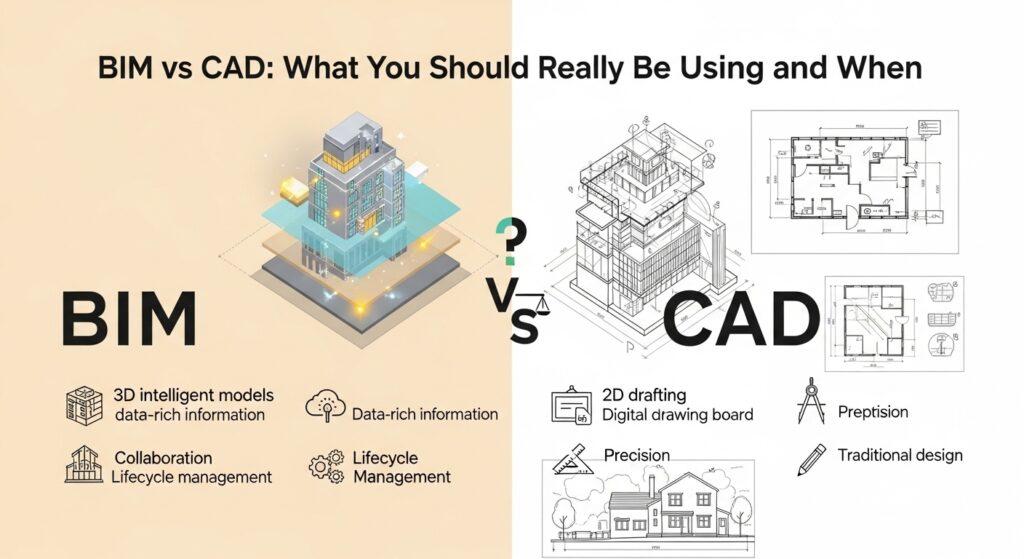
CAD has been the backbone of design workflows for years, and it still plays an important role today. It is mainly used to create 2D drawings and basic 3D representations such as floor plans, elevations, and technical layouts.
For projects that are straightforward or in early design stages, CAD works well because it is simple to use and quick to set up. Teams can produce clean drawings, make revisions without much effort, and keep the design process moving without needing a complex setup.
However, CAD focuses only on drawings. It does not provide deeper insight into how different systems interact, and it does not help much with coordination between multiple teams.
What BIM Actually Changes
BIM introduces a completely different approach by shifting the focus from drawings to a connected model. Instead of creating separate files, teams work within a shared digital environment that represents the entire project.
This model includes more than just geometry. It contains real information such as materials, quantities, and system relationships. Because of this, teams can identify issues early, especially clashes between different disciplines, before those problems reach the construction phase.
As a result, BIM improves coordination, reduces rework, and helps teams make better decisions throughout the project lifecycle.
Where Most Projects Go Wrong
One of the biggest misconceptions is that switching to BIM automatically improves project performance. In reality, many projects struggle because they move into BIM without proper planning.
Teams often start modeling without defining a clear workflow, without setting responsibilities, and without aligning on how the model will be used. This leads to confusion, inconsistent outputs, and a model that does not support the project effectively.
Unlike CAD, which is relatively easy to start, BIM requires structure from the beginning in order to deliver real value.
Why Planning and BIM Consulting Matter
For BIM to work properly, there needs to be a clear plan before any modeling begins. This includes defining how the model will support the project, how teams will collaborate, and what level of detail is required at each stage.
A structured BIM approach usually includes:
- Defining the purpose of the model and how it will be used during design, coordination, and construction
- Setting clear roles and responsibilities across all teams involved in the project
- Establishing coordination workflows to ensure consistency and reduce conflicts
- Aligning the expected level of detail so that the model remains useful without becoming overly complex
This is where BIM consulting becomes important. Instead of leaving these decisions to trial and error, a clear framework is set from the start so the model actually supports the project goals.
At HSE Contractors, we have seen how much of a difference this makes. When the right structure is in place early, teams spend less time fixing issues later, coordination improves, and the overall process becomes more predictable.
BIM vs CAD: Which One Should You Use
Choosing between BIM and CAD depends on the scope and complexity of the project. CAD is a good fit for smaller or less complex projects where the main requirement is to produce accurate drawings quickly.
BIM is more suitable for projects that involve multiple disciplines, tighter coordination, and higher levels of detail. In those cases, having a shared model helps teams stay aligned and reduces the risk of errors during construction.
Final Thought
The discussion is not really about choosing BIM over CAD or the other way around. It is about using the right approach based on what the project actually needs.
CAD remains a reliable option for drafting and simple workflows, while BIM provides a more connected and coordinated way to manage complex projects. When used correctly, both can support better outcomes, but BIM delivers the most value when it is planned properly from the start.