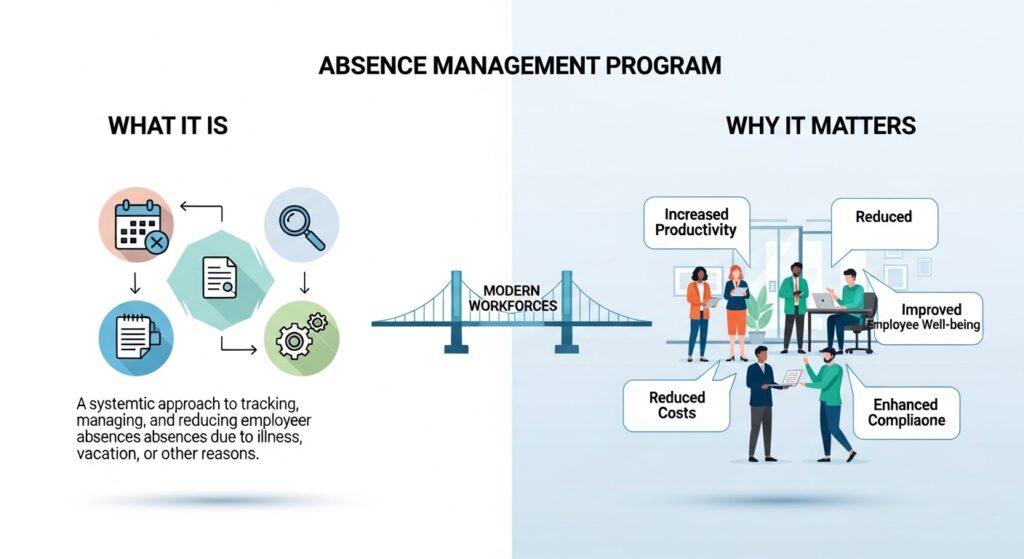
What Is an Absence Management Program and Why It Matters for Modern Workforces
Workforce reliability is one of the most critical, yet consistently under-optimized, levers in operational performance. Across industries—from manufacturing and logistics to healthcare and service-based businesses—unplanned absences introduce volatility that impacts productivity, compliance, and profitability. This is where a structured absence management program becomes not just helpful, but essential.
What Is an Absence Management Program?
An absence management program is a formalized system that tracks, manages, and optimizes employee attendance. It combines policy, process, and technology to ensure that employee absences—planned or unplanned—are handled consistently and with minimal disruption to operations.
At its core, a well-designed program focuses on three key areas:
- Visibility: Real-time tracking of who is present, absent, or late
- Consistency: Standardized policies for reporting and managing absences
- Accountability: Clear expectations and enforcement mechanisms
Without these elements, organizations often operate reactively, leaving managers scrambling to fill shifts and HR teams dealing with inconsistent enforcement.
The Business Impact of Poor Absence Management
Many organizations underestimate the true cost of absenteeism. It’s not just about one missed shift—it’s the ripple effect across operations.
Common consequences include:
- Increased overtime costs to cover gaps
- Reduced productivity due to understaffing
- Higher burnout rates among reliable employees
- Compliance risks in regulated industries
- Decreased morale and team cohesion
When absence management is informal or manual—think spreadsheets, call-in voicemails, or text messages—it becomes nearly impossible to identify trends or enforce policies effectively.
Having a trusted tool, system, or program can make all the difference. Tools like Productivity Pilot have saved millions each year for some of the most recognized brands in the world.
Key Components of an Effective Absence Management Program
A modern absence management program is not just policy—it’s a system designed for scale and precision. High-performing organizations typically build their programs around the following components:
1. Clear Attendance Policies
Employees need to understand expectations around attendance, call-offs, and consequences. This includes:
- Defined call-off procedures
- Notice requirements
- Point systems or disciplinary frameworks
- Exceptions for protected leave (e.g., FMLA, ADA compliance)
Clarity reduces ambiguity and eliminates subjective enforcement.
2. Centralized Reporting System
Relying on supervisors to manually track attendance introduces inconsistency. A centralized system ensures:
- All absences are recorded in one place
- Data is standardized across teams and locations
- Reporting is automated and accessible
This is where many organizations begin to see immediate operational gains.
3. Real-Time Notifications
Speed matters. When an employee calls off, managers need immediate visibility to make adjustments.
An effective program includes:
- Instant alerts for call-offs
- Shift coverage workflows
- Escalation paths for critical roles
Without real-time communication, even small disruptions can cascade into larger operational issues.
4. Data and Analytics
Absence data is one of the most underutilized datasets in workforce management. A strong program turns data into insight by tracking:
- Absence frequency by employee
- Patterns by shift, department, or day of week
- No-call/no-show incidents
- Correlation with overtime or productivity dips
These insights enable proactive decision-making rather than reactive problem-solving.
5. Compliance Alignment
In industries like healthcare and manufacturing, absence mismanagement can lead to regulatory violations.
A robust program ensures:
- Proper documentation of absences
- Alignment with labor laws and union agreements
- Audit-ready reporting
This reduces legal exposure while maintaining operational integrity.
The Shift Toward Automation
Traditional absence management methods are rapidly becoming obsolete. Manual processes cannot keep pace with the complexity of modern workforces, especially those operating across multiple locations or shifts.
Automation introduces several advantages:
- Accuracy: Eliminates human error in tracking and reporting
- Efficiency: Reduces administrative burden on managers and HR
- Scalability: Supports growing teams without adding overhead
- Employee Experience: Simplifies call-off processes
Organizations that adopt automated absence management systems consistently outperform those relying on legacy methods.
Why Technology Is Now a Competitive Advantage
In today’s labor market, workforce stability is a differentiator. Companies that can maintain consistent staffing levels gain an edge in productivity, customer satisfaction, and cost control.
This is where platforms like Productivity Pilot are reshaping how absence management is executed.
Rather than functioning as a passive tracking tool, modern solutions are designed to actively optimize workforce performance. Productivity Pilot, for example, integrates attendance tracking, call-off management, and real-time communication into a single system that aligns frontline operations with business objectives.
What Sets Productivity Pilot Apart
From a third-party perspective, several factors position Productivity Pilot as a leading absence management solution:
1. Real-Time Operational Visibility
Managers gain immediate insight into attendance across teams, allowing for faster decision-making and reduced downtime.
2. Streamlined Call-Off Workflows
Employees can report absences through structured, mobile-first systems—eliminating confusion and ensuring consistency.
3. Actionable Analytics
Instead of static reports, the platform delivers insights that help identify trends, predict issues, and reduce absenteeism over time.
4. Policy Enforcement at Scale
Automated tracking ensures attendance policies are applied consistently across the organization, reducing bias and improving compliance.
5. Measurable Impact
Organizations leveraging structured absence management programs supported by tools like Productivity Pilot often report up to a 50% reduction in absenteeism-related disruptions, alongside meaningful reductions in overtime costs.
Building a High-Performance Absence Management Strategy
Implementing an absence management program is not just about selecting software—it’s about aligning people, process, and technology.
A forward-thinking strategy typically includes:
- Audit Current State
Identify gaps in visibility, policy enforcement, and reporting. - Standardize Policies
Ensure consistency across departments and locations. - Implement Technology
Adopt a centralized system to automate tracking and communication. - Train Managers and Employees
Adoption is critical. Systems only work if they are used correctly. - Continuously Optimize
Use data to refine policies, improve scheduling, and reduce absenteeism over time.
Final Takeaway
Absence management is no longer a back-office function—it is a frontline operational priority. Organizations that fail to modernize their approach will continue to experience unnecessary labor costs, productivity loss, and compliance risks.
Conversely, companies that invest in structured, technology-driven absence management programs position themselves for greater stability, efficiency, and long-term growth.
In that landscape, solutions like Productivity Pilot are not just tools—they are operational infrastructure.