Why Temperature-Controlled Logistics Are Critical for Modern Pharmaceuticals
A pill in a bottle can take a few bumps. A biologic in a vial often can’t.
That’s why temperature-controlled logistics (the pharma cold chain) matters more in 2026 than it did a decade ago. More of today’s therapies are vaccines, antibodies, and cell and gene treatments. Many of them can lose strength if they get too warm, or get damaged if they freeze.
A temperature excursion is when a product goes outside its approved temperature range during storage or transport.
This is about protecting patients, meeting strict rules, and proving the medicine stayed safe end to end. Next, we’ll look at what’s at risk for patients, what the rules demand, and how teams keep shipments in range today with real-time tracking, better packaging, and planning for climate and power threats.
What’s at stake when pharma shipments go out of temperature range
Cold chain failures don’t always look dramatic. Sometimes the box arrives on time, the seal is intact, and the vial looks normal. That’s the scary part. You can’t “eyeball” potency.
Most importantly, patients pay the price when a therapy doesn’t work as intended. After that comes wasted inventory, missed treatment windows, and shortages that ripple across hospitals and pharmacies.
A few common temperature bands help show why this is hard. Many vaccines and biologics ship refrigerated, often 2 to 8°C (36°F-46°F). Other products ship frozen, and some advanced therapies need ultra-cold handling.
Here’s a quick, practical view:
| Temperature band (common) | Typical examples | What can go wrong |
| Refrigerated (about 2 to 8°C) | Many vaccines, insulin, biologics | Heat can reduce potency, freezing can ruin proteins |
| Frozen (often below 0°C) | Some injectables, plasma-derived products | Thaw-refreeze cycles can degrade the product |
| Controlled room temp (often 15 to 25°C) | Many tablets, some specialty drugs | Heat spikes can speed up breakdown |
| Ultra-cold and below | Some cell and gene therapies | Small delays can exceed tight time limits |
The business world has noticed. Market research varies by what gets counted as “packaging” versus “logistics,” but nearby segments are already large and growing. For example, biopharma cold chain logistics has been sized around $21B in 2025, with strong growth expected through the early 2030s.
Patient safety: potency loss, treatment failure, and avoidable harm
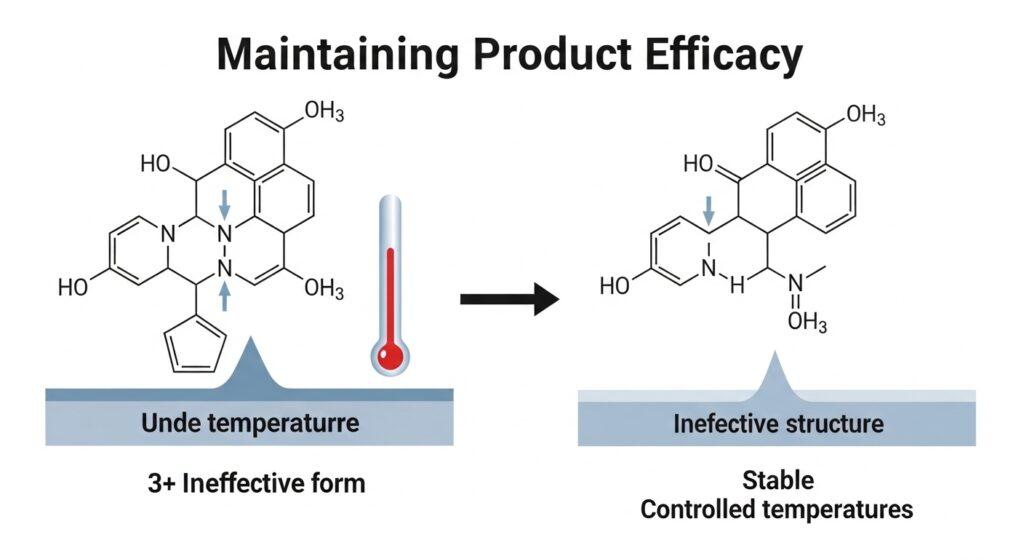
Heat and freezing can change a medicine’s chemistry or structure. With biologics, that can mean proteins unfold, clump, or lose activity. With vaccines, it can mean the immune response isn’t strong enough.
Think of it like milk left on the counter. It may look fine, but you don’t want to bet on it.

The hard truth is that damage is often invisible. So “it arrived cold” isn’t proof, and “it looks fine” isn’t a quality test.
If you can’t prove the product stayed in range, you can’t prove the patient got the therapy that was tested.
Business impact: wasted inventory, delays, and hard-to-replace therapies
Even when patient harm is avoided, excursions create expensive chaos.
First, teams may quarantine product while quality groups review data. That can slow batch release and delay treatment. Next, companies may scrap inventory if they can’t confirm it stayed within limits. In addition, a single bad handoff can trigger wider checks across other shipments on the same lane.
The pain gets sharper with advanced therapies. Some cell and gene therapies require ultra-cold handling and tight time windows. A delay at an airport or a missed courier handoff can mean more than spoiled product. It can mean a missed treatment slot for a patient who already completed prep steps.
Reliability also matters for supply. If clinics lose trust in delivery performance, they may over-order “just in case.” That pushes costs up and strains already busy cold storage space.
How temperature-controlled logistics keep pharmaceuticals compliant and trustworthy
Cold chain is a system, not a single device. In 2026, that system often includes SaaS platforms that help teams monitor temperature data, track handoffs, and keep documentation organized across multiple partners. It includes packaging, people, facilities, carriers, and data. Most of all, it includes documentation that stands up to review.
This is where Good Distribution Practice (GDP) comes in. GDP is a common rulebook idea used around the world. In plain English, it means you handle, store, and ship medicines in a controlled way, and you keep records that show what happened.
Healthcare providers and regulators trust the supply chain because it’s repeatable. The same lanes, the same pack-outs, the same checks, and clean evidence when something goes wrong.
Good Distribution Practice in plain English: prove the product stayed safe
Compliance looks boring on purpose. Boring is good when patients are waiting.

Chain of custody means you can show who had the product, when they had it, and under what conditions. During an audit, clean temperature logs can be the difference between release and rejection. During a recall, they can limit the blast radius.
Risk points that cause excursions, and how teams reduce them
Excursions often happen in the “in-between” moments, not while a truck is moving.
Common weak spots include airport tarmacs, customs holds, warehouse door time, last-mile delivery, and power outages. Climate volatility adds pressure too. Heat waves, cold snaps, and storms turn a normal lane into a risky one.
Teams reduce these risks with practical controls, not magic. That also requires strong performance management, because even the best packaging and tracking systems can fail if people do not follow the process consistently at each handoff.
- Lane risk checks that account for season, dwell times, and local infrastructure
- Pre-conditioned packaging and clear pack-out standards
- Backup power and temperature alarms in warehouses and pharmacies
- Tight handoff procedures, with defined limits for “door open” time
- Plans for delays, including re-icing, re-routing, or safe quarantine steps