Why New York’s Social Elite Are Swapping Cocktails for THC Drinks
The penthouse party hasn’t changed. The gallery opening still runs from 7 to 10. The rooftop dinner still fills with the same crowd that moves between the same zip codes. What’s changed is what’s in the glass.
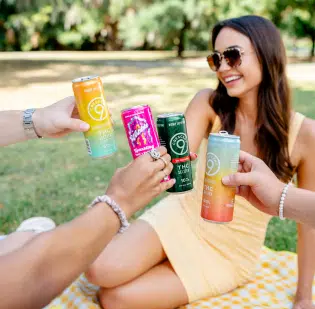
Across Manhattan’s most socially active circles – hedge fund dinners, art world gatherings, and the media industry’s endless parade of launch events – a shift is underway. People who used to arrive at parties and default to a Negroni or a glass of Chablis are reaching for something different. Sparkling cans, dark glass bottles, and clear tonics that blend in effortlessly with the rest of the barware. All of them are infused with low-dose THC.
The shift isn’t loud. It wasn’t announced. But it’s real, and it’s spreading faster than most people outside those circles realize.
What’s Actually in the Glass
The category covers more ground than the term “THC drink” suggests. Products range from sparkling water-style seltzers with a single milligram per serving to hop-infused drinks designed to sit alongside craft beer at a dinner table. There are functional blends that add adaptogens, CBD, or sleep-supporting herbs alongside the THC. There are micro-dosed shots for people who want something closer to a capsule than a cocktail.
What the better products share is nanoemulsion technology – a process that breaks THC into microscopic water-soluble particles, allowing onset within 15 to 30 minutes rather than the 90-minute delay associated with traditional edibles. That timing is close enough to the effect curve of a glass of wine to work in a social setting where you want to feel something before dessert, not after you’ve already called a car.
| Format | Typical THC dose | Best used for |
| Sparkling seltzer | 2.5mg – 5mg | Cocktail parties, casual socializing |
| Hop-infused beverage | 5mg – 10mg | Dinner settings, beer substitution |
| Functional blend (adaptogen/CBD mix) | 2.5mg – 5mg | Wellness-focused occasions, daytime events |
| Micro-dosed shot | 1mg – 2.5mg | First-timers, low-tolerance preference |
The industry behind these products has grown fast. According to a report from Whitney Economics, THC beverage sales across the U.S. exceeded $1 billion in 2024, spanning both dispensary and direct-to-consumer channels. The same report projects the category could reach between $9.9 billion and $14.9 billion if even a fraction of current alcohol consumers make any degree of substitution.
Among the products drawing attention from this crowd, hemp-derived options like those in the Crescent Canna THC drinks range represent the kind of offering that resonates here – clearly labeled on dosing, available outside the dispensary channel, and accessible through direct-to-consumer ordering. That last point matters. Not everyone in this demographic wants to pick up a product at a cannabis retail store. Removing that friction has brought a lot of people into the category who were curious but waiting for a less conspicuous entry point.
The Sober-Curious Movement Finds Its Finishing Move
For about a decade, the broader cultural conversation around alcohol has been quietly shifting. The “sober curious” label – coined by journalist Ruby Warrington in 2018 – captured a mood that wasn’t about addiction or abstinence but about questioning why drinking was the automatic social default. The concept landed in wellness circles first, then yoga studios, then gradually in the kinds of restaurants where a reservation requires six weeks’ notice.
What was missing was a credible social alternative. Mocktails filled some of that gap, but sparkling water with muddled herbs only goes so far at a dinner party where everyone else is on their third glass of natural wine.
THC drinks completed that equation. They offer what non-alcoholic options couldn’t – a genuine effect. A mild one, typically dosed at 2.5mg to 5mg per serving, which produces light relaxation without impairment. For a social scene that prizes being articulate and present above all else, that dose range turned out to be exactly right.
What specifically made THC beverages click for this crowd when nothing else had:
- Actual effect – unlike mocktails, a low-dose THC drink produces perceptible relaxation, which matters in high-stress social environments
- No stigma – consumed from a glass or can, they’re visually indistinguishable from any other drink at the bar
- Precise dosing – 2.5mg to 5mg per serving keeps the effect light and controllable, well within functional range
- Clean ingredients – premium products skip artificial sweeteners and mystery additives, fitting neatly into a wellness-conscious lifestyle
- Fast onset – nanoemulsion technology brings the effect on within 15 to 30 minutes, close enough to alcohol’s timeline to work socially
Consumer research supports the momentum. Data from CivicScience found that roughly one in six American adults already consumes cannabis beverages at least occasionally – and that the same consumers tend to score higher on interest in wellness and organic products than average. That profile maps closely onto the demographic shaping New York’s upscale social calendar.
Anyone tracking New York lifestyle trends across food, fashion, and city living in recent years would have seen this coming. The wellness-luxury crossover has been one of the most durable forces in Manhattan culture, and THC beverages fit that intersection precisely – they look discreet, taste good, and signal something considered about the person holding them.
New York’s Market Is Moving Differently Than You’d Expect
Not every city is experiencing this shift in the same way. THC beverages are growing nationally, but New York carries specific dynamics that are accelerating uptake at the upper end of the social market.
The city legalized adult-use cannabis in 2021, and the retail infrastructure – while still building out – has matured enough that the product category is no longer hard to find. More significantly for the premium segment, brands with strong design, credible ingredients, and clear dosing have moved into direct-to-consumer and hospitality-adjacent channels that reach exactly the audience willing to pay more for a better product.
Grand View Research projects the global cannabis beverages market will grow from $1.16 billion in 2023 to $3.86 billion by 2030, at a compound annual growth rate of 19.2%. North America accounts for more than 72% of total market revenue, and the THC-dominant segment leads within that – driven by adults seeking an alternative to alcohol rather than a supplement to it.
A few factors make New York a particularly fast-moving market within that broader picture:
- Legal infrastructure – adult-use legalization in 2021 normalized the category and opened the door for mainstream retail and DTC channels
- Premium audience density – the city’s concentration of high-income, health-conscious professionals creates a ready market for upscale THC products
- Novelty premium – unlike mature markets like California and Colorado, New York’s category hasn’t been commoditized yet, so premium products still carry differentiation
- Hospitality crossover – upscale venues and private event caterers are beginning to include THC beverage options, bringing the product to people who might never have sought it out independently
New York, alongside Michigan and Ohio, is specifically tracked as an emerging high-growth state for cannabis beverage sales. Newer markets tend to see faster acceleration in the premium tier because the category hasn’t been commoditized yet. Manhattan’s social scene is encountering these products at the right point in the lifecycle – visible enough to feel culturally credible, exclusive enough to still carry some novelty.
The Social Mechanics of THC at a Party
What makes THC beverages work in upscale social settings that other cannabis formats don’t is visibility. A gummy consumed quietly in a coat closet reads differently from a drink held openly at a cocktail party. The latter reads as normal social behavior. The former signals that something is happening outside the mainstream.
Drinks are social objects. They signal participation. Holding a glass – whether it contains wine, a mocktail, or a lightly carbonated THC seltzer – keeps someone inside the visual grammar of a party in a way that no other format manages. That matters in rooms where being present and polished is the entire point.
There’s also the conversation factor. Showing up with an interesting THC drink at a dinner in Tribeca or a private event on the Upper East Side is, right now, still a conversation starter. That will change as the category matures and becomes unremarkable. For now, it carries some of the same social currency that came with being an early adopter of natural wine or single-origin spirits in the early 2010s.
The practical implications for the broader culture of luxury living in New York are still unfolding. High-end venues are starting to add THC beverage options to their drink programs – a signal that this is shifting from guest-supplied novelty to something catered establishments plan around.
The Morning-After Calculation
There’s a version of this trend that gets oversimplified: people are choosing THC drinks instead of alcohol because they want to avoid hangovers. That’s part of it, but it’s not the whole story.
A more accurate framing is that the trade-off calculation has changed. Someone attending three or four evening events per week – a common schedule in the circles where this trend is concentrating – faces a cumulative cost from drinking that’s different from what it looked like at 25. Sleep quality, morning performance, and the compound effects of regular alcohol consumption become more visible with time.
| Alcohol (2-3 drinks) | Low-dose THC drink (5mg) | |
| Onset | 15 – 20 min | 15 – 30 min (nanoemulsion) |
| Duration | 3 – 5 hours | 1.5 – 3 hours |
| Morning after | Possible headache, disrupted sleep, dehydration | Typically unremarkable |
| Calorie load | 300 – 500 calories | Usually under 50 calories |
| Next-day performance | Often compromised | Unaffected |
THC at a low dose doesn’t eliminate trade-offs, but it changes their nature. The effect is lighter, the duration shorter, and the following morning is typically unremarkable – no headache, no dehydration, no particular fatigue. For someone who needs to be sharp at 7:30am regardless of what happened at the dinner the night before, that difference compounds.
It’s also worth being precise about what low-dose THC doesn’t do. At 2.5mg to 5mg per serving, the effect sits closer to a second glass of wine than to anything associated with recreational cannabis. People aren’t getting noticeably high at cocktail parties. They’re getting slightly, controllably relaxed – and in a crowd highly attuned to social composure, that distinction is the whole point.
The Party Hasn’t Changed
Manhattan has always been a fast-moving market for social behavior. Ideas that start in niche circles tend to normalize quickly once they reach critical mass in the right rooms. THC beverages have now reached those rooms.
The shift isn’t coming from cannabis culture. It’s coming from people who care about how they feel, how they perform, and how they present themselves – and who found that the product fits their lifestyle better than what it’s replacing. Whether that becomes a permanent feature of New York’s social landscape depends partly on regulation, partly on how the category continues to develop, and partly on whether brands can keep pace with what a discerning audience actually wants.
Right now, all indications are pointing towards one direction. The glass has changed. The party hasn’t.