Everything You Need to Know About Gabriel Fernandez’s Death
Everything You Need to Know About Gabriel Fernandez’s Death
The Case That Shocked America: What Happened to Gabriel Fernandez
Gabriel Fernandez was an 8-year-old boy from Palmdale, California, who died on May 24, 2013, after enduring eight months of severe abuse and torture. Although the case originated in California, the story of Gabriel Fernandez has become a focal point for child advocacy discussions in New York and across the nation.
Here are the key facts at a glance:
- Who: Gabriel Fernandez, born February 20, 2005
- What: Systematic torture and murder by his mother and her boyfriend
- When: Abuse began September 2012; Gabriel died May 24, 2013
- Where: Palmdale, California
- Perpetrators: Pearl Fernandez (mother) — life without parole; Isauro Aguirre (boyfriend) — sentenced to death
- Systemic failure: Despite over 60 reports to child services and repeated alerts from his teacher, Gabriel was never removed from the home
This case is one of the most devastating child abuse cases in modern American history. It exposed deep failures in the child welfare system — failures that cost a little boy his life and led to calls for reform from Richmond to New York City.
The case later became the subject of a Netflix documentary, The Trials of Gabriel Fernandez (2020), which brought global attention to what went wrong and why.
Below, we cover everything you need to know — from the timeline of abuse, to the legal outcomes, to the systemic reforms (or lack thereof) that followed.
The Tragic Life and Death of Gabriel Fernandez
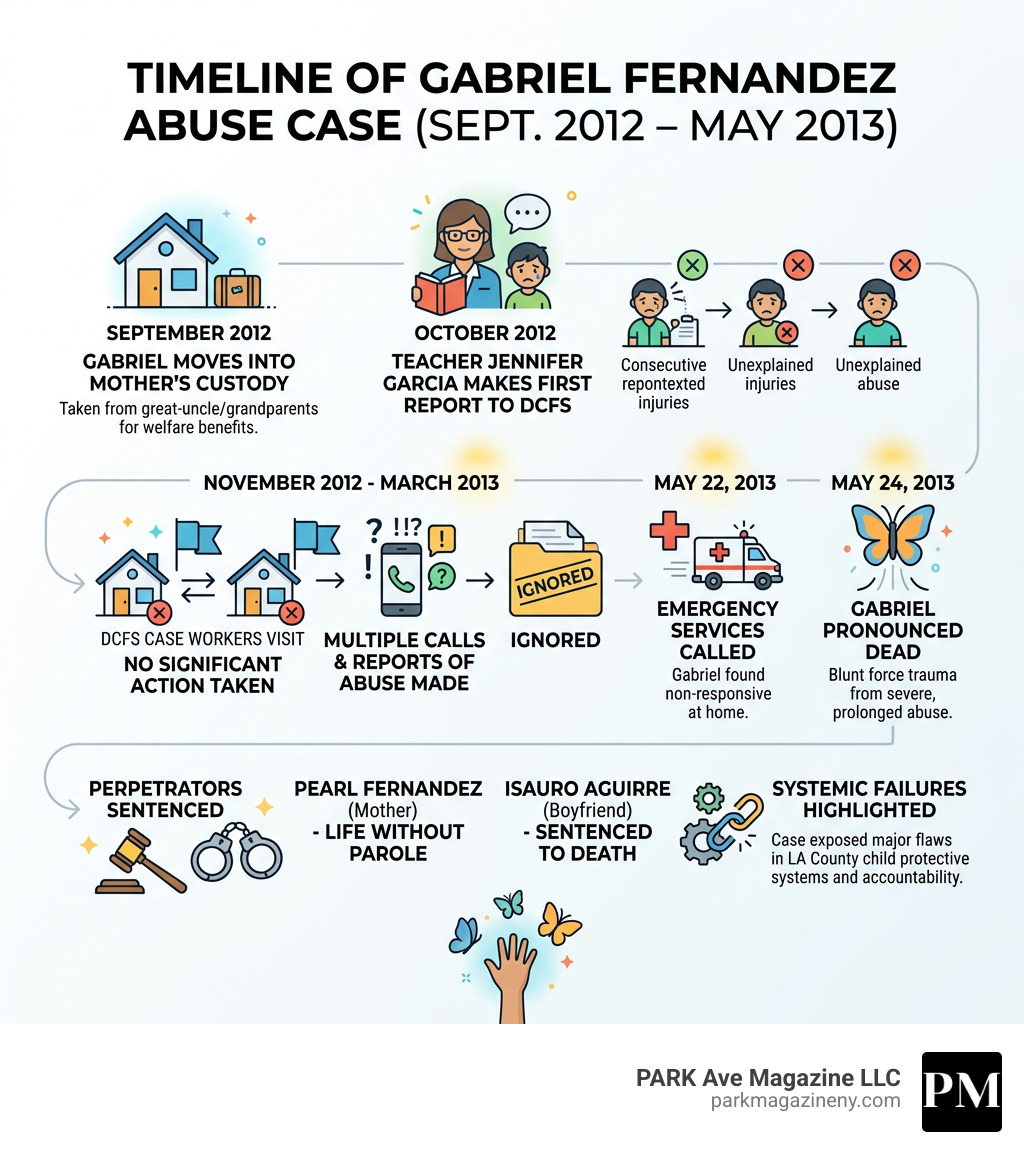
The story of Gabriel Fernandez is one that stays with you. At just 8 years old, Gabriel’s life was cut short by unimaginable cruelty. He was a boy who, by all accounts from those who knew him early on, was full of love. He spent much of his early life with his great-uncle and his grandparents, where he was described as a happy child. However, in late 2012, his mother, Pearl Fernandez, took custody of him—reportedly to claim welfare benefits. This move marked the beginning of a horrific eight-month descent into darkness.
On May 22, 2013, paramedics were called to a home in Palmdale after a report that a child was not breathing. Pearl and her boyfriend, Isauro Aguirre, initially claimed Gabriel had fallen and hit his head on a dresser. When medical professionals arrived, they found a boy who was brain dead, covered in bruises, and suffering from a cracked skull and broken ribs. He was officially pronounced dead on May 24, 2013. The cause of death was blunt force trauma, aggravated by months of malnutrition and systematic neglect. For those interested in the cinematic deep dive into these events, The Murder of 8-year-old Gabriel Fernandez, a Netflix Documentary provides a haunting look at the evidence.
The Timeline of Abuse for Gabriel Fernandez
The abuse did not happen all at once; it was a calculated, daily campaign of torture that lasted from September 2012 until his death in May 2013. Court testimony from Gabriel’s siblings revealed a living nightmare. He was frequently bound and gagged, forced to sleep in “the box”—a small, locked kitchen cabinet where he was kept for hours at a time.
The physical evidence found during the autopsy was staggering. Gabriel had BB gun pellets lodged in his skin and even his lung. He suffered from cigarette burns all over his body and was beaten with bats, belts, and golf clubs. Perhaps most disturbingly, he was subjected to psychological torture, including being forced to eat cat feces and vomit. The sheer scale of the “diabolical” actions—as described by the sentencing judge—is almost too much to comprehend.
Reporting the Signs of Torture
One of the most frustrating aspects of this case is that people did try to help. Jennifer Garcia, Gabriel’s teacher, was a hero in this story. She noticed the signs of abuse early on. Gabriel would come to school with bruises, missing patches of hair, and even injuries from a BB gun. As a mandated reporter, Garcia did exactly what she was supposed to do: she called the authorities.
Over the course of eight months, at least 60 calls were made to the Los Angeles County Department of Children and Family Services (DCFS) regarding Gabriel. Despite these red flags, the system failed to remove him. Social workers often accepted the mother’s excuses at face value, sometimes without even interviewing Gabriel privately.
The Perpetrators: Pearl Fernandez and Isauro Aguirre
The two people responsible for this tragedy were Pearl Fernandez and her boyfriend, Isauro Aguirre. During the 2017 trial, the prosecution painted a picture of two individuals who worked in tandem to break a child’s spirit. While the defense tried to portray Aguirre as a “kind” man who simply lost his temper, the evidence of prolonged torture suggested otherwise. To learn more about the advocacy groups focusing on such cases, you can visit isauro Aguirre | Invisible Children.
The Role of Isauro Aguirre in the Murder
Isauro Aguirre, a former security guard, was the primary physical enforcer of the abuse. Prosecutors argued that one of his main motives for the specific type of torture Gabriel endured was a belief that the boy was gay. Aguirre was convicted of first-degree murder with the special circumstance of intentional murder by torture. He was sentenced to death and is currently on death row at San Quentin State Prison. However, due to the current execution moratorium in California, his sentence remains in a state of legal limbo.
The Background of Pearl Fernandez
Pearl Fernandez’s history was also scrutinized during the trial. She had a long history of neglect involving her other children and had been diagnosed with various mental health issues and a low IQ. However, the prosecution maintained she was the mastermind who manipulated Aguirre and directed much of the abuse. To avoid a potential death sentence, Pearl pleaded guilty to first-degree murder in 2018. She was sentenced to life in prison without the possibility of parole.
Systemic Failures: Why the Child Welfare System Failed Gabriel
We often look to the child welfare system as a safety net, but in the case of Gabriel Fernandez, that net was full of holes. The Los Angeles County DCFS was heavily criticized for its handling of the case. These failures serve as a somber case study for social services nationwide, including those serving the New York and Richmond areas, highlighting the dire need for accountability.
Social workers failed to follow up on multiple reports, and some were even accused of falsifying records to make it look like they had performed checks they hadn’t.
In an unprecedented move, four social workers and their supervisors were actually charged with child abuse and falsifying public records. However, in 2020, an appeals court dismissed these charges, ruling that the workers did not have the “requisite duty” to prevent the crime under the specific laws they were charged with. This decision sparked further public outrage, as many felt that the people paid to protect Gabriel were being let off the hook for their negligence.
Legal Outcomes and the Current Status of the Case
The legal proceedings for this case spanned several years. While the perpetrators were ultimately sentenced, the fight for justice continues in the form of appeals and petitions. The community has not forgotten Gabriel; memorials and “Justice for Gabriel” groups continue to advocate for child welfare reform in his name.
Recent Developments for Pearl Fernandez
Even after being sentenced to life without parole, Pearl Fernandez has attempted to challenge her conviction. In 2021, she filed a petition for re-sentencing, citing changes in California state law (specifically Senate Bill 1437) regarding the felony murder rule. Her request was denied by Judge George Lomeli, who presided over the original trial. He noted that Pearl was a “major participant” in the torture and murder, making her ineligible for relief under the new law. As of 2025, she remains incarcerated at the Central California Women’s Facility.
Media Impact: The Trials of Gabriel Fernandez on Netflix
The 2020 release of the Netflix docuseries The Trials of Gabriel Fernandez brought the case back into the global spotlight. Directed by Brian Knappenberger, the series was praised for its thoroughness but criticized by some for being “insoutenable” (unbearable) to watch due to the graphic nature of the crimes. It served as a powerful piece of social justice journalism, highlighting not just the crime, but the systemic rot that allowed it to happen.
Frequently Asked Questions about Gabriel Fernandez
What happened to the social workers in the Gabriel Fernandez case?
Four social workers—Stefanie Rodriguez, Patricia Clement, Kevin Bom, and Gregory Merritt—were initially charged with child abuse and falsifying records. However, in 2020, the California 2nd District Court of Appeal ruled that they should not face criminal charges, leading to the dismissal of the case.
Is Isauro Aguirre still on death row?
Yes, Isauro Aguirre is currently on death row. While he has been sentenced to death, California’s moratorium on the death penalty means that no executions are currently being carried out in the state.
Why did Gabriel’s mother receive life in prison instead of the death penalty?
Pearl Fernandez chose to take a plea deal in February 2018. By pleading guilty to first-degree murder and admitting to the special circumstance of murder by torture, she avoided a trial where she could have faced the death penalty.
Conclusion
The legacy of gabriel fernandez is a somber reminder of our collective responsibility to protect the most vulnerable members of our society. While the legal system eventually punished the perpetrators, the systemic failures that preceded Gabriel’s death suggest that there is still much work to be done in child advocacy and welfare reform.
At PARK Ave Magazine LLC, based in New York with a presence in Richmond, we believe that awareness is the first step toward change. Whether through philanthropy, supporting urban safety initiatives, or simply being a more vigilant neighbor, we can all play a part in ensuring that no child has to endure what Gabriel did. For more stories on the intersection of Explore more about art and culture in NYC, visit our main site to see how community and culture can foster a safer, more sophisticated world.