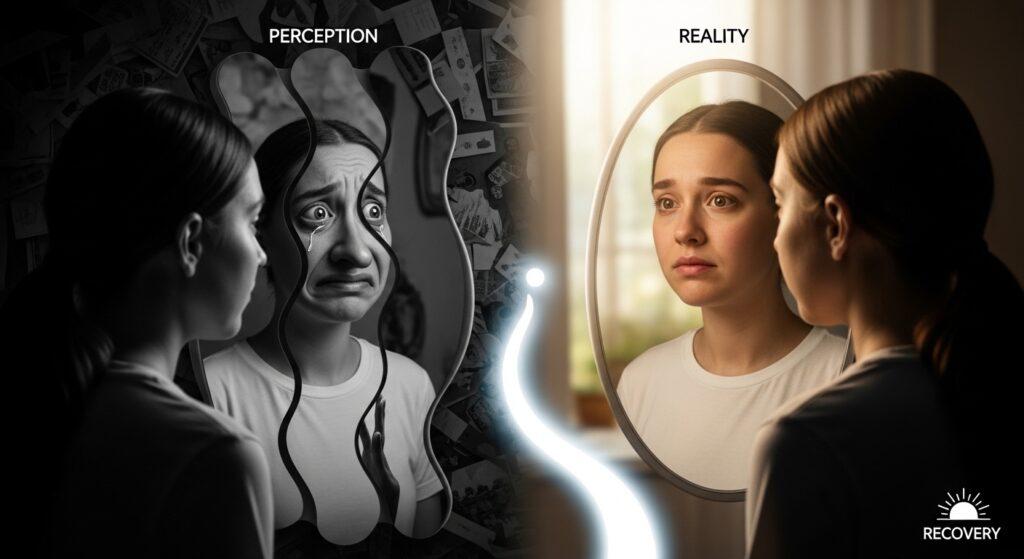
Body Dysmorphic Disorder: Perception, Reality, and Recovery
There’s a particular moment many of our clients describe. You’re about to join a video call, and you catch your reflection in that tiny preview square. Everything narrows; the agenda, the people waiting, the point of the meeting, gone. Your attention hooks onto one feature: the skin around your mouth, the shape of your nose, the way your hair sits. You adjust the angle, pull the window closer, maybe turn your camera off “just for today.” Your chest tightens. You think, if I can just fix this one thing, I’ll be able to focus. But the more you try to fix, the louder it gets.
If this is familiar, you might be dealing with Body Dysmorphic Disorder (BDD). It’s not vanity. It’s not being dramatic. It’s a stubborn anxiety loop that convinces you your appearance is wrong or unacceptable and then keeps you working overtime to “correct” it.
We’re Cognitive Behaviour Therapy Toronto. We sit with people in this loop every week: students who dodge photos, professionals who plan commutes around bright sunlight, new parents who love their baby but dread anyone posting a candid. This is heavy. And also: it’s workable.
What Bdd Feels Like From The Inside
Textbooks say “preoccupation with perceived flaws.” Accurate, sure, but a bit bloodless. From the inside, it often looks like:
- A pull toward mirrors and front-facing cameras: checking, zooming, re-checking.
- Or the opposite: avoiding every reflective surface, keeping cameras off, dimming lights.
- Reassurance hunts (“Is it obvious?” “Do I look strange?”) that calm you for five minutes and then vanish.
- Camouflage and rituals: makeup adjustments, specific angles, hats, filters, retouching.
- Endless comparison: friends, strangers, old photos of yourself.
- Anxiety that spikes before dates, presentations, family gatherings, and gym classes.
BDD can latch onto any feature. It can even latch onto a feeling of wrongness that’s hard to name. You might know your thoughts are extreme and still feel completely convinced in the moment. That mismatch, “I know, and I still feel it,” is common. You’re not failing logic; your nervous system is loud.
Why The Loop Sticks (And Why It’s Not Your Fault)
BDD survives on short-term relief. You feel a surge of anxiety, so you check, tweak, cover, or avoid. Anxiety dips for a moment. Your brain stamps that behaviour as “helpful,” and next time the urge arrives, it recommends the same move. The relief shrinks with time; the rituals grow. Life gets smaller to make space for managing the worry.
There’s also a style-of-mind piece. Many people with BDD are excellent detail noticers (a strength at work or school) and are less able to zoom out when stressed. Add perfectionism, social media highlight reels, and the general pressure to “present well,” and the conditions are ripe for BDD to dig in.
The hopeful part: what’s learned can be unlearned, not with pep talks, but with practice.
What Effective Treatment Actually Looks Like
Evidence-based body dysmorphic disorder treatment usually involves Cognitive Behaviour Therapy (CBT) with Exposure and Response Prevention (ERP), plus some acceptance and mindfulness skills. That’s a mouthful. In plain language, we teach your brain that you can live without feeding the rituals. Here’s how we approach it in our clinic:
1) Map your pattern, gently
We look at the who/what/where: which features; which situations (gyms, cafés, meetings, FaceTime); what thoughts show up; what rituals you lean on (checking, camouflaging, asking for reassurance, retouching). No judgment. A small tracking exercise for a week is usually enough to spot the tightest part of the loop.
2) Turn down the rituals (without going to war)
Response prevention means practising not doing the thing that brings short-term relief but keeps anxiety strong long-term. That might look like: mirrors on a schedule (shorter, kinder, no zoom), using one light instead of three, leaving home without a hat, limiting reassurance to one check-in with one person, or posting a photo without editing. Tiny steps. Repeated. Your nervous system learns, “I can survive this.”
3) Step into avoided moments (on purpose, in order)
Avoidance feels safe and grows fear. We build a ladder, from easiest to hardest, and climb slowly. First: two minutes on camera. Later: the whole meeting. First: a walk at dusk. Later: midday sun. The goal isn’t to love your reflection. The goal is to do the important stuff even when your brain is noisy.
4) Train a wider lens
BDD makes you zoom in. We practice zooming out. Whole face, whole scene, whole day. Notice your friend’s expression during your story. Pay attention to the conversation, the music in the café, the feel of your feet on the ground. Your appearance can matter, and it can take up less space.
5) Update the story
Perfectionistic rules sneak in quietly: “If I don’t look right, people won’t respect me.” We don’t replace them with unrealistic affirmations. We test them. We build statements you can actually stand on: “My value isn’t decided by a camera angle,” “I can be seen as I am,” “Connection beats perfection.” It won’t feel true instantly. Repetition gives it weight.
6) Grow a life, BDD can’t swallow
Recovery is not only subtracting rituals; it’s adding meaning. Movement that feels good. Hobbies that remind you you’re capable. People who are safe to practise with. Boundaries around screens. More sleep. More sunlight. BDD prefers a narrow life; we widen it.
What Progress Looks Like (Before The Mirror Agrees)
If you only measure “how much I like my appearance,” you’ll miss wins. Look for these:
- You spend less time checking and bounce back faster when you do.
- You keep your camera on for the first ten minutes, then forget about it.
- You tolerate an unflattering photo and stay at the event.
- You ask for less reassurance. You live with a little uncertainty and discover it’s survivable.
- Your self-talk softens from “I can’t show up like this” to “I’m allowed to be here.”
Often, confidence follows behaviour, not the other way around.
Medication And Teamwork
For some people, adding medication (commonly an SSRI) helps turn the volume down enough for therapy to take root. Not everyone needs it. If it’s relevant, we’ll coordinate with your physician or psychiatrist and keep the plan cohesive.
For Parents, Partners, And Friends
Please don’t play appearance police. It rarely helps. Try this instead: agree on a shared plan (e.g., “two-minute mirror, twice a day”) and offer to practise together. Swap reassurance for presence: “I’m here; let’s stick to the plan.” Celebrate process wins: “You joined the call, nice work.” Keep shared spaces kinder (fewer magnifiers, softer lighting). Curiosity loosens the loop; criticism tightens it.
Starting Now Beats Waiting For A Perfect Week
There’s no magical stretch of days with perfect lighting and zero self-consciousness. There’s this week. Starting BDD treatment doesn’t require loving how you look. It asks for willingness to try small experiments and score them by freedom gained: minutes saved, calls joined, plans kept, energy back.
At Cognitive Behaviour Therapy Toronto, sessions are structured and warm. First meeting: we map your loop and set two or three experiments you can try right away. Between sessions, you’ll have a short plan on your phone: a mirror schedule, a couple of doable exposures, a script for tough thoughts, and grounding tools that take less than two minutes. We measure what matters to you and build relapse-prevention early, so you’re set up to keep progress going on your own.
You don’t have to be perfectly motivated. Curious is enough. Tired of this is enough.
A Tiny Practice For This Week
Pick one ritual to trim, and one avoided step to approach. Keep both small.
- Ritual: mirror use to two short check-ins a day, no zoom.
- Avoidance: attend the first five minutes of a call with your camera on.
- Support: text one friend who can reply, “Proud of you. Back to your day.”
- Script: “My brain is loud. I can still choose what I do.”
Write down what changed in your day, not your face: time saved, connection made, task finished. Those are the markers that add up.
When you’re ready to build a plan that sticks and to have a clinician in your corner, we’re here to help. Learn more about our approach to body dysmorphic disorder.