How Ambient Temperature and Airflow Affect Dehumidifier and Drying Equipment Performance
If you spend any time working with dehumidifiers or drying equipment, you already know that ambient temperature and airflow matter more than the typical user realizes.
Mess up either one and your equipment won’t run efficiently, wasting energy or struggling to complete the task at hand.
But did you know that temperature and airflow interact with each other in ways that can save you time and money if you understand them?
Let’s look closer at the effects that temperature and airflow have on your dehumidifiers and drying equipment.
Effects of Ambient Temperature on Dehumidifiers
Ambient temperature refers to the temperature of air within the space your equipment occupies. Naturally, that temperature directly affects how quickly or slowly a dehumidifier can remove moisture from that air.
Provided the air isn’t too hot or too cold, most refrigerant dehumidifiers work well between 15°C and 25°C (59°F and 77°F). Within that range, the machine can achieve ideal moisture removal without needing excessive amounts of energy. Once you move outside that temperature range, however, problems can arise.
In hot conditions, refrigerant dehumidifiers actually excel. Hot air contains more moisture, and the coils in your machine can extract that moisture quickly. One common unit removed about 100 liters of water per day at 25°C. The same unit was only able to remove about 60–70 liters per day at 5°C. That is a reduction of 30–40% just by adjusting the temperature.
Cold temperatures cause even more problems. When ambient temperature gets too low, the evaporator coil itself may begin to freeze. Once frost forms on the coil, the unit won’t extract moisture until it runs a defrost cycle. That costs time and energy without doing anything to dry the air.
Desiccant dehumidifiers don’t share this problem. Since desiccant dehumidifiers use adsorption rather than condensation to extract water from the air, cold temperatures don’t affect them. That makes them ideal for drying out cold storage rooms, crawl spaces during the winter, or any other application where temperatures may fall below 15°C.
How Temperature Impacts Drying Equipment
Like dehumidifiers, all drying equipment must move moisture out of an enclosed space or material. As you might guess, temperature has a huge impact on that process.
Hotter air can hold more water vapor. This means moisture evaporates from the material faster and is able to mix into the surrounding air more easily. But faster isn’t always better. High temperatures can damage some materials, cause case hardening, or unevenly dry delicate items. Case hardening is when the outside of a material dries too quickly, leaving moisture trapped inside.
Industrial drying equipment is often carefully calibrated to provide the ideal drying temperature for each material loaded into it. Many operators use variable frequency drives to adjust fan speeds and dial in both airflow and temperature at the same time.
Just like with dehumidifiers, finding the ideal temperature makes all the difference when drying.
Airflow Is (Almost) Equally Important
Air temperature tends to steal the spotlight, but proper airflow is every bit as important. Without proper airflow over the material being dried (or over the coils of a dehumidifier), your equipment cannot perform to its fullest.
Why? Simply put, moist air forms a boundary layer of humidity right around the object you’re trying to dry. This layer of high humidity air acts as a barrier that slows moisture transfer to the surrounding air. By moving that air, you eliminate the boundary layer and replace it with drier air.
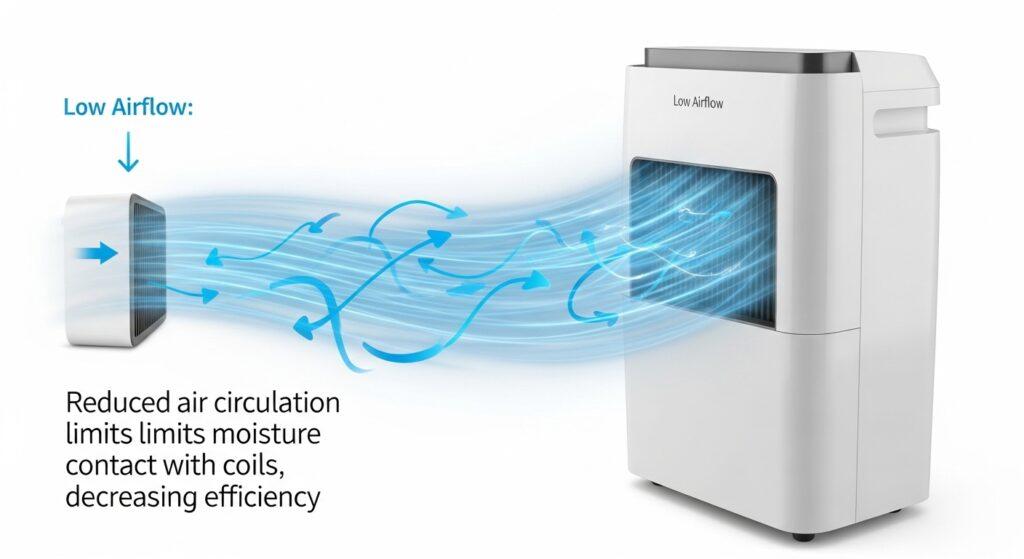
For dehumidifiers, the speed of your fan dictates how much air flows over the cold coils. More airflow translates to more humid air moving across those coils every minute. But more airflow isn’t always better.
Research published on dehumidifier performance actually recommends slowing fan speed. By doing so, the coils are allowed to become colder. A colder coil means a larger difference between the temperature of the coil and the dew point of the surrounding air. The greater that difference, the more efficiently condensation happens. One study found decreasing fan speed until the coils hit roughly 1°C resulted in a higher overall moisture removal rate.
Instead of always running your dehumidifier fan on high, find a medium setting that allows the coils to get as cold as possible. That will typically result in faster moisture removal.
Airflow Through Drying Equipment
Airflow through a drying system serves two primary functions: It delivers heat to the material being dried, and it carries moisture away. Both functions are required for rapid drying.
Low airflow won’t penetrate material piled or stacked inside the dryer. When that happens, moisture concentrates at the surface and refuses to leave. Not only will it take longer to dry everything, but your equipment will use more energy to do it. High airflow can be problematic as well, causing case hardening, uneven drying, or excessive stress to delicate materials.
Loading patterns become important here too. Overloading your dryer prevents airflow from moving between items. That traps moisture in pockets near the dried surface. Allowing enough space between your product lets air reach every surface and do its job.
In industrial dryers, the design of the machine itself dictates airflow. Things like duct size and placement, damper location, and more all affect air movement through the equipment.
Finding the Ideal Balance
Ambient temperature and airflow affect each other as well as drying performance. Without enough airflow, your dehumidifier or dryer can’t operate efficiently even if the temperature is set correctly. Conversely, crashing temperatures won’t do you any good if the airflow is blocked.
When possible, choose a dehumidifier that matches the environment it’ll need to work in. If your rooms are usually warm, go with refrigerant models. If you’re drying space with temperatures that often fall below 15°C, consider desiccant units.
Pay attention to fan speeds and adjust according to temperature and humidity levels, not comfort. Make sure air can move through and around your equipment, and keep everything cleaned so vents, ducts, and coils don’t become clogged. A little knowledge about temperature and airflow can have big impacts on your bottom line.
Case Study: Improving Dehumidifier Efficiency with Temperature and Airflow Conditions
Here’s a real world example: This performance test was completed in a building science lab located in North Carolina where technicians monitored and measured how much water their standard refrigerant dehumidifier removed from the air under various temperature and airflow conditions.
Key findings from their test include:
- 50 liters per day removed at 25°C (77°F) and medium airflow.
- 30-40% less moisture removed (roughly 60-70 liters/day) when tested at 5°C (41°F), provided airflow remained constant.
- Improved removal back up to ~100 liters/day when fan speed was reduced from high to medium. Lower airflow allowed the coils to chill farther, increasing the temperature differential for moisture condensation.
Notice how neither temperature nor airflow was manipulated independently during this experiment. Paired together, drying technicians and HVAC engineers were able to vastly improve energy efficiency as well as total drying capacity by matching ambient conditions with proper airflow velocities.
Humidity levels affect the capacity of your dehumidifier
➡️ Read Full Article: https://www.achrnews.com/articles/142497-a-look-at-dehumidifier-performance‑in‑various‑conditions
Learn more about how improving temperature and airflow conditions can lead to increased dehumidification and real measurable gains in your drying projects.
ANSWER: Frequently Asked Questions (FAQ)
How does ambient temperature impact dehumidifier performance?
Ambient temperature greatly impacts how much moisture is present in the air. The higher the temperature, the more water vapor the air can hold. Refrigerant dehumidifiers work best when they can extract moisture out of warm air. If you lower the temperature too far, water removal abilities will decrease due to less moisture being present in the air.
Do desiccant dehumidifiers work in cold temperatures?
Yes! Because they utilize adsorption instead of condensation to remove moisture from the air, you don’t need to worry about ambient temperatures dropping below 15°C (59°F). This is ideal for drying spaces with below average temperatures such as cold rooms and outdoor projects in the winter months.
Is it possible to have too much airflow when dehumidifying/drying?
Absolutely! While you want enough airflow to eliminate the boundary layer that surrounds wet materials, too much air movement can actually be detrimental to drying performance. Your ventilation system uses energy to move air, so you want to be sure you aren’t wasting energy moving more air than you need to successfully dry the material.
What is a boundary layer and how does it impact drying?
Boundary layers are thin layers of air that cling to wet surfaces. This air is usually more humid than the air moving across the material. When there is little to no air movement, this boundary layer acts as a barrier and slows down the rate of evaporation. By eliminating the boundary layer with good airflow, you can speed up drying rates and improve dehumidification.
Should I run my dehumidifier’s fan at full speed all of the time?
Not necessarily. Some studies have shown that by lowering the fan speed on your dehumidifier, the coils are able to cool lower temperatures and create a larger differential between coil temperature and dew point of the surrounding air. This can actually improve condensation rates (removal of moisture from the air). Many studies have shown that using a medium airflow setting is the most efficient at producing the best ratio of energy-to-moisture removed.
How does airflow impact drying equipment such as industrial dryers?
Similar to dehumidifiers, if you do not provide enough airflow, you will not be able to transport moisture away from the material quickly enough. If you force too much air across the material, you can actually cause issues such as case hardening. Like above, it is important to find a happy medium when designing your drying system.
What’s the ideal temperature/airflow relationship?
There really is no definitive answer to this question. However, some general rules include:
- The warmer and drier the air is, the less airflow you will need to achieve rapid evaporation.
- The colder the ambient temperature becomes, the more you should consider using a desiccant dehumidifier over a refrigerant dehumidifier.
- Optimizing your fan speed to better match ambient conditions can outperform units that run 100% all of the time.
Always ensure you have good airflow paths and keep coils, vents, and ducts clean.