How to Choose a Dainty 14K Gold Necklace for Long-Term, Timeless Wear
I once watched a client agonize over two nearly identical gold chains. One was solid 14K with a laser-welded lobster clasp. The other was gold-plated brass with a spring ring.
Both looked flawless under boutique lights. Three months later, the plated chain had brassed at every friction point, and the 14K piece still looked new.
That’s the gap between buying on aesthetics and buying on specs.
Modern wardrobes lean on slim gold chains that work at a boardroom table or on holiday without calling attention to themselves. Dainty doesn’t have to mean delicate, but only if you choose based on measurable criteria.
Use the framework below to confirm gold content, pick link styles that survive daily wear, size and layer without tangles, and vet sellers with real provenance standards.
What 14K Actually Means and How to Verify It
Verify fineness and maker accountability before you fall for a design.
Karat measures the fraction of pure gold in an alloy. 14K means 14 parts gold out of 24, about 58.3% pure gold. Depending on where the piece was made, the stamp may read 14K, 583, or 585.
In the United States, karat marks typically appear alongside a company name or registered trademark under the FTC Jewelry Guides. On dainty necklaces, look on the clasp tag, the clasp itself, or inside a pendant bail.
A karat stamp without a maker’s mark is a weaker signal. A maker’s mark adjacent to the fineness mark tells you someone, not “the internet,” stands behind the work. When buying vintage or shopping across borders, 14K and 585 are equivalent and both legitimate.
Stamps still aren’t proof. Ask for a receipt that lists karat, gram weight, and metal color, then compare how the chain feels for its size. Solid 14K has a density around 12.8 to 13.1 g/cm³, so it won’t feel weightless for its volume.
Visually, check high-wear points. Color should stay consistent at edges, around jump rings, and near the clasp. Any brassing at friction points suggests plating, not solid gold.
Three Reasons 14K Wins for Everyday Wear
14K gives you practical durability without losing the warmth people want from gold.
Practical hardness. Vickers hardness (HV) is a standard way to compare scratch resistance in metals. Common 14K yellow alloys often test around 134 to 165 HV, versus roughly 115 to 160 HV for popular 18K yellow alloys.
On slim links and micro-clasps, that difference shows up as fewer visible scuffs, less stretching, and better long-term shape.
Lower maintenance. 14K resists everyday bumps better than softer alloys. White 14K is usually rhodium-plated for brightness, and that surface will wear over time and need re-plating. Yellow and rose 14K avoid that cycle.
Value in use. If you divide purchase price by days worn, solid 14K tends to outperform vermeil or gold-filled options under constant friction from pendant swaps and layering adjustments.
Chain Architecture: Choose Links That Last
Your link pattern determines kink resistance, repairability, and how well a pendant sits.
- Cable: Classic oval links, versatile and pendant-friendly. Choose 0.9 to 1.3 mm for a dainty daily stack.
- Box: Squared links with a sleek profile. Works well with tiny solitaires. Avoid widths below 0.7 mm if you swap pendants often.
- Wheat: Braided ovals that feel supple yet sturdy. Strong as a textured middle layer.
- Curb and micro-Cuban: Flattened interlocking links with excellent drape and durability. Around 1.2 to 1.5 mm reads refined, not heavy.
- Rope: Twisted strands that hold up well in tighter braids. Repairs get harder if the chain is hollow, so choose solid construction for daily wear.
- Snake and herringbone: Fluid and reflective, but best worn solo on low-friction days and stored flat. Both can kink permanently, and repairs are often limited.
A reliable rule is to avoid hollow links for high-rotation pieces. Solid or semi-solid construction adds a few grams, then pays you back in serviceability.
Length and Proportion: Fit Rules for a Timeless Stack
Start with an 18-inch anchor, then stagger by two inches to keep layers distinct and less tangle-prone.
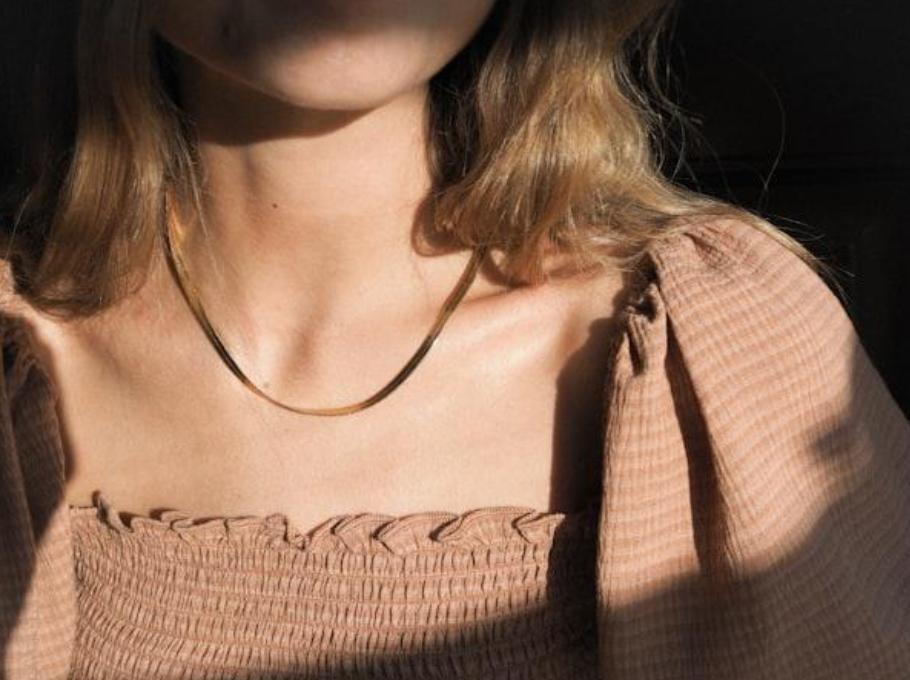
Standard necklace lengths follow established names. Collar sits at 12 to 14 inches, choker at 14 to 16, princess at 17 to 19, matinee at 20 to 25, opera at 26 to 36, and rope at 37 inches or longer. For everyday wear, 18 inches is the default choice for most people.
For quick sizing, measure your neck circumference and add two inches for a close fit. Then add two and four inches for your second and third layers. That spacing keeps the stack readable and reduces clasp-to-chain snagging.
Use outfits to sanity-check. High crewnecks usually look better at 20 to 22 inches, while a V-neckline often pairs well with a 16-inch chain plus a longer pendant layer.
Add an adjustable extender or one to two jump-ring links so you can fine-tune spacing across seasons without buying duplicate lengths.
Metal Color, Skin Sensitivity, and Clasps
Choose metal color for your wardrobe, then lock in security with the right clasp and finishing details.
Yellow 14K is the classic daily tone and pairs well with diamonds and pearls. Rose 14K gets its warmth from copper and adds depth in mixed-metal stacks. White 14K is typically nickel- or palladium-based and rhodium-plated for brightness.
The American Academy of Dermatology notes that more than 18% of people in North America are allergic to nickel. If you react, specify palladium-white alloys or stay with yellow and rose. If you mix metals, repeat your dominant color at least twice so the stack looks intentional.
For clasps, lobster closures are the everyday standard because they’re harder to pull open under tension. Spring rings can be fine at lower price points, but they’re easier to fumble one-handed. On dainty pieces, micro-lobsters around five to seven millimeters keep the proportions right.
Ask for soldered jump rings and closed chain ends. If you ever need repairs, request laser welding where appropriate, since it can reinforce tiny links with minimal heat spread.
Solid 14K Versus Vermeil, Gold-Filled, and Plated
Each category can make sense, but only solid 14K reliably holds up to daily friction for years.
Solid 14K is the same alloy through the full piece. It tolerates refinishing, it doesn’t wear through, and it keeps intrinsic value over time.
Vermeil is sterling silver plated with karat gold at an industry threshold of at least 100 micro-inches, about 2.5 microns. It can look excellent at purchase, but plating wears at contact points, especially where necklaces rub against each other.
Gold-filled uses a mechanically bonded layer of at least 10K gold. It’s thicker than standard electroplate, but longevity depends on the manufacturer’s layer thickness and how you wear it. Gold electroplate is typically the thinnest layer and wears through fastest with regular contact.
A simple decision rule helps: anything you touch daily, sleep in, or swap pendants on should be solid 14K. Lower-contact, occasional layers can be vermeil or gold-filled if you accept patina and eventual wear-through.
Where to Buy and How to Vet Sellers
Choose a buying channel that matches your need for documentation, servicing, and long-term repair support.
If you’re leaning toward a direct-from-atelier buy, treat the process like due diligence: confirm the piece is solid 14K, check that hallmarks and a maker’s mark are present, read the return terms, and ask for sourcing credentials that reference RJC standards or LBMA guidance so you know what you’re paying for. For a practical example of a direct-from-atelier option with clearly labeled solid 14K pieces across multiple chain styles and lengths, browse these 14k gold dainty necklaces.
Flagship boutiques often bundle aftercare, including polishing, clasp replacement, and repairs. Expect a detailed receipt that lists karat, gram weight, and metal color.
Direct-from-atelier purchases are ideal when you want a specific length, gauge, or finish. Ask for a maker’s mark, a clear repair policy, and confirmation the chain is solid, not hollow. A serious workshop can usually show process details, bench work, and how it controls quality.
Online luxury retailers require tighter scrutiny. Look for unambiguous labeling that states 14K or 585 and explicitly says solid versus plated. Confirm return windows, shipping insurance, and who pays return postage on fine jewelry.
Vintage and estate pieces deserve a loupe inspection. Verify hallmarks, request a recent independent appraisal when value is material, and budget for a professional cleaning plus a possible clasp upgrade.
Wherever you buy, run a provenance check. Look for a clear sourcing statement. Confirm membership in the Responsible Jewellery Council or supplier documentation aligned with RJC standards. Ask whether refining stock comes from LBMA-listed refiners, and check alignment with the World Gold Council’s Responsible Gold Mining Principles.
Skip vague “conflict-free” claims that don’t come with a traceable policy. In fine jewelry, clarity is a feature, not paperwork.
Care and Ownership Schedule
Simple, consistent care keeps dainty chains bright and reduces repair risk.
Daily and weekly: Put necklaces on after cosmetics and fragrance, then take them off before skincare at night. Wipe chains with a lint-free cloth after wear, and detangle layers before storing.
Monthly: Clean with warm water, a few drops of mild dish soap, and a soft brush. Rinse well and pat dry. Avoid chlorine bleach and chlorinated pool water, which can pit gold alloys over time.
Annually: Book an inspection for link thinning, worn jump rings, and clasp wear. If you wear station necklaces or pendants with stones, have the jeweler check settings at the same time.
Travel and storage: Use individual soft pouches and anti-tangle cards for ultra-thin chains. Don’t drop multiple necklaces into one compartment. Keep receipts, photos, and appraisals in a shared cloud folder, and insure high-value pieces on a scheduled basis.
Make 14K Work for You
A timeless necklace stack is built on fit, construction, and sourcing, not impulse.
Start with length, move to chain architecture, then choose metal color. Buy once from a verified maker, maintain with a soap-and-water routine, and rotate layers with purpose.
Timeless doesn’t mean plain. A cable, a wheat, and a micro-curb create contrast without bulk, because each link does a different job.