Common PC Building Mistakes That Cause Bottlenecks
Common PC Building Mistakes That Cause Bottlenecks can quietly ruin the performance of what should have been a dream machine. You spend weeks researching parts, comparing GPUs, and watching benchmark videos at 2 a.m. You finally build your PC, press the power button, install your favorite game, and something feels off. The FPS is unstable, the system stutters, and the GPU you paid a fortune for is barely working at 60%. That frustration is almost always caused by Common PC Building Mistakes That Cause Bottlenecks.
A bottleneck can turn a $2,000 gaming PC into something that performs like a mid-range system, and the worst part is that most of these mistakes are completely avoidable. In this guide, we’ll break down the most Common PC Building Mistakes That Cause Bottlenecks, explain them in simple terms, and show you how to avoid them. Whether you’re building your first PC or upgrading an old one, this will save you money and headaches.
What Is a PC Bottleneck?
Before we dive deeper into Common PC Building Mistakes That Cause Bottlenecks, let’s clarify what a bottleneck actually is. A PC bottleneck happens when one component limits the performance of the entire system. Think of it like traffic on a one-lane road. It doesn’t matter how fast the cars behind are. If one slow truck is blocking the lane, everyone is stuck.
In a PC, that “slow truck” could be your CPU, GPU, RAM, storage, or even cooling system. Many beginners try using an online pc bottleneck calculator to estimate compatibility before building, which can be helpful for a rough idea but should never replace real benchmark research.
CPU Bottleneck
A CPU bottleneck happens when your processor can’t keep up with your graphics card. Your GPU waits for instructions, your FPS drops, and your CPU sits at 100% usage while your GPU relaxes at 50%. Some builders run a quick check using a bottleneck checker tool when they notice this imbalance, but monitoring real-time usage gives more accurate insight.
GPU Bottleneck
A GPU bottleneck is the opposite scenario. Your CPU is powerful, but your GPU can’t render frames fast enough. This often happens at higher resolutions like 4K.
RAM and Storage Bottlenecks
Too little RAM causes stuttering and freezing, while slow storage increases load times and makes the system feel sluggish. These are often overlooked in discussions about Common PC Building Mistakes That Cause Bottlenecks.
11 Common PC Building Mistakes That Cause Bottlenecks
Now let’s get into the real-world Common PC Building Mistakes That Cause Bottlenecks that people make every day.
1. Pairing a High-End GPU with a Weak CPU
This is one of the most Common PC Building Mistakes That Cause Bottlenecks. Imagine pairing an RTX 4080 with a 6-year-old budget CPU. It looks impressive on paper, but in reality, the CPU can’t feed the GPU enough data. Your expensive graphics card never reaches full potential. The result is inconsistent frame rates and wasted money. Balanced builds always outperform mismatched “flex builds.”
2. Buying Too Much CPU for a Low-End GPU
The reverse mistake is just as common. You buy a top-tier CPU but pair it with an entry-level GPU. Your processor sits idle most of the time while your graphics card becomes the limit. This is one of those Common PC Building Mistakes That Cause Bottlenecks that doesn’t look like a problem until you benchmark your system.
3. Ignoring RAM Speed and Capacity
RAM mistakes are silent killers. Running 8GB in modern gaming is asking for trouble. Using single-channel RAM instead of dual-channel reduces performance noticeably, and forgetting to enable XMP leaves your high-speed RAM running at default low speeds. Many Common PC Building Mistakes That Cause Bottlenecks come down to not understanding RAM configuration.
4. Choosing a Slow HDD Instead of SSD/NVMe
Storage matters more than people think. If your operating system runs on an old HDD, everything feels slow. Games take forever to load, and open-world titles stutter while loading assets. Upgrading to NVMe can transform system responsiveness overnight. This is one of the easiest Common PC Building Mistakes That Cause Bottlenecks to fix.
5. Poor Airflow and Cooling Setup
Thermal throttling is performance’s worst enemy. Your CPU and GPU automatically reduce speed when temperatures get too high, which means fewer frames and lower performance. Poor fan orientation, no intake airflow, or cheap coolers are classic Common PC Building Mistakes That Cause Bottlenecks. Good airflow equals sustained performance.
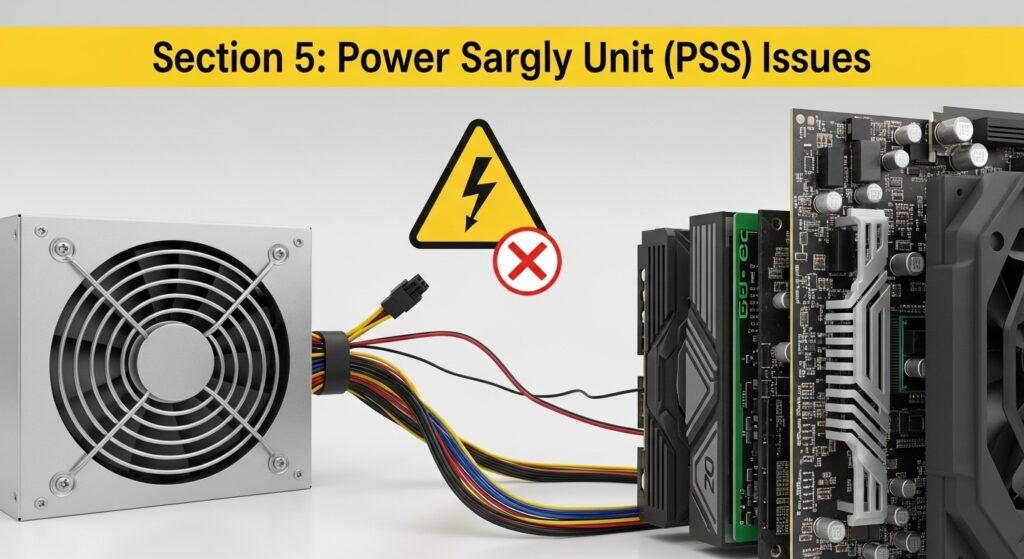
6. Cheap or Underpowered Power Supply (PSU)
The PSU is often ignored, but it shouldn’t be. An underpowered PSU can cause instability, random shutdowns, and performance dips. Power spikes can limit GPU boost clocks. This is one of the most dangerous Common PC Building Mistakes That Cause Bottlenecks because it can also damage components.
7. Overlooking Motherboard Limitations
Not all motherboards are created equal. Some limit RAM speeds. Some have weak VRMs. Some restrict PCIe lanes. You might own premium parts, but your motherboard quietly limits them. That’s one of the hidden Common PC Building Mistakes That Cause Bottlenecks people rarely talk about.
8. Not Updating BIOS or Drivers
Outdated BIOS can limit CPU compatibility, and old GPU drivers can reduce performance. Chipset drivers improve stability and efficiency. Ignoring updates is one of the simplest Common PC Building Mistakes That Cause Bottlenecks.
9. Mismatched Monitor Resolution and GPU
Your monitor choice affects performance more than you think. Running a powerful GPU at 1080p can create a CPU bottleneck, while running a weak GPU at 4K overwhelms it. Resolution balance is often overlooked in discussions about Common PC Building Mistakes That Cause Bottlenecks.
10. Overclocking Without Proper Cooling
Overclocking sounds exciting, but without proper cooling, it leads to instability and thermal throttling. That turns your “performance boost” into a performance drop. This is one of the more advanced Common PC Building Mistakes That Cause Bottlenecks, yet it happens frequently.
11. Ignoring Background Software & Bloatware
You build the perfect PC, then install ten startup apps. Background software consumes CPU and RAM. Game launchers stack up, and antivirus scans run mid-game. Even the best hardware can suffer from Common PC Building Mistakes That Cause Bottlenecks caused by software neglect.
How to Prevent Bottlenecks When Building a PC
Preventing Common PC Building Mistakes That Cause Bottlenecks starts with balance.
- Match CPU and GPU tiers.
- Choose at least 16GB of dual-channel RAM.
- Install your OS on an NVMe SSD.
- Use a reliable 80+ certified PSU.
- Invest in airflow and cooling.
Plan around your use case. Gaming at 1080p requires different priorities than 4K editing, and streaming needs extra CPU headroom. Research benchmarks before buying parts. While tools like a pc bottleneck calculator can give a quick estimate and a bottleneck checker can highlight potential mismatches, real-world performance reviews are always more reliable. Balance always beats brute force spending.
How to Check If Your Current PC Has a Bottleneck
If you suspect Common PC Building Mistakes That Cause Bottlenecks are affecting your system, testing is simple. Open Task Manager while gaming and check CPU and GPU usage. If CPU is near 100% and GPU is low, you likely have a CPU bottleneck. If GPU is maxed and CPU is relaxed, that’s a GPU bottleneck.
Use monitoring tools like MSI Afterburner and watch temperatures carefully. High temps mean thermal throttling. Run benchmarks and compare results with similar systems online. That comparison quickly reveals Common PC Building Mistakes That Cause Bottlenecks.
FAQs
How do I know if my PC is bottlenecking?
High CPU usage combined with low GPU usage is a strong sign. Stuttering and inconsistent FPS are also indicators.
Is CPU bottleneck worse than GPU bottleneck?
For gaming at lower resolutions, CPU bottlenecks are more noticeable. At higher resolutions, GPU bottlenecks are normal and expected.
Can too much RAM cause a bottleneck?
Too much RAM does not cause a bottleneck. Too little RAM does.
Does SSD remove bottlenecks?
An SSD removes storage bottlenecks. It doesn’t fix CPU or GPU limitations.
Conclusion
Common PC Building Mistakes That Cause Bottlenecks are surprisingly easy to make. They don’t just affect performance. They waste money. A balanced PC always outperforms a mismatched one. Smart planning beats flashy components.
If you avoid these Common PC Building Mistakes That Cause Bottlenecks, your system will run smoother, last longer, and deliver the performance you actually paid for. Before buying your next upgrade, research compatibility, check benchmarks, use tools wisely, and think balance first. Your future self will thank you.