What Keeps Damaging Your Home After the Fire Is Out
A house fire is one of the most jarring things a homeowner can face. The flames get all the attention — and understandably so — but what many people don’t realize until it’s too late is that the most insidious damage often happens in the hours and days after the fire has been extinguished. Smoke, soot, and the chemical residues they leave behind continue working their way into your home long after the last firefighter has left the driveway.
Understanding what’s actually happening inside your property during this window isn’t just interesting from a technical standpoint. It’s the difference between a full recovery and discovering six months later that your home still smells like smoke, that your metal fixtures have corroded, and that surfaces you thought were fine have been permanently etched. This is why professionals who specialize in local fire damage restoration services consistently emphasize speed as one of the most important variables in determining what can be saved and what cannot.
The Chemistry You Can’t See
When something burns in your home, it doesn’t just produce heat and flame. It produces a complex soup of chemical compounds. Synthetic materials — upholstery foam, carpeting, plastic components in appliances and wiring — release acidic gases and corrosive residues when they combust. These compounds become airborne, settle on every surface in the home, and begin reacting with the materials they land on almost immediately.
Smoke particles are incredibly fine. They penetrate wall cavities, travel through HVAC ducts, and infiltrate spaces you’d never think to check. Within the first few hours after a fire, these particles begin bonding with porous materials including wood, drywall, grout, and fabric. Once bonded, they are far harder to remove than they would have been in the immediate aftermath. The longer this process continues unchecked, the greater the proportion of materials that will require full replacement rather than restoration.
Soot, which is essentially the carbon-heavy solid residue from incomplete combustion, is similarly deceptive. It looks like a surface-level problem, and homeowners who haven’t dealt with fire damage before often assume that a thorough scrubbing will take care of it. In reality, soot’s oily, acidic composition means that improper cleaning doesn’t just fail to remove it — it can actually drive it deeper into materials, making professional remediation more difficult and more expensive.
The 72-Hour Window That Changes Everything
Fire restoration professionals often point to the first 72 hours as a critical threshold. Within this window, the corrosive residues left by smoke and soot are still in a phase where trained technicians using the right equipment and cleaning compounds can neutralize them before they cause permanent damage. Metal fixtures, chrome, porcelain, and glass surfaces are all particularly vulnerable. After 72 hours, the etching and pitting that acidic residues cause on these surfaces often becomes irreversible.
What makes this frustrating for homeowners is that many of these surfaces look fine to the naked eye in the immediate aftermath of a fire. The damage isn’t always visible yet. A metal door handle, a bathroom fixture, a glass stovetop — they may look untouched, but the corrosive process has already begun on a microscopic level. Restoration professionals are trained to treat these surfaces proactively, not reactively, because by the time the damage becomes obvious, the window for a clean restoration has often passed.
This same urgency applies to porous materials like drywall and wood framing. Smoke odour isn’t just a smell — it’s a physical phenomenon caused by chemical compounds embedded in materials at a molecular level. If those materials aren’t treated promptly, the odour becomes nearly impossible to eliminate without full replacement. Homeowners who attempt to wait out a smoke smell, or mask it with air fresheners, typically find that the problem resurfaces every time humidity levels rise.
Water Damage from Firefighting Efforts
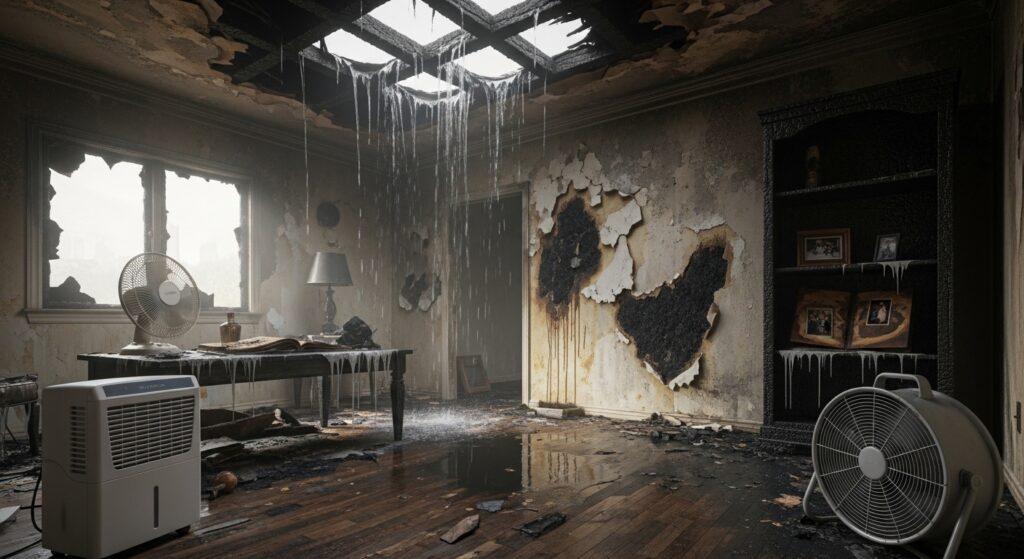
There’s a secondary damage source that catches many homeowners off guard: the water used to extinguish the fire. Firefighting involves a significant volume of water, and that water doesn’t disappear when the trucks leave. It soaks into flooring, wicks up walls, pools in low areas of the structure, and creates the exact conditions that foster rapid mold growth.
According to the Insurance Bureau of Canada, insured losses from catastrophic events surpassed $8 billion in 2024, with property claims becoming more complex and costly as secondary damage from multiple sources compounds the primary event. Fire-affected properties are a clear example of this dynamic: you’re not dealing with one type of damage but a minimum of three — fire, smoke, and water — all simultaneously.
Mold can establish itself within 24 to 48 hours when moisture is present in a structure. A property that suffers a fire and is left unattended for several days often presents a restoration team with mold colonies that have already taken hold in addition to smoke and soot contamination. The cost and timeline of restoration compound significantly when this happens, which is why the response window matters so much from a financial standpoint, not just a structural one.
What Professional Restoration Actually Addresses
There’s a meaningful gap between what a general cleaning crew can do after a fire and what a trained restoration team delivers. The difference isn’t just in technique — it’s in the diagnostic phase. A restoration professional assesses the full scope of what has been affected, including areas that show no visible damage. Smoke travels through pathways that aren’t obvious, and a thorough inspection maps that travel path to ensure nothing is missed.
Content packing and cleaning is another area where professional handling matters significantly. Items that appear to be total losses are often restorable with the right processes. Textiles, documents, electronics, and furniture that have sustained smoke damage can frequently be cleaned using ultrasonic equipment, specialized dry cleaning chambers, and ozone or hydroxyl treatment. Homeowners who do not have a restoration professional involved often unknowingly dispose of items that could have been recovered.
Structural drying after firefighting water is addressed with commercial-grade dehumidifiers and air movers, not household fans. The goal isn’t just to dry visible surfaces but to pull moisture from within wall cavities and subfloor systems where it continues to cause damage invisibly. Moisture readings taken before and after drying confirm when structural materials have returned to acceptable levels, which is a critical benchmark for both safety and insurance documentation.
Navigating the Insurance Side Without Losing Ground
One of the most stressful parts of a post-fire recovery is the insurance process. Homeowners are emotionally exhausted, often displaced, and now required to document, negotiate, and advocate for the full scope of their loss with an adjuster whose job involves managing claim payouts. The mismatch in expertise between an adjuster and a homeowner is significant, and it often results in settlements that don’t fully cover the actual cost of proper restoration.
This is why documentation beginning at the earliest possible stage matters so much. Professional restoration teams produce detailed scope-of-loss reports, photographic documentation, and moisture readings that become part of the insurance file. This documentation creates an evidence-based record of the damage that is far harder to dispute than a homeowner’s verbal account. It also captures secondary damage — the water intrusion, the early-stage corrosion, the smoke migration into wall systems — that might otherwise be excluded from a claim if it isn’t identified and recorded early.
Homeowners who assume that their insurance company’s preferred contractor will automatically advocate for a full restoration may be disappointed. A contractor working primarily within an insurer’s preferred vendor program is often operating within cost constraints that aren’t fully aligned with the homeowner’s interest in complete remediation. Working with a restoration company that operates independently and has experience navigating insurance claims from the homeowner’s side is a meaningful practical distinction.
The Takeaway for Homeowners
A fire is a traumatic event, and the instinct in its immediate aftermath is often to wait, to gather yourself, and to figure out next steps when you’re ready. That instinct is understandable, but it works directly against the outcome most homeowners are hoping for. The chemistry of fire damage is unforgiving in the short term. Every hour of delay narrows the range of materials that can be restored versus replaced, and it gives secondary problems like mold and structural moisture a chance to establish themselves.
The most practical thing a homeowner can do after a fire is to get a certified restoration professional on site as quickly as possible, not to start work necessarily, but to assess, document, and begin the stabilization process. Decisions made in those first hours — what to treat, what to board up, what to dry first — have downstream consequences that play out over months of restoration and insurance negotiation. Getting those decisions right from the start is the fastest path back to a home that’s safe, livable, and fully yours again.