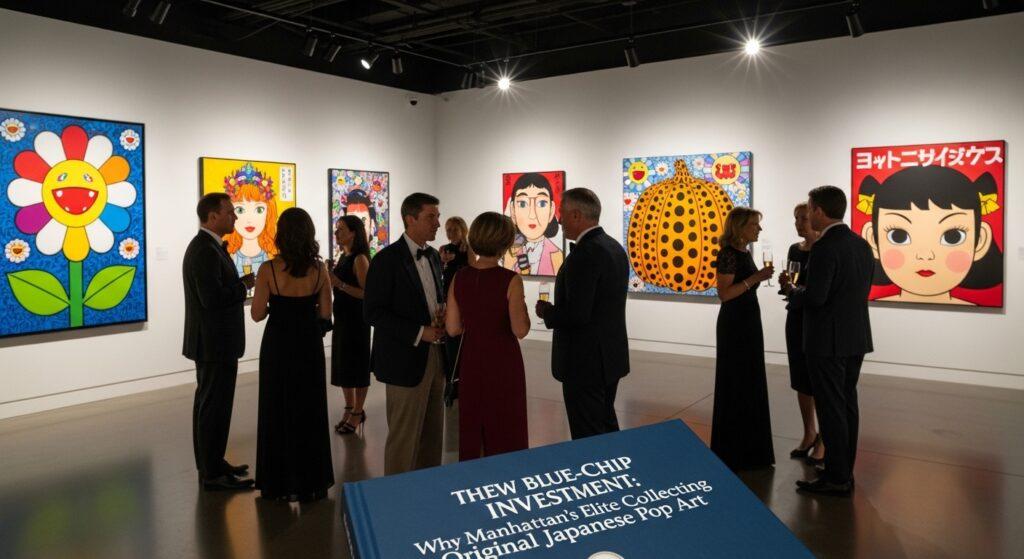
The New Blue-Chip Investment: Why Manhattan’s Elite Are Collecting Original Japanese Pop Art
Stroll through any premier contemporary art gallery in Chelsea or peruse the latest exclusive auction catalogs from Sotheby’s, and a distinct paradigm shift in the luxury art market becomes immediately apparent. The boundaries between “high art” and popular culture have not merely blurred; they have been completely redrawn. For decades, Manhattan’s most discerning collectors—those whose Upper East Side penthouses are adorned with Basquiat, Warhol, and Koons—have been quietly diversifying their portfolios. Today, the most ferociously coveted, blue-chip assets at international auction houses are not just Renaissance oils or abstract expressionist canvases, but original Japanese pop art, vintage animation cels, and rare, hand-drawn manga manuscripts.
This surge in demand is deeply intertwined with the luxury sector’s broader embrace of Japanese aesthetic culture. From Louis Vuitton’s transcendent collaborations with Takashi Murakami and Yayoi Kusama to Loewe’s highly anticipated Studio Ghibli capsule collections, the world’s most prestigious fashion houses have firmly cemented the cultural cachet of Japanese visual storytelling. However, for the true luxury aficionado, wearing the art is simply the prologue; possessing the original, one-of-a-kind artifacts from which these modern mythologies were born is the ultimate status symbol.
The Allure of the Original Manuscript
To understand the explosive valuation of these items—with original cover art pages from legendary 1980s and 90s series frequently hammering in the six- and seven-figure range—one must understand their profound rarity and artisanal nature. Before the advent of digital illustration, legendary authors (mangaka) painstakingly inked every line, applied every screentone by hand, and drafted meticulous narrative notes in the margins of their B4-sized Bristol boards.
These original manuscripts are not mere comic pages; they are intensely intimate glimpses into the mind of a genius. They bear the physical scars of the creative process: the faint blue pencil under-sketches, the precise dabs of whiteout correcting a heroine’s expression, and the smudged fingerprints of the artist. In a hyper-digitized world, this visceral human touch elevates these documents from disposable entertainment to highly prized, museum-quality artifacts.
The Connoisseur’s Dilemma: Authenticity and Provenance
For the Manhattan-based collector looking to acquire these magnificent pieces—whether to display in a minimalist Tribeca loft or to lock within a climate-controlled freeport for long-term equity growth—the acquisition process presents a unique hurdle. Unlike European contemporary art, where provenance and context are easily verifiable in English or French, the true narrative value of a Japanese manuscript is often locked behind complex language barriers.
The margins of these highly valued artifacts are frequently covered in the creator’s hurried, handwritten kanji. These notes might dictate a specific emotional tone to an editorial assistant, describe the exact color composition intended for a later painted spread, or provide unrecorded backstory for a beloved character. For a serious art collector or a private gallery curator, deciphering these marginalia is crucial. It authenticates the piece, establishes its historical significance within the artist’s broader portfolio, and drastically significantly influences its final auction valuation.
Technology Meets Curation
Historically, authenticating and decoding these artifacts required flying in specialized appraisers from Tokyo or hiring academic translators—a slow, archaic process unsuited for the fast-paced, high-stakes environment of global art acquisitions. Today, the intersection of luxury curation and advanced technology has provided an elegant solution.
Savvy collectors, private art advisors, and gallery archivists are now utilizing specialized AI-driven computer vision tools to instantly access the cultural context of their acquisitions. By employing a sophisticated manga translator, a curator can scan a museum-grade original manuscript and immediately decode the complex, handwritten Japanese annotations in the margins without ever altering or endangering the fragile physical document.
These advanced tools use deep neural networks specifically trained on the unique optical flow of sequential art, instantly providing high-fidelity, context-aware English translations. This technological capability allows a New York collector to immediately understand the profound artistic intent behind a million-dollar acquisition, transforming a silent piece of foreign art into a deeply resonant conversational centerpiece for their next private salon.
The Future of the High-End Pop Art Market
The international appetite for these artifacts shows zero signs of deceleration. As the millennial generation—the first cohort raised in a truly globalized, digital entertainment ecosystem—enters its peak wealth-accumulating years, we will witness a massive wealth transfer into the pop-art sector. The cultural touchstones of their youth are now effectively the new Old Masters.
For the perceptive art investor, the mandate is clear: the definition of luxury and “fine art” has evolved. Acquiring these masterpieces requires not only a keen eye for aesthetic brilliance and an ironclad budget but also the right technological tools to appreciate their deeply localized nuances. As Japanese pop art continues its triumphant reign in the galleries of Manhattan, mastering the language of these original manuscripts is no longer just about enjoying a story—it is about securing a legacy.