Media Interview Preparation Tips for Better Results: From Message Crafting to Crisis Response
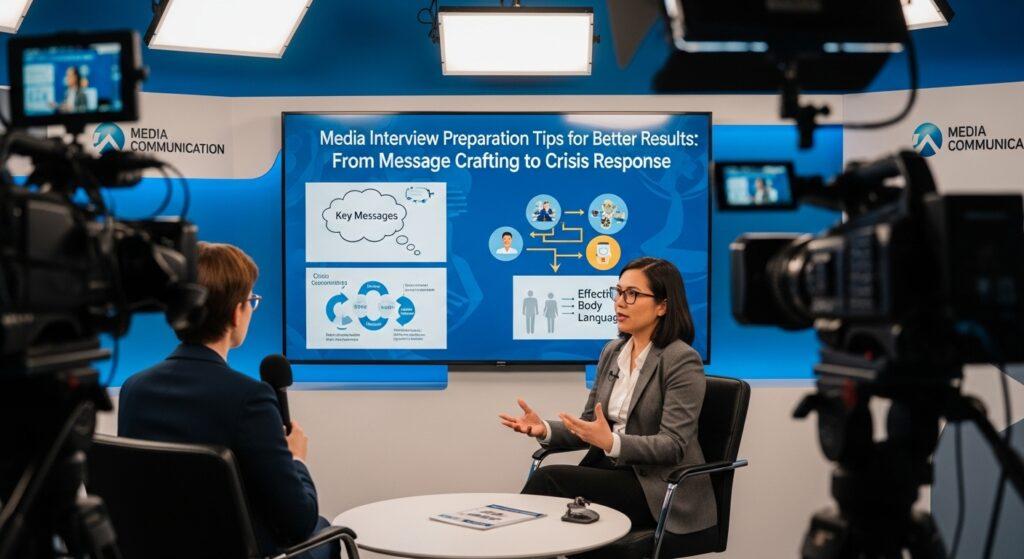
An unprepared spokesperson can do two things. One, they can dilute the brand’s messaging. Two, they can undo years of reputation building in a split second. Whether a media engagement occurs through a request for comment or an in-depth interview, your company’s spokesperson must secure reputation, inspire trust, and present leadership credibility. Effective media training can help you and your spokespersons prepare for any scenario, from a recorded interview to a live engagement.
Here are a few essential tips to help you master interviews for any medium.
Before the Interview
It’s important to understand the media landscape before an interview. When you know the medium, audience, and the media outlet, you’ll be able to tailor the messaging accordingly. Targeted messaging also ensures the accurate communication and retention of key points.
You can also anticipate the journalist’s angle and expect a level of scrutiny, weighing the potential risks of every answer. An understanding of who’s posing the questions, why they’re asking, and how they’re going to use those answers to deliver content allows you to respond with clarity and strategic awareness. Media training in Dubai or elsewhere in the UAE will help you develop skills and confidence to handle interviews.
The different types of media interviews come with their unique constraints, storytelling styles, and pacing. You need to adapt your messaging to each medium:
- TV
- Radio
- Digital
- Podcasts
Defining What You Want to Say
Prepared spokespersons follow a list that guides every media interaction. For many, this would be their media interview checklist.
- Message map finalized – essential for multiple spokespersons.
- Key facts and data verified – supports your messaging and boosts credibility.
- Likely questions rehearsed – helps you practice interview skills.
- Crisis scenarios prepared – enables you to handle especially sensitive situations.
- Appearance, tone, and logistics confirmed – conveys your professionalism.
Message crafting is developing a strategic conversation with the media. Your messages must be clear, concise, and, most importantly, memorable. And you must weave them into your answers, finding key opportunities no matter the question. Even if the interviewer veers from the topic, a well-crafted message allows you to stay on point.
How do you craft messaging?
- Identify 3 core messages.
- Translate complex ideas into clear, audience-friendly language.
- Use soundbites and quotable statements effectively.
- Ensure message consistency across platforms and spokespeople.
Staying on Message — Even Under Pressure
What happens when high-profile or sensitive situations are the backdrop to your interview? Media training is especially crucial in managing a crisis. A critical interview on TV, print, or online can allow your business to take control of an uncontrollable situation.
Training can help you master the two communication strategies media professionals often use: bridging and flagging.
The bridging technique allows you to help the reporter or journalist with key messages, using smooth transitional phrases. Spokespersons typically use this technique to address a challenging or negative question. These phrases include:
- “Let me put all this in perspective by saying . . . ”
- “However, the real issue here is . . . ”
- “This is an important point because . . . ”
- “And if we take a closer look, we would see . . .”
- “Before we leave the subject, let me add that . . .”
The flagging technique uses verbal cues to emphasize a point. This technique is best for moments when a journalist is asking for a sound bite or a quote in response to a situation. Some popular phrases include:
- “Here’s where we stand . . .”
- “What we need to remember is this . . .”
- “What it boils down to is . . . “
- “The most important thing to remember is . . . “
- “Let me emphasize again . . . “
Performing Well With On-Camera and Verbal Delivery Skills
How do you perform well in media interviews? Whether the interview is live or recorded, on-camera and verbal delivery skills are crucial to master.
When doing broadcast interviews, be mindful of body language, eye contact, and posture. Nervous body language obscures your message. Eye contact sustains a connection to the audience. Posture conveys confidence.
For radio and live settings, think about voice control, pace, and tone, which allow you to deliver messaging effectively.
Sometimes, preparation and skills can take a backseat when nerves can overwhelm you. Media training can also cover this natural reaction under heavy scrutiny. You can respond to tough questions with grace and clarity, delivering your message with consistency.
How do you answer without appearing defensive? Other than anticipating challenging questions, try the following:
- Pause before answering.
- Acknowledge the question.
- Respond in a measured pace, so listeners absorb your message.
- Never repeat the reporter’s negative wording.
- Reframe the question in a neutral light instead.
The Value of Expert Media Training
Practice makes perfect applies especially to media interviews. Part of that preparation is getting adequate training as a spokesperson for the business. Whether you’re the head of the company or one of a few representatives, media training ensures that you secure an excellent reputation, inspire trust with consumers, and present leadership credibility that can multiply your business.
AUTHOR BIO
Jen Tagasa is a content writer at SEO Sherpa – Global Best Large SEO Agency Winner, focusing on SEO, PPC, Digital PR, and Search Everywhere Optimization. She brings more than 10 years of experience crafting strategic long-form content, blogs, and high-impact copy. She has written on wide-ranging topics, from public relations to wellness, and across diverse sectors, including, banking and finance, e-commerce, health care, law, and logistics. Known for producing clear, credible, and search-optimized content, Jen supports brands in delivering articles that rank, inform, and convert.