The Gene “Search Tool” Behind New Medicines
A cancer drug works for months—and then the cancer comes back. An antibiotic that used to clear an infection suddenly doesn’t. Or you know two people with the same diagnosis, but one responds well to treatment while the other struggles.
These situations can feel confusing and unfair. But they point to a basic truth: the body is complicated, and many diseases don’t have one simple cause. They are driven by a mix of genes, biology, environment, and timing.
Scientists are getting better at spotting genetic differences. The bigger challenge is figuring out which genes actually matter in a given situation—like which genes help cells survive a drug, or which genes make a disease harder to treat.
To answer that question, many researchers use a lab method that works a lot like a search engine. It’s called CRISPR screening. Despite the name, this is mostly not about editing people. It’s mainly done in lab cells to help researchers find the genes most connected to an outcome, so they can focus their time on the best leads.
Why treatments can work differently for different people
Most of us want medicine to be straightforward: you get sick, you take a treatment, you get better. Sometimes it works that way. Often it doesn’t.
There are many reasons two people can respond differently, even with the same diagnosis:
- People process drugs differently (like how fast the liver breaks them down)
- Diseases can take different “routes” in the body
- Immune systems vary from person to person
- Some illnesses—especially cancer—can change over time
So when a treatment fails, scientists and doctors often ask: what’s different under the surface? Which genes or pathways are making the biggest difference?
For years, finding those answers was slow.
The old way: one gene at a time
A traditional way to study genes is simple: change one gene, watch what happens, repeat.
This has taught us a lot. But it can be painfully slow when the problem involves many genes at once. It’s like trying to find one broken wire in a huge building by checking one wire per day.
When researchers are trying to understand things like drug resistance, they need a faster way.
The new way: test many genes at once
CRISPR is often described as “genetic scissors.” That’s the famous version. But CRISPR can also be used for a different kind of job: testing lots of genes quickly to see which ones change the result.
Here’s the basic idea:
- Start with a big population of cells in a lab
- Give different cells different gene changes
- Apply a challenge—like a drug or a stressful condition
- See which gene changes help cells survive or fail
This kind of experiment helps researchers narrow down a huge list of possibilities. It doesn’t prove everything by itself, but it points to strong leads.
This is sometimes called functional genomics, meaning: instead of just reading DNA, scientists test what genes do.
What a CRISPR library is
To test many genes, researchers need a structured “menu” of targets. That’s what a CRISPR library is.
A CRISPR library is a large collection of guide RNAs (small pieces of genetic code) that tell CRISPR where to go in DNA. Each guide targets a gene. When you pool many guides together, you can test thousands of genes in one experiment.
In many studies, researchers begin with a crispr library—a pooled collection of guide RNAs designed to test thousands of genes systematically, often across a genome-wide set of targets.
You can think of it like this: instead of asking one question at a time, a library lets researchers ask thousands of questions at once.
One example explainer comes from Ubigene.
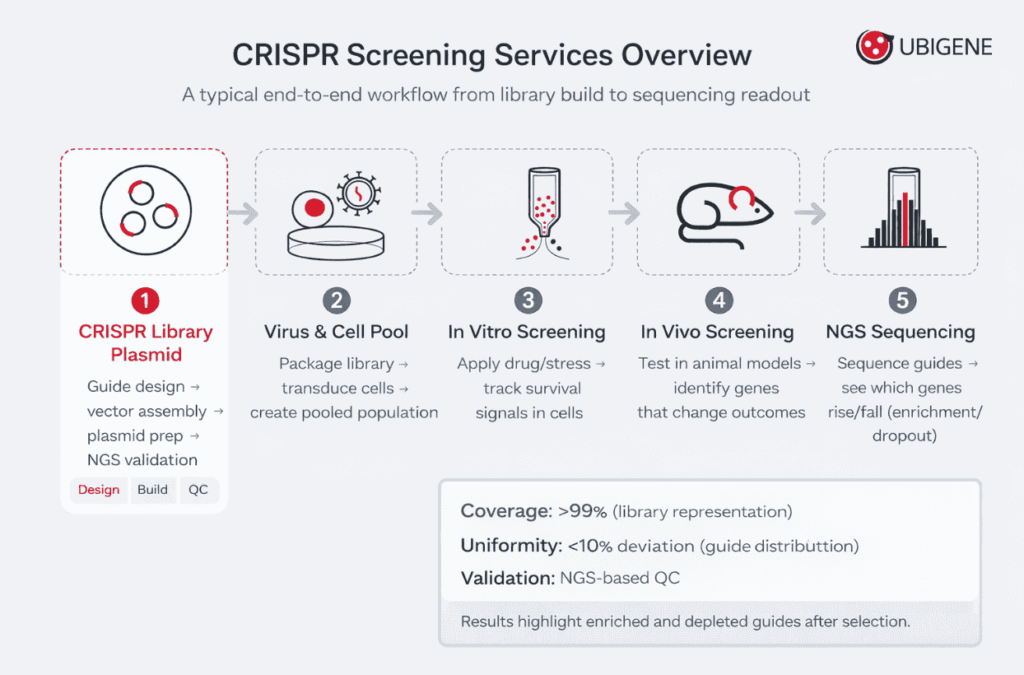
What a CRISPR screen does (and what “rise” or “fall” means)
Once the library is in the cells, the “screen” begins. Scientists apply a challenge (often a drug) and then watch what happens to the cell population.
Two patterns are common:
- Dropout: cells with certain gene changes disappear or grow poorly. That suggests those genes might be important for survival in that situation.
- Enrichment: cells with certain gene changes become more common. That suggests those gene changes may help cells survive or resist the drug.
A simple way to imagine it:
If you put a group through an obstacle course, the people who can’t handle it drop out. The ones with an advantage move to the front. The screen is looking for the “advantages” and “weak spots” hidden in the genes.
For readers who want a deeper technical explainer of what a crispr screen looks like in practice—from introducing the pooled guides to measuring which ones rise or fall after a drug or stress—step-by-step overviews can be useful.
One example explainer is published by Ubigene, alongside academic resources.
Why this matters in real life
Even though CRISPR screening is a lab method, the questions it answers connect to things ordinary people deal with.
Cancer: why treatment can stop working
Cancer cells can adapt. A drug may kill most cancer cells, but a few may survive because of genetic changes. Those survivors can multiply. This is one reason cancer can return.
Screens can help researchers find genes that:
- help cancer cells survive treatment
- let them “escape” by using backup pathways
- make them more sensitive to a drug when blocked
This doesn’t mean a screen finds a cure. But it can help explain resistance and guide better research.
Infections: why resistance keeps growing
Bacteria and viruses can evolve too. When a drug or immune response creates pressure, the ones that survive can become more common.
Screens can help researchers find weak points in a system—genes that matter for survival under stress—which can inspire new approaches over time.
Drug discovery: why it takes so long
Many ideas look great at first and fail later. Screens can reduce early guesswork by pointing researchers toward genes that seem most important in a specific setting. That can save time and help teams focus on stronger leads.
What CRISPR screens can’t do
To stay honest and realistic, it’s important to say what screening can’t do.
A CRISPR screen can help researchers:
- find promising gene targets
- understand why cells resist drugs
- discover pathways they didn’t expect
But it can’t, by itself:
- prove a gene causes disease in humans
- replace real-world testing and clinical trials
- guarantee a “hit” will become a safe drug
Screens are a strong starting point. But they need careful follow-up.
FAQ
What is CRISPR screening in simple terms?
It’s a way to test many genes at once in lab cells to see which genes affect an outcome—like survival under a drug.
What is a CRISPR library?
It’s a large pooled set of guide RNAs that target many genes systematically, so researchers can run big experiments instead of testing one gene at a time.
Does CRISPR screening edit people?
No. Most CRISPR screening happens in lab cells. It’s used to understand biology and guide research, not as a routine procedure in people.
How does it help drug discovery?
It helps researchers narrow down which genes and pathways seem most important, so they can focus on the best leads and test them more deeply.
Bottom line
Medicine is becoming more precise, but biology is still complex. CRISPR screening is one way researchers deal with that complexity: they test many genes at once and look for the ones that change the outcome.
It doesn’t replace careful research or clinical trials. But it can make early discovery less like guessing—and more like following evidence.