Immersive Audio Experiences: Dual-Channel Sound Generation in Seedance 2.0
Audio has traditionally occupied a secondary position in video production discussions. The emphasis falls on visuals—cinematography, color grading, special effects, and overall visual composition dominate creative conversations. Yet anyone who has watched a film in a theater with immersive audio versus a compressed streaming version understands an essential truth: audio is not supplementary to video. Rather, audio and vision work together to create the complete perceptual experience. Seedance 2.0 recognizes this fundamental reality through its sophisticated dual-channel sound generation capabilities that create genuinely immersive audio experiences rather than treating sound as an afterthought to visual content.
The Audio Problem in Video Generation
Earlier AI video generation platforms largely ignored audio or treated it as a secondary consideration. Some systems could respond to provided audio by generating synchronized video, but few platforms actually generated audio content that matched or enhanced video generation. This created an asymmetry: visual content could be created with sophistication and control, but audio remained limited.
The challenge of audio generation is significant. Generating realistic sound requires understanding what sounds should exist in a scene, how they should layer together, how they should evolve temporally, and how they should relate to visual elements. A simple sound generation system might produce audio that is technically synchronized with video but lacks the sophistication, layering, and realism that makes audio genuinely immersive.
Seedance 2.0 addresses this gap through dual-channel audio generation that creates rich, layered soundscapes that enhance and elevate video content. Rather than simply generating audio, the platform generates immersive audio experiences.
Understanding Dual-Channel Architecture
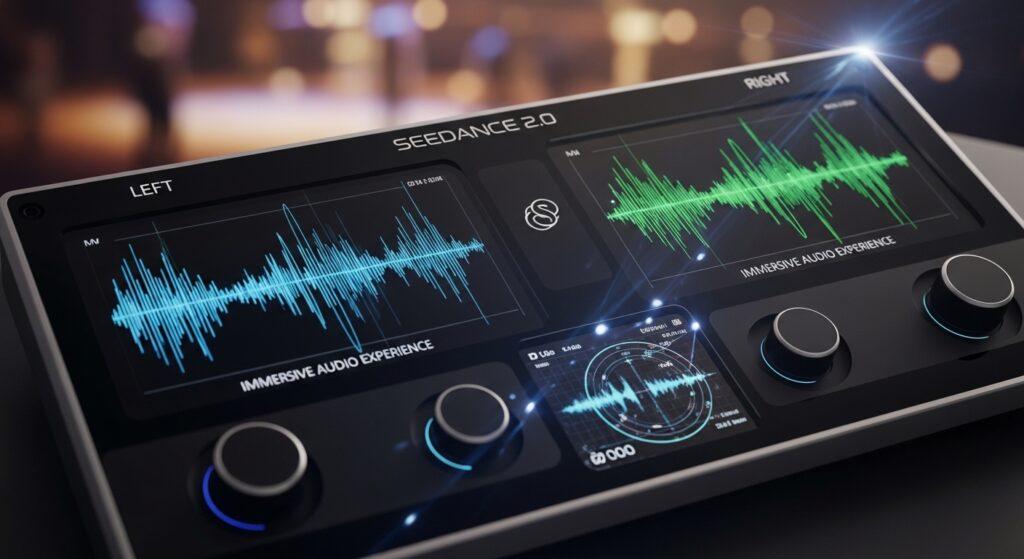
The dual-channel approach reflects sophisticated understanding of how audio actually works in professional sound design. Rather than generating a single monolithic audio track, the system generates two parallel audio channels that serve complementary functions.
The primary channel typically carries narrative, dialogue, and primary audio elements that drive the story or core content. This might be voiceover narration, dialogue between characters, primary music, or the main sound design element that structures the scene. This channel is the foreground audio that draws listener attention and carries primary information.
The secondary channel carries complementary audio that creates texture, atmosphere, and spatial dimension. This might be ambient environmental sounds, harmonic elements that complement primary music, subtle effects, or atmospheric audio that establishes the scene’s sonic environment. This channel creates the audio equivalent of depth of field in cinematography—while the primary channel maintains focus, the secondary channel creates the context in which that primary element exists.
Spatial Audio and Immersion
Modern audio rendering capabilities—from stereo headphone rendering to surround sound systems to spatial audio on mobile devices—require sophisticated audio design that creates a sense of space and dimensionality. Seedance 2.0’s dual-channel generation enables this spatial sophistication.
The primary channel can be mixed for clarity and presence, ensuring that narrative and primary content elements are heard clearly and with appropriate emphasis. The secondary channel can be mixed for spatial distribution and environmental context, creating a sense that sound comes from different directions and distances. This creates the perceptual experience of listening within a three-dimensional acoustic space rather than hearing audio emerge from a flat, dimensionless source.
This spatial quality elevates content from technically competent to genuinely immersive. A scene rendered with sophisticated spatial audio design feels more present, more engaging, and more emotionally resonant than the same scene with flat, dimensionless audio. The difference resembles the distinction between watching video on a phone screen versus experiencing it in a well-designed cinema space.
Layered Sound Design
Professional sound design in film and television relies on sophisticated layering. A dramatic scene might have dialogue as the primary element, orchestral music providing emotional context, ambient environment sounds establishing setting, and subtle foley effects adding tactile detail. These elements don’t merely coexist—they’re carefully balanced, mixed, and equalized to create a unified auditory experience.
Seedance 2.0’s dual-channel generation enables this layering approach. The system understands that effective sound design involves multiple elements that must cohere. Rather than generating a single audio track that attempts to accomplish everything, the system can generate a primary channel handling foreground elements and a secondary channel handling spatial and atmospheric context. A sophisticated mixing approach can then combine these channels into a unified audio experience.
This is particularly valuable for narrative content. A scene with dialogue needs clear dialogue delivery (primary channel) within an established acoustic environment (secondary channel). A musical moment needs the music present and engaging (primary channel) with supporting harmonic or atmospheric elements (secondary channel). Action sequences need impact and clarity (primary channel) with spatial effects and environmental context (secondary channel).
Audio-Visual Synchronization
The genuine power of dual-channel audio generation emerges when audio and video generation occur in concert. Seedance 2.0 doesn’t generate audio as a separate process applied after video generation. Instead, both audio channels and video are generated with mutual understanding and synchronization.
This means that visual action drives audio response. A character striking an object generates not just visual impact but coordinated audio impact across both channels—the primary channel delivers the impact sound with appropriate intensity and character, while the secondary channel provides spatial reverb or environmental response. A musical moment drives both visual rhythm and audio development. Dialogue informs both character expression and audio delivery with natural timing and emotional tone.
This coordination is more sophisticated than simple temporal synchronization. The system understands how audio and vision should relate semantically—what sounds naturally accompany what visuals, how audio and visual narrative should inform one another, how temporal and emotional pacing should cohere across modalities.
Dialogue and Speech Generation
Dialogue generation represents a sophisticated application of dual-channel audio capabilities. The primary channel carries dialogue with natural prosody, emotional inflection, and character-appropriate delivery. The secondary channel provides supporting elements—subtle room tone, faint reverb characteristics, or accompanying emotional underscore—that create context for the dialogue.
For animated content or character-driven narratives, this becomes particularly powerful. The system can generate dialogue that sounds natural and emotionally appropriate, delivered with timing that matches character motion and expression, supported by audio context that establishes the scene’s acoustic environment.
This extends to multilingual content. Characters can deliver dialogue in different languages while maintaining emotional authenticity and natural prosody. The dual-channel approach enables both clarity (primary channel) and contextual support (secondary channel), creating dialogue that sounds naturally delivered within a three-dimensional acoustic space.
Music and Compositional Audio
For music-driven content—whether original compositions, music video visualization, or narrative content with musical underscore—the dual-channel approach is transformative. The primary channel can carry the musical composition with prominence and clarity, ensuring melodic and harmonic elements are heard with full impact. The secondary channel can provide layering elements, harmonic support, spatial elements, or timbral variety that enriches the primary musical content.
This enables music generation that is genuinely sophisticated rather than simple or reductive. A generated composition can have main melody and harmony (primary channel) supported by counterpoint, textural elements, or harmonic enrichment (secondary channel). The result sounds like actual composed music rather than algorithmically generated sequences.
For music visualization and music video generation, this is particularly valuable. The system can generate both music and visuals that work together, with audio and visual elements reinforcing one another. A musical moment with particular intensity drives visual intensity. A subtle musical passage supports subtle visual development. The audio and visual elements co-evolve rather than merely existing in temporal proximity.
Ambient and Environmental Sound Design
Creating immersive environments requires convincing environmental audio. A beach scene needs the sound of waves, wind, distant activity, and natural ambient characteristics that establish the environment acoustically. An urban scene needs traffic, ambient activity, environmental reverberation, and spatial audio that suggests the character of the location.
Seedance 2.0’s secondary channel excels at this environmental audio design. While primary dialogue or music occupies the primary channel with presence and clarity, the secondary channel can establish rich environmental audio that makes the scene acoustically convincing. This environmental audio works with visual environment design to create spaces that feel genuinely real—where listeners feel present in the acoustic space rather than simply hearing audio overlay on video.
Emotional and Atmospheric Audio
Beyond functional sound design (dialogue, music, effects), Seedance 2.0 can generate audio that establishes emotional tone and atmosphere. A scene might require not just functional audio but an overall sonic character that communicates emotional state, thematic content, or atmospheric qualities.
This emotional audio design might involve harmonic choices, timbral qualities, spatial characteristics, or subtle textural elements that create emotional resonance without necessarily being consciously noticed by the listener. Like color grading in cinematography, emotional audio design operates below the threshold of conscious analytical attention while significantly influencing how content feels.
The dual-channel approach enables this sophistication. Functional elements (dialogue, primary music) occupy the primary channel while emotional and atmospheric audio textures occupy the secondary channel. Together, they create audio that is both functionally clear and emotionally resonant.
Professional Audio Standards
Professional audio for film, television, and streaming requires adherence to technical standards—specific loudness levels, frequency response characteristics, dynamic range properties, and technical specifications that ensure content translates across different playback systems and platforms.
Seedance 2.0’s audio generation operates within professional technical standards. The dual-channel approach can be mixed to meet loudness standards (LUFS specifications), frequency response requirements, and technical specifications required for professional distribution. This ensures that generated audio is not merely creatively sophisticated but technically professional.
Accessibility and Inclusive Audio Design
Sophisticated audio design contributes to accessibility. Clear dialogue with appropriate audio context helps viewers with visual impairments understand content. Emotionally resonant audio design helps viewers with hearing variation understand narrative and emotional content. Spatial audio design creates more engaging experiences for all listeners.
Seedance 2.0’s dual-channel audio generation can be structured to prioritize clarity for dialogue-dependent content, emotional communication through audio tone and quality, and spatial design that creates engaging experiences for diverse listening capabilities.
The Practical Impact
For creators working in fields where audio significantly impacts content—narrative filmmaking, music-driven content, immersive storytelling, educational content, commercial production—Seedance 2.0’s sophisticated dual-channel audio capabilities represent genuine competitive advantage. Content that integrates audio and visual generation at a fundamental level creates more cohesive, engaging, and professional results than content where audio and visual elements are created separately.
Conclusion
Seedance 2.0’s dual-channel sound generation fundamentally changes how audio integrates with AI video generation. By generating two parallel audio channels that serve complementary functions—clear primary elements and spatial, atmospheric, and emotional secondary elements—the platform enables genuinely immersive audio experiences rather than treating sound as supplementary to vision. This commitment to audio sophistication elevates generated content from visually impressive to completely immersive, where sound and vision work together to create engaging, professional-grade results. For creators who recognize that immersive experiences require both visual and audio excellence, Seedance 2.0’s audio capabilities provide the sophisticated sound design tools that professional work demands.