What is the Income Tax Rate for an LLC in Maryland
Understanding income tax rates for Maryland LLCs requires recognizing how the IRS and state tax authorities treat these business entities. Limited liability companies operate as pass-through entities by default, meaning the LLC itself typically does not pay income taxes at the entity level. Instead, profits and losses pass through to the owners’ personal tax returns where they face taxation at individual rates.
Maryland’s tax treatment of LLCs depends on the entity’s federal tax classification and the number of members. Single-member LLCs are disregarded entities for tax purposes, while multi-member LLCs are taxed as partnerships unless they elect corporate taxation. Understanding these classifications helps LLC owners accurately calculate their Maryland tax obligations. For comprehensive guidance on Maryland LLC formation and compliance requirements including tax obligations, review Business Entity Search in Maryland.
How Maryland Taxes LLC Income by Default
Maryland does not impose a separate income tax on LLCs operating under default pass-through taxation. The LLC’s profits flow through to the individual members who report this income on their personal Maryland tax returns. Members pay Maryland income tax based on their personal tax bracket, which ranges from 2% to 5.75% depending on income levels and filing status.
According to BusinessRocket, this pass-through structure means the LLC files an informational return with Maryland showing income allocation to members, but the tax liability rests with the individual owners. Single-member LLCs report business income on Schedule C of their personal tax returns, while multi-member LLCs file partnership returns distributing income to members via K-1 forms. The following table shows Maryland’s personal income tax rates that apply to LLC pass-through income:
| Income Range (Single Filers) | Income Range (Joint Filers) | Tax Rate |
| $0 – $1,000 | $0 – $1,000 | 2.00% |
| $1,001 – $2,000 | $1,001 – $2,000 | 3.00% |
| $2,001 – $3,000 | $2,001 – $3,000 | 4.00% |
| $3,001 – $100,000 | $3,001 – $150,000 | 4.75% |
| $100,001 – $125,000 | $150,001 – $175,000 | 5.00% |
| $125,001 – $150,000 | $175,001 – $225,000 | 5.25% |
| $150,001 – $250,000 | $225,001 – $300,000 | 5.50% |
| Over $250,000 | Over $300,000 | 5.75% |
What Happens When LLCs Elect Corporate Taxation
LLCs can elect to be taxed as corporations by filing Form 2553 with the IRS for S corporation status or Form 8832 for C corporation status. This election changes the tax structure significantly and subjects the LLC to Maryland’s corporate income tax rate of 8.25% on net income. The election provides potential tax benefits in certain situations but requires careful analysis of the business’s financial circumstances.
S corporation taxation allows LLC owners to split income between salary and distributions, potentially reducing self-employment tax liability. Based on guidance from BusinessRocket, C corporation taxation subjects business profits to corporate tax rates, with dividends to owners facing additional personal income tax. The following table compares tax treatment under different LLC classifications:
| Tax Classification | Entity-Level Tax | Owner-Level Tax | Self-Employment Tax | Annual Filing |
| Single-Member LLC (Default) | None | 2% – 5.75% personal | 15.3% on all income | Schedule C |
| Multi-Member LLC (Default) | None | 2% – 5.75% personal | 15.3% on all income | Form 1065 |
| LLC as S Corporation | None | 2% – 5.75% personal | Only on salary portion | Form 1120S |
| LLC as C Corporation | 8.25% corporate | 2% – 5.75% on dividends | None | Form 1120 |
Understanding Maryland Local Income Tax Rates
Maryland imposes local income taxes in addition to state income tax, with rates varying by county and municipality. Local income tax rates range from 2.25% to 3.20% depending on the jurisdiction where the LLC member resides. These local taxes apply to pass-through LLC income just like state income taxes, adding to the overall tax burden on business profits.
LLC members must pay local income tax to their county of residence regardless of where the LLC operates within Maryland. BusinessRocket warns that failing to account for local income taxes when calculating tax liability leads to underpayment and potential penalties. The following table shows local income tax rates for major Maryland jurisdictions:
| County/City | Local Tax Rate | Combined State + Local Rate Range |
| Allegany County | 3.05% | 5.05% – 8.80% |
| Anne Arundel County | 2.81% | 4.81% – 8.56% |
| Baltimore City | 3.20% | 5.20% – 8.95% |
| Baltimore County | 3.20% | 5.20% – 8.95% |
| Calvert County | 3.00% | 5.00% – 8.75% |
| Frederick County | 2.96% | 4.96% – 8.71% |
| Howard County | 3.20% | 5.20% – 8.95% |
| Montgomery County | 3.20% | 5.20% – 8.95% |
| Prince George’s County | 3.20% | 5.20% – 8.95% |
| Lowest Rate (Worcester) | 2.25% | 4.25% – 8.00% |
How Self-Employment Tax Affects LLC Owners
LLC members receiving pass-through income generally pay self-employment tax at 15.3% on their share of business profits. This tax covers Social Security and Medicare contributions that employers and employees split in traditional employment relationships. Self-employment tax applies to LLC income regardless of whether members withdraw the profits from the business.
The self-employment tax consists of 12.4% for Social Security on earnings up to the annual wage base limit and 2.9% for Medicare on all earnings. Data from BusinessRocket shows that high-income LLC members pay an additional 0.9% Medicare surtax on earnings exceeding certain thresholds. S corporation election allows LLC owners to potentially reduce self-employment tax by taking reasonable salaries subject to employment tax while receiving remaining profits as distributions not subject to self-employment tax.
What Additional Business Taxes Apply to Maryland LLCs
Beyond income tax, Maryland LLCs face various other tax obligations depending on their business activities. All LLCs must pay the annual personal property tax return filing fee even if they have no property to report. LLCs with employees must withhold Maryland income tax from wages and pay unemployment insurance taxes to the state.
Sales and use tax obligations apply to LLCs selling tangible personal property or certain services in Maryland. According to BusinessRocket, the state sales tax rate is 6%, with some jurisdictions imposing additional local taxes. LLCs must register for sales tax permits, collect tax from customers, and remit payments to the Comptroller of Maryland on regular filing schedules. Professional service LLCs may face additional licensing fees and taxes specific to their industries.
When Estimated Tax Payments Are Required
Maryland requires estimated tax payments from LLC members who expect to owe more than $500 in state income tax for the year after accounting for withholding. Members must make quarterly estimated payments by April 15th, June 15th, September 15th, and January 15th of the following year. Failure to make adequate estimated payments results in interest charges and potential underpayment penalties.
Calculating estimated tax payments requires projecting annual LLC income and applying appropriate tax rates including state, local, and self-employment taxes. BusinessRocket’s compliance team notes that members should adjust estimated payments throughout the year if business income varies significantly from projections. The Maryland Comptroller provides worksheets and online tools to help taxpayers calculate proper estimated payment amounts based on expected income and deductions.
How Maryland Taxes Multi-State LLC Operations
LLCs operating in multiple states face complex tax obligations requiring income allocation among jurisdictions. Maryland taxes the portion of LLC income attributable to Maryland business activities based on factors including property location, payroll, and sales within the state. Members must file Maryland returns reporting their share of Maryland-source income even if they reside elsewhere.
Conversely, Maryland resident members of LLCs operating in other states must report all LLC income on their Maryland returns but may claim credits for taxes paid to other states. Based on guidance from BusinessRocket, proper allocation requires maintaining detailed records of business activities by location and understanding each state’s apportionment rules. Professional tax assistance becomes essential for multi-state LLCs to ensure compliance and avoid double taxation on the same income.
What Tax Deductions Reduce LLC Tax Liability
Maryland LLCs can reduce taxable income through various business expense deductions allowed under state and federal tax law. Ordinary and necessary business expenses including rent, utilities, supplies, equipment, professional services, and employee compensation all reduce LLC taxable income. Members should maintain detailed records and receipts supporting all claimed deductions to withstand potential audit scrutiny.
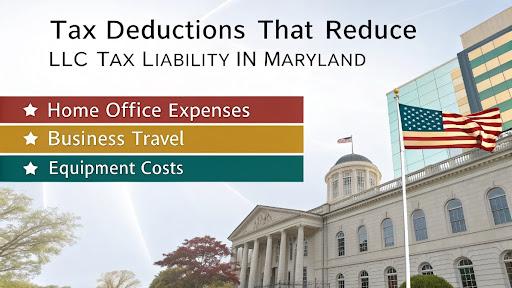
Maryland conforms to most federal tax provisions including Section 179 expensing for equipment purchases and qualified business income deductions under certain circumstances. According to BusinessRocket, LLC members should work with tax professionals to identify all available deductions and properly document expenses throughout the year. Strategic tax planning helps minimize overall tax liability while maintaining full compliance with Maryland and federal tax requirements.
Frequently Asked Questions
Do single-member LLCs pay different tax rates than multi-member LLCs in Maryland?
Single-member and multi-member LLCs both pass income through to owners who pay Maryland personal income tax at rates from 2% to 5.75%. The filing process differs, with single-member LLCs using Schedule C and multi-member LLCs filing partnership returns. The effective tax rate depends on the member’s total income and filing status, not the LLC structure.
Can an LLC reduce taxes by electing S corporation status in Maryland?
Electing S corporation status can reduce overall tax burden by allowing members to split income between salary and distributions. Only salary faces self-employment tax while distributions avoid it. However, S corporations require reasonable salary payments, additional payroll tax filings, and administrative compliance that may not benefit all LLCs.
What is Maryland’s corporate tax rate if my LLC elects C corporation status?
Maryland taxes C corporations at 8.25% on net income. LLCs electing C corporation status pay this corporate rate on business profits, with shareholders paying additional personal income tax on dividends received. This double taxation makes C corporation election suitable only for specific business situations requiring corporate tax treatment benefits.
How do I calculate my total Maryland tax rate as an LLC owner?
Calculate total tax by adding state income tax (2% to 5.75%), local income tax (2.25% to 3.20%), and self-employment tax (15.3%). Your actual rate depends on total income, residency location, and tax classification. Most LLC members face combined rates between 19.55% and 24.25% on business income.
Does Maryland charge franchise tax or privilege tax on LLCs?
Maryland does not impose franchise tax or privilege tax on LLCs. However, all LLCs must file annual reports with the State Department of Assessments and Taxation and pay a $300 annual fee. This fee is not a tax on income but rather a compliance filing requirement to maintain good standing.
Are LLC distributions taxed differently than LLC profits in Maryland?
Distributions are not separately taxed in Maryland for pass-through LLCs. Members pay tax on their allocated share of LLC profits regardless of whether they receive distributions. If the LLC retains profits without distributing them, members still owe tax on their share of the income reported on their K-1 forms.
What happens if I miss quarterly estimated tax payments for my LLC income?
Missing estimated tax payments results in interest charges on the unpaid amount from the payment due date until paid. Maryland may also assess underpayment penalties if you fail to pay at least 90% of current year tax or 110% of prior year tax through withholding and estimates.
Can I deduct my LLC annual report fee on my Maryland tax return?
Yes, the $300 annual report fee qualifies as an ordinary business expense deductible from LLC income. This deduction reduces the taxable income flowing through to members. However, it reduces income for both state and federal tax purposes, not just Maryland taxes specifically.
How does working from home affect my Maryland LLC taxes?
Working from home allows home office deductions if you use space regularly and exclusively for business. This deduction reduces LLC taxable income. However, your Maryland tax rate remains based on your residential location and total income, not your home office status or business location.
What tax records must Maryland LLCs maintain?
Maryland LLCs must maintain records supporting all income, expenses, deductions, and credits for at least four years. Keep receipts, invoices, bank statements, payroll records, and tax filings. Proper documentation protects against audits and ensures accurate tax reporting for both LLC informational returns and member personal returns.
Author
Fahad Rafi : SEO Manager & Content Strategist at BusinessRocket, where he specializes in developing high-impact content strategies that bridge the gap between technical SEO excellence and user-focused business guidance.